
Historic churches in downtown are in a position to help the area”s poor.
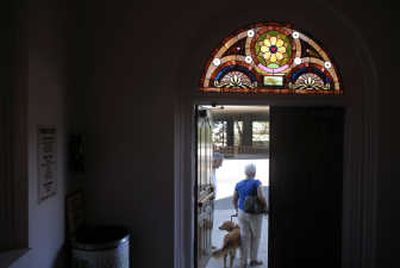
They come to the church door almost every day – homeless men begging for food, a family who can’t afford the power bill, transients in need of a few dollars for a bus ticket home. “We see an endless stream of people whose voices are not heard because they’re poor, because they’re fresh out of jail, because they’re mentally ill,” said the Rev. Andy CastroLang, pastor of Westminster Congregational United Church of Christ. “They come to us because there’s nowhere else to go.”
Like other congregations in downtown Spokane, Westminster can’t avoid the reality of the streets. Crime, poverty and drug addiction aren’t just abstract issues for church members; they’re actual problems that sometimes confront them as they walk into church on Sunday.
While members see this as an opportunity to serve, the church’s location on Fourth Avenue and Washington Street poses its share of challenges.
Stay or go? It’s a question that’s been posed many times over the years to members of Westminster and other historic downtown churches.
Stay in a weathered old building that costs thousands of dollars to heat? On a lot where there’s no parking, no grass, no room to grow? On a traffic-snarled street surrounded by commercial property, peppered with panhandlers and plagued with petty crime?
It’s the type of situation that doesn’t exactly attract new members, especially young families – adding another layer of complexity to the dwindling membership problem that already plagues these mainline Protestant churches downtown.
Seeking greener pastures
Last month, St. John’s Lutheran Church, located on the busy corner of Division Street and Third Avenue, was sold to a couple who plan to demolish the 57-year-old building and erect a Best Western Hotel. Founded by German immigrants in 1900, St. John’s will be building a new worship and ministry center on eight acres of land in Latah Valley.
“Our congregation has placed a high priority on Christian education and ministering to children and families,” said the Rev. David Jensen, the church’s pastor for the past six years.
“St. John’s is one of the friendliest and most welcoming churches – it’s what we do best. … There isn’t much that we can do in this neighborhood. We’re downtown, but we’re not really a downtown church where there are a lot of social ministries happening. …
“We’re moving to an area where there are lots of new homes and growth, which is more in line with the roots of this congregation,” Jensen said. “This will strengthen our members and bring more people into the kingdom.”
Most of the church’s members don’t live downtown, he said. Driving to the church’s new location near U.S. Highway 195 and Meadowlane Road will actually be easier for some current members, as well as for others seeking a church home.
“Being in the middle of things downtown has always been an issue,” Jensen said. “Sure, people drive by. But how do you get them to stop?”
Other churches – those who don’t have the option of leaving downtown, as well as those who have vowed to stay – continue to face that same dilemma.
Urban ministry can be a tough calling, especially given the added pressures and constraints of a downtown location, acknowledged Dale Soden, director of Whitworth’s Weyerhaeuser Center for Christian Faith and Learning and an expert on religion in the Pacific Northwest.
“It’s one thing for a suburban church to send kids to volunteer downtown – not to minimize that, but it’s another thing for the church to be visibly present in the midst of poverty, in the midst of the most needy of the community,” he said.
“That’s obviously both an opportunity and a challenge, because the resources that you would like to commit to serving the poor and the marginalized have oftentimes migrated out of the center of the city since the people with the means are simply not living in the downtown area.”
As far as members are concerned, sometimes little things like parking downtown can become a big issue, Soden said. The upkeep of older downtown churches also can become a costly endeavor for congregations, he said.
“These churches end up having to make horrible choices,” Soden said. “Do we invest in the building or do we support ministries? How do we try to keep all this going?”
Three years ago, Holy Temple Church of God in Christ moved out of its old location at Third Avenue and Spokane Street on the fringe of downtown because the century-old building could no longer accommodate the congregation. It was too old and desperately needed repair, said the Rev. Ezra Kinlow.
The church had no classrooms for Sunday school, the sanctuary seated only 150, the stairs were too steep and there was no wheelchair access to the restrooms. So instead of spending tens of thousands of dollars fixing a building that was falling apart, Holy Temple moved to a newer church on West Indiana Avenue.
“People today do ‘church shopping,’ and the place we had was very inadequate and not attractive,” said Kinlow, pastor of the multiracial church. “We wanted the possibility of growth. … People appreciate having a church that they can enjoy and be proud of.”
Although Holy Temple is no longer in the downtown core, the church still considers itself part of the inner city and continues to serve the same constituency, he said. People who need food, gas and clothing still find Holy Temple, even though it’s now more than a mile away from its old location.
Difficult decisions
For smaller congregations, juggling the enormous tasks of pastoral ministry, social ministry, building maintenance and increasing their memberships often becomes a Catch-22 situation.
“If you don’t have the people, you don’t have the resources, and if you don’t have the resources, you can’t keep the building up, and if you can’t do that, you can’t attract new folks,” explained the Rev. Charles Ayars, associate pastor of First Presbyterian Church, a congregation of more than 1,000 members on the corner of Third Avenue and Cedar Street.
While First Presbyterian has recently experienced a significant loss in membership – a problem that a 2006 self-study attributes to a lack of direction, as opposed to its downtown location – the largest congregation in the Presbytery of the Inland Northwest has managed to survive all these years.
In the 1980s and early ‘90s, when downtown Spokane had yet to be revitalized, First Presbyterian wasn’t just the biggest church in the city. It was one of the fastest-growing congregations in the United States.
Even with its diminished size and the fact that it’s been without a head pastor for the past three years, First Presbyterian continues to maintain a strong children’s and youth program that draws several hundred kids to Sunday school each week. It also offers the Barton School, where new immigrants can learn English for free, as well as public service and outreach ministries that include the Spokane City Forum, which sponsors speakers who focus on issues and ideas that affect the region.
“First Presbyterian has intentionally stayed downtown,” said Ayars, who is also the church’s acting head of staff. “First Pres still has enough of a critical mass as well as a heart for the city to continue to dedicate ministry time and resources to supporting Spokane.”
Having lived and worked in many cities, including New York, Ayars believes Spokane is just the right size for a downtown church to thrive.
People don’t have to spend too much time in a car driving to get to the central location, he said. And when a church has a vision that people share, he added, parking problems and other hassles no longer present such a huge obstacle.
Although it’s no longer the huge downtown flagship it once was during the 1930s and ‘40s, Westminster, too, continues to be a notable presence downtown. In recent years, more people who are “passionate about progressive Christianity” have found their way to Westminster, according to CastroLang. Some of its newest members are people who not only choose to worship downtown, but who have bought condos and live nearby, too.
“We are not in the most idyllic setting – we have no grass, no playground toys,” said CastroLang, whose previous church experience includes working with a rural congregation in Nebraska and a suburban church in Bellevue.
“But we have a rich mix of folks in our congregation – urbanites, people from the outlying areas, people who live in the apartments around us … . We all worship together, drink coffee and eat doughnuts together. The people who come to a downtown church and worship are very real. Their eyes are open. …
“Sometimes, being downtown asks us to put our dearest-held Christian principles immediately to work.”
To keep churches afloat in this sometimes tough, urban environment, congregations continue to find strength in their faith, said CastroLang. It also helps to have an outward focus and a heart for service – especially for the homeless and others who are invisible in society, she said.
“In order for any church to be healthy, it has to understand and take seriously the context in which it exists,” said the Rev. Tim Dolan, director of Whitworth’s Institute for Clergy and Lay Leadership Development and a former pastor of 17 years. “They have to find ways to connect to their community.”
Serving the people
For many churches in the downtown core – an area where the poor and the marginalized tend to gather and look for help – social ministry becomes an inevitable focus for the congregation, Dolan said.
Central United Methodist Church, for instance, has always reached out to its downtown neighbors. Located on the corner of Third Avenue and Stevens Street, this historic church was involved in the creation of Meals on Wheels, Goodwill Industries and other service organizations in Spokane.
Today, hundreds of homeless men, struggling families and the working poor continue to count on Central UMC’s Shalom Ministries – which not only serves thousands of free meals a month but also offers job training, counseling and health services.
Despite the fact that many government and social service agencies provide assistance in the downtown area, churches are often the first place people turn to for help, Dolan said.
“There would be a big hole without the presence of churches downtown,” he said.
Although the work can be exhausting and a strain on already limited resources, congregations like Westminster have embraced the call to serve.
The church wants to share its historic building, from the stained-glass windows and the beautiful setting to the glorious organ music on Sundays, said CastroLang. It wants to keep its doors open to 12-step programs, the Children’s Chorus and other community groups. It wants to be a place that welcomes everyone, she said.
“Why don’t you move?” people have asked over the years.
“Because we have a history here,” CastroLang often tells them. “Because we are a voice for the voiceless. Because we are committed to downtown and serving the least of our brothers and sisters.”