
Beyond hope
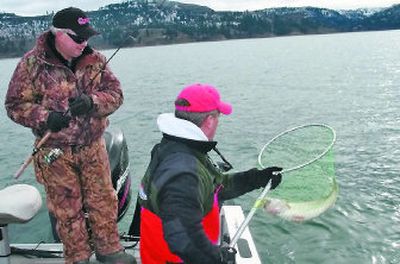
Bob Ploof embraces walleye fishing with the same can-do attitude he’s applied in 28 years with the U.S. Air Force Survival School.
“Hope is not a course of action,” he said.
Undeterred by a chilly February day on Lake Roosevelt, Ploof conferred across the length of the boat with his partner, John Carruth, regarding the color combinations they had yet to try. Then he changed the type of jig on the end of his line for the eighth or ninth time in a few hours of sketchy fish-catching.
The boat’s sonar was showing fish on the mud-flat bottom, but only one 20-incher had been lured to strike.
“It could be the type of jig head or the weight, the length of the plastic grub or the color or size, the rate of drop or speed of the retrieve, or something as simple as changing the angle of the boat,” Ploof said.
He never mentioned luck.
“Getting lucky helps in anything you do,” he said, responding to the question. “It’s not something you rely on.”
“And sometimes you just have to pick up and move to find more agreeable fish,” said Carruth, a Davenport electrician.
But these walleye diehards rarely stray from their favored technique.
Ploof and Carruth are tournament-fishing teammates who have the common bond of being hooked on jigs.
“It’s all about figuring out what you’re going to be, and then working to be good at it,” Ploof said. “That doesn’t mean you ignore other techniques. It means you find something you have faith in and refine it to an art.”
They were unfazed by news that a Richland man had caught the state-record 19.3-pound walleye a week earlier while trolling a spinner rig on the Columbia near the mouth of the Snake.
“We’ll start with jigs,” Ploof said, casting and demonstrating his subtle hop-hop-stop retrieve. Other times he used the electric trolling motor to slowly drag and bounce the jig along the bottom.
“Sure, you have to be flexible,” he said, noting that on one trip last year he started by drop-shotting – a method in which the bait is rigged a few inches up to a few feet above the weight or jig at the end of the line.
“I got two fish right away,” Ploof recalled. “But then John caught the next eight or nine fish in a row using a jig. I might be slow, but I’m not stupid. I finally changed over.”
And they weren’t stupid about staying too long in a former hot spot that had gone cold. They had already talked about moving to a place down the reservoir when they saw another boat move onto it and start fishing. Soon, three other boats were fishing there.
“They’re not leaving,” Ploof said later. “I think we’re missing something.”
Indeed, by the time Ploof and Carruth motored down and eased in among the boats, one angler had just hooked, netted and released his second walleye in the 12-13 pound range. Several other fish were being landed.
It wasn’t long before Carruth hooked into a 5-pounder.
Then the catching suddenly slowed for all of the boats.
On one cast, Carruth hooked a 20-inch rainbow – walleye anglers call them “slimers” – before the jig could sink to the bottom. Over the next couple hours, however, he caught only three more fish, nothing bigger than about 6 pounds.
“That’s the way walleyes are,” Ploof said as he came back to net one of Carruth’s bigger fish. “The bite will come on and then go off just as fast. That’s when you have to start experimenting again.”
As Carruth baited his jig hook with a fresh nightcrawler, Ploof stole one of his Berkeley Gulp Grubs before going back to his seat in the front of the boat.
“He would steal a toy from a baby if he thought it would get him a big walleye,” Carruth snorted.
Ploof has been organizing his thoughts for walleye fishing presentations he will be making this week and next month in Spokane.
“Fishing has a lot of basics, but it also has a lot of personal preference,” he said.
“Some guys like to use the braided super lines because they don’t stretch and they like the way you can feel the bite. Fireline is very sensitive. But you can set the hook too quick with it and rip the hooks out of a walleye’s mouth.
“My preference is monofilament. This 6-pound Trilene XL casts well in the cold and I can see it better in all light conditions. A lot of times, catching walleyes with jigs is as much about seeing your line move or go slack as it is about feeling the bite.”
“But to each his own. The braided super lines are just another way.
“Rod choice can be an angler’s biggest mistake, especially for jigging,” he continued as he cast with his 6-foot-6 inch spinning model. “You don’t want anything that’s too limber. You want a medium power rod with a fast, sensitive tip.”
After five hours of fishing, the two angling partners had been through a few dozen jig presentation combinations. Ploof was even trying knife-like blade baits.
“You want to try a mix of methods before leaving a school of fish,” Ploof said.
“Some days are slow like this, other are so fast you don’t have time to drink your coffee. Changing lures like we do, it’s not just hunches. We’ve been fishing so long, it’s like riding a bike. At first you have to think about steering, but after a while you just turn, you don’t’ think about it.”