
Winning loss
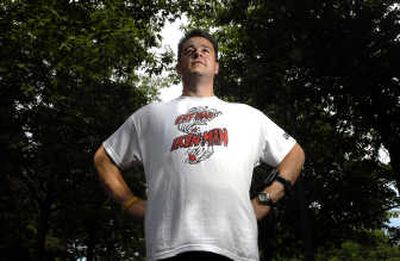
Do, or do not. There is no try. James Hicks is a living, breathing testament that Yoda’s adage does work in real life.
In 2003, Hicks weighed 575 pounds and had such low blood oxygen levels that his doctor told him he could expect to die from a heart attack any day.
Four years later, Hicks has lost more than 375 pounds, completed about 30 triathlons and will compete in the New York City Triathlon on July 22.
The death sentence from his doctor and his insurance company’s subsequent refusal to pay for a gastric bypass surgery catalyzed the Spokane man’s transformation from “fat man to Ironman.” But Hicks attributes his success to a tip he picked up from Dr. Phil’s book “The Ultimate Weight Solution” and his own ability to set goals and achieve them.
“Dr. Phil called it ‘right thinking,’ but really it’s finding out what your identity is and how it affects your life, and then deciding if you want to change your identity,” Hicks said.
The book made Hicks realize that no diet plan could help him until he changed his mindset and stopped thinking of himself as “The Fat Guy.”
“I realized that my identity was ‘The Fat Guy.’ It had been so ingrained in me that I was completely locked in to who I was,” Hicks, 33, said. “So all my decisions, all the career choices I made, the friends that I made, the things I did in my spare time, they all kinda fell in line with being ‘The Fat Guy.’ ‘The Fat Guy’ can do Atkins, ‘The Fat Guy’ can go on Weight Watchers. It doesn’t matter because you’re still ‘The Fat Guy’ on a diet. And everything you do on that diet is contrary to what your identity is.
“I realized that if I wanted to have any kind of successful weight loss, I had to change that identity so that if was natural for me to eat healthy and do healthy things.”
Hicks’ first step was to join a Weight Watchers program. His new identity: Weight Watchers guru.
“It all started as a New Year’s resolution. I would join Weight Watchers and do everything I could to follow the program to the ‘T’ – eating the right amount of points, never cheating, getting to know everything there is to know about the program, and just being a rock star,” Hicks said. “I never planned to lose all my weight, just to lose a little bit to get away from death’s door.”
Determined to succeed, Hicks also set weekly and daily goals to stay on track with the program.
It worked.
Three months later, Hicks had lost about 60 pounds.
That’s when he began walking.
“I woke up one morning, got out of bed and actually had energy,” Hicks said. “In 30 years of my life, I never had energy, ever. Even as a toddler I was always tired.”
That morning, Hicks decided to walk to work from his wife’s office instead of having her drop him off.
The eight-tenths-mile walk took him 55 minutes that day, but Hicks finished it feeling more energized than he had in a long time.
From then on, Hicks walked to work from his wife’s office every morning. Then, he started walking during his half-hour lunch break. Soon, Hicks was up to 3 miles a day.
Inspired by the joggers he saw on the Centennial Trial on his daily walk, Hicks signed up for the annual Bloomsday run.
“Here I was, at a point where I could not walk more than 3 miles in a day, and I signed up for a 7.5-mile race a month away because I had a few weeks to prepare, and I made a decision that I was gonna make it happen,” Hicks said. “If I did it a little bit at a time, I knew I could get there.”
On the week of the race, Hicks hit the 100-pound weight loss milestone. Hicks and his wife walked Bloomsday and finished in last place. But he was so proud at having finished that he decided to run the race the following year.
That summer, Hicks bought a cheap bike and began riding to work. The rush he got that first day on the bike excited him, and was similar to the rush he’d had the first day he’d started walking to work.
Soon, Hicks started running and going to the gym.
One day, he overheard someone at the gym talking about triathlons. The idea intrigued Hicks so much that he decided his new goal was to complete an Ironman.
Hicks did his first triathlon in March 2006. Since he first picked up Dr. Phil’s book, Hicks’ new healthy ways have rubbed off on his friends and family.
Gone are the days when Hicks and his wife, Amy, would come home from work, bake a cookie sheet full of an assortment of frozen deep-fried bar food, and chow down on a 3,000-calorie dinner. Dinner now consists of salad and lean protein, and James Hicks has also inspired his brother to start exercising and eating better.
Hicks even motivated his friend and workout buddy Stephanie Holten to start doing triathlons.
“James is a wonderfully inspiring person and he makes me feel like I can do more,” said Holten, 33. “I don’t swim well, but did my first triathlon with him, and he stayed with me the whole time. He swam on the other side of me so that I’d have that safe feeling of having someone there.”
Hicks and Holton are training together for the Portland Marathon in October and Hicks will also compete in his first Ironman-distance triathlon (140.6 miles) this August.
But at the moment, he’s gearing up for next week’s trip to New York.
The event organizers heard about Hicks’ story and offered to waive the race entry fee. Hicks signed up, but had to figure out how to raise money for his airfare and accommodations.
Hicks is in talks with Southwest Airlines to see if they’ll sponsor his airfare, but he still needs to raise funds to pay for other costs.
“If you put in your mind that failure is not an option, then it’s easier to succeed,” Hicks said. “I’m determined not to give up on New York, up to the date I have to leave. At the time I signed up, I wasn’t sure how I was going to get there. But I knew I could make it I set my mind to do it.”