
Tough talk begins already
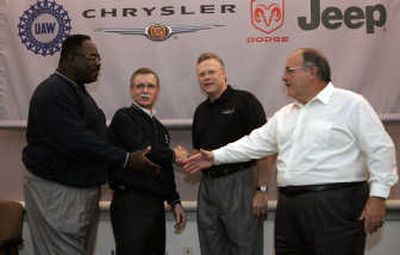
AUBURN HILLS, Mich. — After they dispensed with the formalities on Friday, officials of Chrysler Group and the United Auto Workers staked out how they’ll approach what many consider to be the most important talks in U.S. automotive history.
UAW President Ron Gettelfinger repeatedly wouldn’t answer specific questions about bargaining strategy, but told reporters that the union already has done a lot to make the Detroit Three more competitive. The UAW has given health care concessions to General Motors Corp. and Ford Motor Co. and approved buyout and early retirement packages that let all three companies, including Chrysler, downsize their work forces.
In the past, he has said the union is not in a concessionary mode.
Chrysler Chief Executive Tom LaSorda, on the other hand, predicted the negotiations would be difficult and said they are an opportunity for true change in the face of unprecedented challenges.
“We can no longer afford to conduct ‘business as usual,”’ LaSorda said.
The comments came after traditional handshakes that formally kick off the talks, but negotiations actually have been under way for months. Similar events will take place on Monday with Ford and GM. The UAW’s national contracts with the Detroit Three expire on Sept. 14.
All three have said they need to reduce labor costs to become competitive with their Japanese rivals: Toyota Motor Corp., Honda Motor Co. and Nissan Motor Co.
Industry analysts have said reducing costs is critical to the domestic companies’ survival.
Chrysler and the union clearly are focused on health care, with both calling for some sort of national solution to the problem of rising costs for active workers and the huge obligation to care for retirees.
Chrysler Senior Vice President John Franciosi, the company’s chief negotiator, said the Detroit Three would begin a more aggressive grass-roots lobbying campaign in Washington to address the costs, and LaSorda called health care a national crisis. Gettelfinger often has called for a national health care system.
Both say they are competing against foreign automakers whose governments pick up the tab for health care.
But without national health care, the companies and the union still must deal with the huge problem of their retirees’ medical expenses.
The Detroit Three collectively have a $90.5 billion unfunded liability for retiree health care, and all are interested in reducing or eliminating it. One possible solution they’ve floated came from a contract settlement last year between the Goodyear Tire & Rubber Co. and the United Steelworkers. The company agreed to pay the union $1 billion to set up a trust and take over $1.2 billion in hourly retiree health care liabilities.
The UAW reached a similar agreement with troubled auto supplier Dana Corp. earlier this month, but Gettelfinger said that doesn’t mean that the union would go for something similar with the automakers.
“The settlement at Dana is not a precursor for any other set of negotiations,” he said, adding that Dana is in Chapter 11 bankruptcy protection and that retirees were in danger of losing health care coverage.
But Gettelfinger would not answer a question about whether the union would rule out a similar trust fund for companies that weren’t in bankruptcy.
Franciosi said reducing costs and becoming more competitive is imperative for both sides.
He also said that while Chrysler would like to get labor costs closer to its Asian competitors, that doesn’t necessarily mean concessions for the union.
“We can get very creative. Creativity and innovation by definition are not necessarily concessionary,” he said.
Gettelfinger is leaving himself some breathing room in case the companies put enough money into a trust to make the health care deal worthwhile, said Gary Chaison, a labor specialist at Clark University in Worcester, Mass.
But any arrangement for the union to take over health care liabilities would also be a difficult sell to the membership, Chaison said, noting that Ford workers barely approved health care concessions in 2005.
“I think he’s very concerned that a health care arrangement that’s radically different is going to be rejected by the membership,” Chaison said.
A strike, which could cripple one of the companies and possibly force bankruptcy, is not an option, Chaison said.
As for Chrysler, Chaison said Franciosi is signaling that a traditional concession such as a wage cut or a lower pay scale for new employees might not be the answer.
“There are lots of ways to tweak health benefits and pension plans,” Chaison said. “It could be a change rather than a cut.”
The Detroit companies have said they have a $25 to $30 per hour labor cost disparity with their Japanese rivals.
Ford, according to its annual report, paid an average of $70.51 per hour in wages, pension and health care costs for hourly workers last year. GM’s annual report says its labor costs average $73.26 per hour, while the Chrysler Group’s costs average $75.86.
All three will seek to reduce costs to around $48 per hour, about the average hourly cost incurred by Toyota, Honda and Nissan.
Studies have shown that the Detroit Three make around $2,000 less per vehicle than their competition, with much of that due to labor costs.
But the UAW says labor costs represent only 10 percent of the price of a new vehicle.
Chrysler’s parent company, DaimlerChrysler AG, in May agreed to sell an 80.1 percent stake in Chrysler to New York private equity firm Cerberus Capital Management LP in a $7.4 billion transaction.