
As the loonie soars and Canadian shoppers return, Spokane businesses are being converted
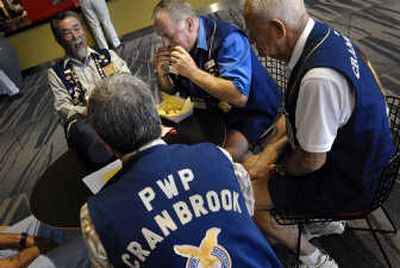
The panoply of maple leaf emblems, adorning everything from strategically shaped umbrella hats to red-and-white-specked scarves and foliage-embossed T-shirts, is a dead giveaway in this lilac-boasting city.
The Canadians are back.
As the Canadian dollar nears par with the American greenback for the first time in 30 years, Spokane businesses are witnessing a resurgence of Canadian visitors. Hotel parking lots are filled with British Columbia tags and area malls play host to large caravans of shopping fiends from Alberta. Spokane Mayor Dennis Hession even showed up at the annual Calgary Stampede last week to help advertise his city.
But the region’s growing popularity and the loonie’s rise to about 95 cents have also left some tourism officials and entrepreneurs questioning whether they should more readily accept Canadian dollars.
“When I go up to Canada, I don’t care whether it’s a dinette or a Four Seasons hotel, the machine calculates the exchange and with a smile they give me change back in Canadian currency,” said Harry Sladich, president of the Spokane Regional Convention and Visitors Bureau. “And we can’t do that here? It’s unbelievable how seamlessly they take our money and it’s embarrassing that we can’t do that.”
If Spokane wants to entice the growing number of Canadians crossing the border with deeper pockets, it needs to learn to speak Canadian, said Sladich. This means making it possible to exchange currency citywide, not only in select hotels or at banks.
“That’s the bee in my bonnet,” he said, describing an initiative where businesses would place a sticker on their door stating, “We speak Canadian,” an indication that that they take Canadian dollars and give change in American money. “Not everybody wants to put their purchases on debit card,” said Sladich, who said Spokane is seeing a rebound in Canadian travel even if the city has no official way to track it. “We are missing the boat when we don’t embrace them 100 percent.”
For almost 20 years from his family bistro downtown, Luigi’s Italian Restaurant co-owner Marty Hogberg has watched the Canadian influx follow the trends of the open market. Hogberg, who accepts Canadian currency at the going rate, agrees with Sladich’s campaign.
“It’s stupid not to (accept the Canadian dollar),” Hogberg said. “In my opinion you should make it as easy as possible to pay the bill,” he quipped, noting that Canadian business is up about 10 percent from last year. When the loonie jumped in the mid-1990s, Hogberg said Luigi’s would process $10,000-15,000 worth of Canadian currency a month. As Canada’s commodity prices fell, the country’s dollar dropped dramatically, reaching an all-time low of about 62 cents in early 2002 and taking the bistro’s processing number down to zero.
“So it’s really started helping,” said Hogberg, who has donated complementary meal gift certificates to the visitors bureau for Canadian tour groups.
The currency conversion service is actually more trouble than it’s worth, said Tawnya Hindman, the guest service manager at Spokane Valley’s Holiday Inn Express. The business provided the service for two years but ended it about a year ago because there wasn’t enough demand.
“It was kind of a hassle when we did have it, caused a lot of confusion at the front desk, and of the Canadians that did visit, you didn’t see too many people paying with Canadian dollars,” she said, adding that 90 percent of Canadians pay with credit card because they don’t expect Spokane businesses to accept cash. “Most of them were surprised we had it,” she said. Neither the famed Davenport Hotel nor the popular Howard Johnson on Division Street accepts the loonie, they said.
The inability to “speak Canadian” has not hindered the Holiday Inn’s business. Since the same time last year, the Valley and downtown locations have had a 26 percent increase in the number of rooms rented to Canadians. The Travelodge on Spokane Falls Boulevard currently has 20 percent of its rooms filled by Canadians, and front desk manager Christine Vavra estimates that maple leaf walk-ins have increased to up to two per day from a previously nominal amount last summer.
But Vavra says that’s because the Travelodge takes Canadian money. “A lot of places only accept credit cards,” she said, describing the first money the hotel ever took from any customer, a crisp $2 Canadian bill. “We make sure we match at par and it’s nice for them to be able to come here and pay Canadian cash.”
For Calgary resident Heather McTavish, 57, walking along the Spokane River on a road trip that would also take her to Sandpoint, the cash issue has become a frustrating inconvenience. She said her husband had difficulty cashing his traveler’s checks, a situation that left them without money. It took a phone call to American Express and a thumbprint check at the bank to get $100.
“It would have been tough if it were me since I have no driver’s license,” said McTavish. “I would have had to go find my passport. It’s a lot more fun when you aren’t all out of cash,” due to a business’s inability to accept Canadian currency, she said.
And they want to spend money, the cluster of Canadian visitors surrounding her affirmed. “You can get those little tubes that you freeze into ice things in bottles,” Calgary resident Margaret Hay, 64, said excitedly, as she launched into a list of cheaper American purchases like towels, linens and gas.
Hay said she has seen other Canadians capitalize on the higher exchange rate, something they last did to this extent in the mid-1970s and late 1980s. The Canadian dollar reached its current level in 1977 and exceeded the American one only in the mid-1970s, hitting a high of $1.04 in 1974.
The maple leaf onslaught has been more consistent for cities closer to the border, but even in Colville, where the Canadian dollar is more willingly accepted and northern neighbors regularly walk through the doors, the numbers are growing. John Acorn has run Acorn Saloon on the city’s Main Street for 20 years and said they are getting 75 percent more Canadians this year than last year.
Acorn still accepts Canadian dollars and thinks that more businesses farther from the border should as well. “There’s gotta be a way of letting them know they can be giving a better rate,” he said.
But some businesses in Sandpoint say credit cards have made currency exchanges worthless. Tom Guscott, owner of Arlo’s Ristorante said he hasn’t taken any Canadian currency in the six years he’s owned the restaurant. “If it did become an issue I would have no problem accepting it,” he said, “but I would wait until I have requests.”
Whether Sladich teaches Spokane to speak Canadian or businesses opt not to accept Canadian cash, Calgary resident Ray Knudson, 65, advised the region to watch for a deluge of maple leaf natives.
“And make sure you practice the ‘eh,’ ” he said, waving his Canadian flag in affirmation.