
U.S. blockades Shiite town
BAGHDAD – A suicide car bomber struck the center of a major Shiite city in southern Iraq today, killing at least 22 people and wounding dozens as the streets were packed with shoppers and people on their way to work, police said.
The explosion occurred at 9 a.m. in a commercial district in Hillah, according to provincial police. Hillah, about 60 miles south of Baghdad, has been the site of some of the deadliest bombings, including a double suicide attack on March 6 that killed 120 people.
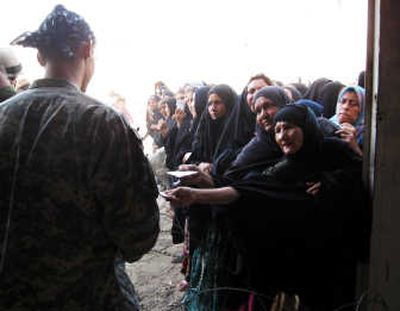
On Monday, U.S. and Iraqi forces blocked access to a town on the northeast outskirts of Baghdad where Shiite gunmen were dug in for a third day behind earthen barriers. Police issued calls for residents to leave the town, and some said they were running out of food and fuel.
The blockade of Husseiniyah came as at least 16 people died when four car bombs rocked the center of the capital. Three of the blasts took place in one 30-minute span, as the relentless Baghdad summer sun pushed temperatures to 115 degrees.
Police, morgue and hospital officials reported a total of at least 59 people killed or found dead nationwide Monday, and the American military announced the deaths of three soldiers and a Marine. At least 3,636 members of the U.S. military have died since the Iraq war began in March 2003, according to an Associated Press count.
The continued fighting and deaths of Iraqis and American forces in the sixth month of the American effort to calm Baghdad and the center of the country illuminate the stubborn resistance to a political solution in Iraq, where the government and legislature appear determined to press for sectarian advantage rather than Iraqi unity.
The Shiite-dominated parliament said Prime Minister Nouri al-Maliki should intervene to end the crackdown by U.S. and Iraqi forces on Husseiniyah. The town is a stronghold of the Mahdi Army, the militia loyal to radical cleric Muqtada al-Sadr, and straddles the highway to Baqouba, where U.S. forces are in the second month of a drive to cleanse that region of al-Qaida in Iraq.
State-run Iraqiya television said the Husseiniyah blockade “would have serious consequences on people’s lives there.”
A 51-year-old woman who would give her name only as Um Bassem said police, apparently expecting a major outbreak of fighting, had issued calls for residents to leave Husseiniyah if they could.
“My husband offered to take us out and return to protect our house and belongings, but we refused to leave because we would be so worried about him,” Um Bassem said. She said food stocks were becoming low.
Lt. Col. Michael Donnelly, spokesman for U.S. forces north of Baghdad, said American and Iraqi forces were now allowing “commercial vendors to bring food to the south of Husseiniyah. Civilians are authorized to walk to these vendors to buy food. Donkey carts may be used, but no vehicle movement is authorized. We are also allowing civilians that need medical aid, to walk to the Hamid Shaub Hospital for free treatment.”