
Markets cave in to subprime fears
NEW YORK — Wall Street finally caved Thursday.
For months, investors had looked past a series of warning signs: Major U.S. banks reporting losses from portfolios of subprime loans amid a slowing housing market. Private equity funds not being able to attract investors on junk bond deals as they had just weeks ago. And hedge funds going belly up on soured investments linked to the subprime market.
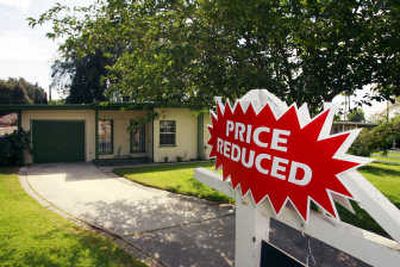
The proverbial last straw came Thursday, with the Commerce Department’s report that new home sales fell 6.6 percent last month, more than triple what had been expected. Investors decided it was time to sell.
The result was the stock market suffering one of its worst days this year, with the Dow Jones industrials plunging 311.50, or 2.26 percent to 13,473.57. The blue chips had managed to come back somewhat from an afternoon loss of 449.77, but the close was the Dow’s worst since the 416.02 it lost on Feb. 27 after a plunge in the Shanghai stock market.
“Worries that have been out there for the past couple of years are coming to a head right now,” said investment strategist Edward Yardeni, president of Yardeni Research Inc. “It’s show time.”
Broader market indicators also slid. The Nasdaq composite index tumbled 48.83, or 1.84 percent, to 2,599.34, while the Standard & Poor’s 500 skidded 35.43, or 2.33 percent, to 1,482.66.
The Nasdaq’s losses weren’t as steep as other major indexes during the session due to strength from Apple Inc., which surged $8.74, or 6.4 percent, to $146.00. The iPod and iPhone maker’s earnings easily surpassed Wall Street projections late Wednesday.
Before Thursday’s big drop, the Dow had been up 10.61 percent for the year — and that margin has now been cut to 8.11 percent. The S&P 500 was up 7.04 percent, and the market decline now puts it at 4.54 percent; while the Nasdaq’s 9.64 percent increase has been cut to 7.62 percent.
Feeding the plunge were a variety of concerns about lending, that higher corporate borrowing costs will curb the rapid pace of takeovers that had driven stocks higher this year. Investors also feared the sluggish environment for home sales and continued defaults in subprime loans would spur debt defaults and weigh on corporate earnings.
While stocks plummeted, investors poured money into the safe haven of the bond market. The soaring price of Treasurys pulled yields lower, and the rate on the 10-year note plunged to 4.79 percent from late Wednesday’s 4.90 percent.
Thursday’s trading was the latest and most extreme in a series of frenetic sessions over the past month — many also accompanied by triple-digit swings in the Dow — as investors sold on worries about the subprime fallout or bought on optimism that there wouldn’t be any widespread problems caused by mortgage failures. Many analysts have described the back-and-forth trading as overwrought and based more on gut emotion than careful consideration of market and economic fundamentals.
That was their feeling again Thursday.
“The rally in bonds at this point looks a little bit overdone,” said Tom Higgins, chief economist at Payden & Rygel Investment Management in Los Angeles. “If you’re going to park money temporarily then cash I think is the way to be but I think that we’re going to form a bottom. I think people are going to be legging it back into the market.”
The Commerce Department’s report raised the market’s anxiety levels after home builders including Pulte Homes Inc. and D.R. Horton Inc. said their quarterly earnings were squeezed by a sluggish environment from home sales and continued defaults in subprime loans.
Also stunting stocks was the Commerce Department’s disappointing durable goods report. Though sales of big-ticket items increased by 1.4 percent last month to a seasonally adjusted $217.07 billion, durable goods excluding transportation equipment had an unexpected drop.
Investors also reacted negatively as oil prices climbed to almost $77 per barrel during the session, stoking the market’s worries about inflation.