
Solo traveler
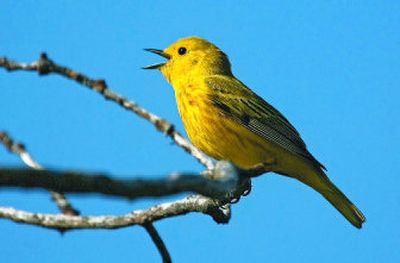

I was sitting here looking at the image of the male yellow warbler that accompanies today’s article. I was looking at the intricacies of his feathers, the brightness of his yellow, the smoothness of his beak, the shiny wetness of his eye, and the tininess of his claws that grasp the branch.
This bird weighs about a third of an ounce. He just arrived here from Costa Rica, or Panama, or Oaxaca – alone. His species does not flock. Last fall he made the same trip in reverse and without any external guidance.
On the trip he flew by night and then frantically fed by day. He had to dodge weather and predators and accidents. In the end, he arrived back here to breed and to help raise a nest of young to perpetuate his species.
His life is so full, yet so tenuous and fragile. His composition and his abilities are so amazing to me.
He is a yellow warbler. To a birder, he is a representative of his species to be noted and enjoyed. He is, though, an individual. As birders, I’m not sure we often think about that.
As I’m studying his captured likeness, I wonder if he enjoys flying and singing, or are they just his job? We enjoy watching and listening.
I wonder if he thinks, or is he simply programmed to react? If he thinks, does he think about migration when he’s nesting? Does he think about North Idaho while he’s in Central America?
We know a lot about his species, but we know so little about him. There is something about his portrait that makes me wonder about him. Yet, I marvel at his species and its uniqueness, too. So, let’s move on.
The yellow warbler is a member of the perching bird group known to ornithologists as wood-warblers and to birders simply as warblers. Ornithologists are more specific because in Europe there is a group of birds called warblers that are nothing like our warblers.
As you can see by our yellow warbler, there are some incredibly beautiful wood-warblers, especially in the East, and there are some really neat wood-warbler names. Some names sound so interesting: northern parula, ovenbird, Louisiana waterthrush, worm-eating warbler, prothonotary warbler, painted redstart.
Many names are attractive in their descriptiveness. Just imagine: blue-winged warbler, golden-winged warbler, black-and white warbler, chestnut-sided warbler, yellow-throated warbler, yellow-breasted chat, bay-breasted warbler, red-faced warbler, hooded warbler, blackpoll warbler. My favorite: cerulean warbler, “a deep blue, like the sky on a clear day.”
And then there are these three multicolored combinations: black-throated blue warbler, black-throated green warbler, black-throated gray warbler.
There are lots of warblers named for people: Grace’s, Lucy’s, Swainson’s, Blackburnian; for places: Virginia, Kentucky, Tennessee, Connecticut, Canada, Cape May; for things: magnolia, prairie, palm, pine; for behaviors: hermit, mourning.
There are three warblers quite rare in the United States: tropical parula, Colima, golden-cheeked; there is one warbler that is almost extinct: Kirtland’s; and one warbler that is extinct: Bachman’s.
In all, there are 50 living wood-warbler species of the family Parulidae that breed in the United States and Canada. Some are incredibly bright and colorful; others are terribly dull and plain. There are another 65 or so wood-warbler species in the American tropics that are non-migratory.
In North Idaho we have only 10 wood-warbler species that summer here. Most of these warblers nest in the mountains: orange-crowned warbler, Nashville warbler, yellow-rumped warbler, Townsend’s warbler, MacGillivray’s warbler, Wilson’s warbler.
One warbler nests in marshy or open-field areas: common yellowthroat. Two warblers can be quite difficult to find in North Idaho: American redstart, northern waterthrush.
And one warbler, with the bright “flash of sun” plumage, with an incessant song of “sweet-sweet-I’m-so-sweet,” and with a short and to-the-point name, is our best known warbler because it is the most widespread and the most abundant warbler in both North Idaho and North America: yellow warbler.
Still, it is not one of the more often seen summer breeders in North Idaho. Yellow warblers tend to hang out in riparian settings: wet areas with willow and alder thickets making a dense, protective cover in which to feed and nest. We have lots of such areas in North Idaho and they all have yellow warblers in them.
You may not see one right off, but you’ll certainly hear the males declaring their territories from somewhere fairly high in the brush. The female yellow warblers are not as flashy or loud, and they’ll tend to be down lower, gleaning bugs from both sides of the leaves that camouflage their summer world. To get at the undersides, they may even hover below a particularly productive leaf, picking off insect larvae, caterpillars, and spiders
Yellow warblers usually arrive in North Idaho during the last week of April or the first week of May—this year’s first sighting was right in the middle, on April 30. By now nesting is in full swing so both members of a pair are busy. Earlier, as the male established and defended his nest territory, the female made the nest.
Some females get lots of practice at nest building in a season. Yellow warblers are particularly susceptible to nest parasitism where a brown-headed cowbird will lay one or two eggs in the warbler’s nest while the warblers are out to dinner.
If undetected, the cowbird eggs will hatch and the young will be reared by the foster parents—often to the detriment to the warbler young. However, yellow warbler moms don’t always fall for the ruse. If they discover a cowbird egg, they often build a new nest floor over the eggs and start again.
Some yellow warbler nests have been found elsewhere with as many as six floors and lots of cowbird eggs. Such would represent a busy warbler summer. Here, after all the alder and willow leaves have fallen for the year, I have found lots of yellow warbler nests out along the road east of Fernan Lake. Among them have been a few multi-storied versions.
Yellow warblers are, as are all warblers, hyperactive little creatures, restlessly flitting the day away. And they are as solitary as they seem, even while nesting. Males tend to glean at higher levels and females tend to glean at lower levels. They both see the process out to the end when the young are left to themselves, but it seems that it’s with a certain reluctance that they tolerate each other.
Perhaps the male is too gaudy. Perhaps the female works too hard. Again I’d like to get inside their heads to know what they might be thinking.
Then, by late August or early September, the male of our picture will be on his way back south, assuming he survives the rigor of summer life in North Idaho. Will he leave with reluctance, or with relief, or will he just leave? I wish I knew.