
Crews meet after shuttle docks with space station
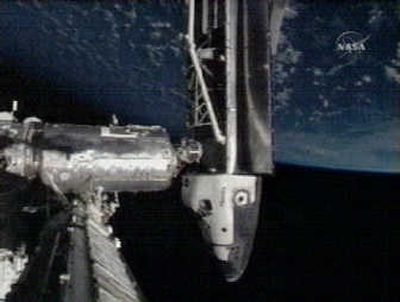
HOUSTON – The crews of Atlantis and the international space station greeted each other with hugs and handshakes Sunday after the space shuttle arrived at the orbiting outpost.
But amid the smiles and salutations, engineers in Houston 220 miles below started evaluating whether a peeled-back thermal blanket should be fixed by astronauts.
A decision likely will be made in the next day or two, and if the answer is to fix it, another decision will be made on whether it would be done during one of three scheduled spacewalks or during an extra, unplanned one.
Astronauts James Reilly and Danny Olivas planned to make the mission’s first spacewalk today to help attach a new 35,000-pound segment to the space station.
Engineers who on other missions had studied past damage to the blanket area, located on a pod of engines near the shuttle’s tail, were uncomfortable with the safety margins of a piece of the blanket sticking out during re-entry into Earth’s atmosphere when temperatures on the shuttle’s heat shield can reach as high as 2,900 degrees Fahrenheit.
Temperatures at the blanket’s location only reach 700 degrees to 1,000 degrees Fahrenheit.
“The concern is that if it sticks up, you get additional heating,” said John Shannon, chairman of the mission management team.
Engineers were confident the loosened blanket was caused by aerodynamic forces during launch, not by being hit by a piece of debris during liftoff.
“Since this wasn’t an impact blow, we have high confidence that the structure beneath it is pristine,” Shannon said.
The rest of the vehicle appeared to be in fine shape, NASA said. Sensors reported six hits on the wing during launch but engineers were not concerned about them.
Hatches between the two spacecraft opened about 1 1/2 hours after the shuttle docked with the space station following leak checks.
“Atlantis arriving,” U.S. space station resident Sunita Williams said after the traditional ringing of a bell.
Atlantis’ astronauts floated into the space station’s Destiny laboratory and hugged each of the station’s residents, which besides Williams includes commander Fyodor Yurchikhin and cosmonaut Oleg Kotov.
After exchanging greetings and receiving a safety briefing from Yurchikhin, both crews resumed working.
Before reaching the space station, Atlantis commander Rick Sturckow told Yurchikhin that shuttle astronaut Clayton Anderson was ready to relieve Williams on the station.
“Are you sure Clay is onboard?” Yurchikhin said.
“Yes we checked before we launched from Florida,” Sturckow said amid laughter.
Sturckow eased the shuttle into the space station’s docking port. Latches fastened the shuttle and orbiting space lab together at 3:36 p.m. EDT. The shuttle’s two-day chase of the space station ended about 210 miles above southeastern Australia.
It was the first visit this year by a shuttle to the space station. The shuttle was delivering Anderson, the newest member of the space station’s crew, as well as a new segment to the orbiting outpost.
Prior to Atlantis’ arrival, Olivas took additional photographs from inside the shuttle of the area where the thermal blanket had peeled back. The images were sent to Mission Control for analysis.
Astronauts inside the space station also took photographs of the shuttle’s belly when Atlantis was 600 feet below the orbiting outpost.
The pictures were taken when Sturckow maneuvered the shuttle into a 360-degree back-flip – part of an inspection technique. Engineers want to make sure there is no damage from launch like the kind that doomed Columbia in 2003.
After the hatches were opened Williams and Anderson were to trade out seatliners on the Russian emergency vehicle attached to the station. The seatliner exchange marks the official replacement of Williams by Anderson as a space station resident.
The shuttle astronauts’ wake-up song Sunday, “Riding the Sky,” written by two Johnson Space Center employees, was dedicated to Anderson in honor of his move to the space station.
Williams will return to Earth aboard Atlantis after more than six months in space.
NASA engineers want to study more photos of the torn blanket, including images taken by cameras attached to the solid rocket boosters that separated from Atlantis after launch.
On Saturday, astronauts took photographs of the thermal blanket and heat shield.
Engineers can build models from the images and perform tests to determine whether the peeled-back blanket would be problematic when Atlantis returns to Earth.