
Singer enters mainstream
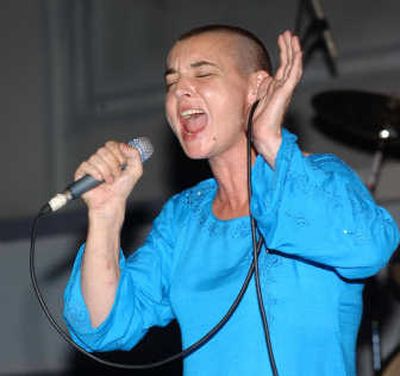
Sinead O’Connor is not your typical Christian music diva.
The Irish singer-songwriter has torn up a picture of Pope John Paul II on “Saturday Night Live,” refused to have “The Star-Spangled Banner” played before a concert, been excommunicated following her “ordination” as a Catholic priest, and announced she was a lesbian – shortly before recanting.
Yet with her new double album “Theology,” coming Tuesday, the Grammy winner will make a foray into the mainstream Christian music market, distributing the CD in major Christian retail outlets.
The move, O’Connor says, is not as out of character as it may seem.
“By blood and by birth I am a Catholic, and I am extremely inspired by that,” she says in a telephone interview from Dublin. “I wanted to acknowledge music as a way of talking to God.”
But will the Christian market buy it?
Besides her public antics, her private life also may be a hard sell to Christians.
She once spent time in a reformatory school for shoplifting and truancy, has been divorced, and is raising four children by as many different men.
“I would think that the people shopping at these stores would find Sinead too controversial,” says Andreas Hager, a senior lecturer at Finland’s Abo Akademi University who has written about Christian themes in O’Connor’s music.
“That usually matters to American conservative Christians.”
But she may find an audience with younger Christians, especially those involved in the emerging church movement, which is generally built upon rebuilding broken lives and is, therefore, more forgiving of people’s pasts.
“Yes, her past is checkered, but I think for many people it’s not inconsistent,” says S. Brent Plate, a professor at Texas Christian University and author of “Blasphemy: Art that Offends” (Black Dog Publishing, 2006).
“There are plenty of lesbian Christians … and plenty of Christians with checkered lives,” he says. “She’s working it all out, I think, and perhaps in some raw and honest ways.
“Her music is obviously an expression for her struggles.”
O’Connor is not the first mainstream rocker to seek out the Christian market. Barry McGuire, of “Eve of Destruction” album fame, converted to Christianity in the 1970s and then made a string of Christian albums.
In 1979, Bob Dylan made the Grammy-winning “Slow Train Coming,” redolent with his newfound Christianity. Bono and U2 have a huge following among Christians and have even seen their music blended into Christian liturgy as the “U2charist” popular with young Episcopalians.
“Sinead’s is different,” Plate says. “Hers is not really a dramatic conversion.
“Many people have known of her religious interests for years, and the fact that she studied theology for some time.”
Indeed, religion long has been an inspiration to O’Connor, 41. Her first record, 1987’s “The Lion and the Cobra,” had a verse from Psalm 91; her second album, “I Do Not Want What I Haven’t Got,” opened with the Serenity Prayer.
Traditional Christian music, including “Ave Maria,” “Kyrie Eleison” and “Regina Caeli,” has been scattered throughout her 20-year recording career.
But she also has explored other religious traditions, forming a musical melange with Christianity at its heart.
“Sinead always makes her own thing out of these religious references,” Hager says. “She has for quite some time strongly mixed at least three distinct religious traditions: Christianity, Rastafarianism and Paganism. … I would say that these themes have become more and more prominent” in her music.
Indeed, in “Theology,” she goes to her Judeo-Christian roots, drawing the lyrics for eight of the album’s 11 songs directly from the Old Testament. “Dark I Am, Yet Lovely,” is from the Song of Songs, while “33” and “Out of the Depths” are taken from the Psalms.
The opening track, “Something Beautiful,” is from the Book of Jeremiah. O’Connor describes it as “a prayer to God for assistance and as a prayer saying, ‘Thanks.’ “
O’Connor, who describes herself as “strictly Old Testament, artistically speaking,” says she has found inspiration there since she learned Psalm 137 – the basis of the track “Rivers of Babylon” – as a schoolgirl.
She says she hopes the new album will speak to young people whose religious ideas are still forming.
“I suppose I am interested in creating spaces where those people could have a relationship to something, which they may call whatever they need to call (it),” she says, referring to the divine.
“I would hope that the record could cause a certain meditation in people who might not otherwise think about a God, that they might contemplate their own spirituality.”
Meanwhile, O’Connor’s own religious ideals have not wavered. While she acknowledges exploring other religions, she still identifies very strongly as a Catholic.
Asked about tearing up the Pope’s picture in 1992, she describes it as “an act of love.”
“People perceived it as an act of dislike for the church or for religion,” she says. “But a person only becomes that upset with their parents out of love.
“Sometimes you want to rattle the bars because you see something you love going down the drain. You have to tear down the walls, and to me that was an artistic and symbolic gesture to tear down the walls and question what are you (the Catholic Church) going to do.
“I am very much the same person in so far as I am still filled with the same love, and principally what I love is God. God is more important.”