
Less is now Moore
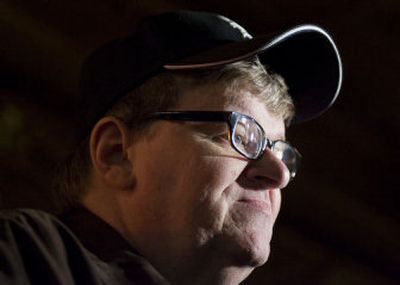
Michael Moore may be the only filmmaker whose target audience is people who despise him.
He became one of the most polarizing figures in America after his 2004 documentary, “Fahrenheit 9/11,” which portrayed the Bush administration as bumbling and corrupt in handling the war on terror. He was a heroic truth-teller to some, a loudmouth instigator to others. At White House news briefings, “Michael Moore” became a metaphor for pushy liberalism.
With his new health care movie, “Sicko,” Moore – known for filming confrontations between himself and authority figures – hopes to become, of all things, a uniter. He says he wants to inspire people of all political stripes to improve a health care system he says is too focused on making profits and not enough on caring for the ill and injured.
In an interview with USA Today, Moore says that’s why he has tried to tone down the heavy-handedness that made his earlier films – “Fahrenheit,” the anti-gun documentary “Bowling for Columbine” and “Roger & Me,” his blast at General Motors for closing auto plants – so divisive. Moore seems dissatisfied with the legacy of those films.
“Did going to (former NRA president) Charlton Heston’s home reduce school shootings in this country? I don’t think so,” Moore says, recalling a scene in “Columbine.”
“Did trying to get onto the 14th floor of General Motors (in “Roger & Me”) to see (chairman Roger Smith) convince GM to start making cars that people want to buy? No. Did ‘Fahrenheit’ stop the re-election of George W. Bush?”
Moore, sitting in a Sacramento, Calif., theater where nearly 1,000 enthusiastic nurses had just finished screening “Sicko,” looks down at the floor. “So a lot of thought went into, ‘OK, I get it. It’s a game of chess, and so far I’ve been in checkmate.’ I need to find a different way to get to where I want to go.”
In “Sicko” – which opens Friday nationwide – Moore tries to make his arguments about the U.S. health care system’s shortcomings without hassling security guards or low-level public relations flacks, as he did in earlier films.
He still does comical stunts, such as taking ill 9/11 rescue workers to Cuba for treatment to try to show they’d have better access to affordable care if they lived there. He also uses a bullhorn to beg for entry to the medical ward for terror suspects at the U.S. military prison at Guantanamo Bay, Cuba.
And Moore’s view of the U.S. health care system isn’t exactly balanced; there’s little in his film on what’s good about it.
But there’s no single bad guy in “Sicko,” in the way Moore cast Smith in “Roger & Me.” And Moore does not go banging on the door of HMO Kaiser Permanente with dissatisfied patients, demanding to “see the Kaiser!” as he did in his 1997 documentary “The Big One,” an attack on corporate greed.
Health companies “were so worried when they heard about the making of (‘Sicko’) that I was going to come banging on their doors,” Moore says. “Now they’re going to wish I did come banging and kept the focus on single issues or a single company as opposed to the system itself. They’re going to be mad that the old Mike isn’t here.”
That’s partly why Moore believes “Sicko” is potentially a “more dangerous” film for those who oppose his views: He hopes he has made it more difficult to dismiss his arguments as mere ranting.
‘Love him or hate him’
After rising to fame in 1989 as the champion for autoworkers in “Roger & Me” and winning an Oscar for 2002’s “Columbine,” Moore solidified his “love him or hate him” status in American culture with “Fahrenheit 9/11.” It took in $119 million in North America and an additional $103 million abroad, making it the largest-grossing documentary ever.
When it was released before the 2004 election, “Fahrenheit” rallied President Bush’s critics, angered his supporters and drew harsh appraisals from some reviewers who said Moore presented quotes and events out of context to make Bush look foolish and uncaring.
Davis Guggenheim, director of Al Gore’s environmental documentary, “An Inconvenient Truth,” said last summer he admired “Fahrenheit” but called it “incredibly manipulative. A lot of people will disagree but I felt like it hardened a lot of hearts.”
Getting people who don’t like Moore to give “Sicko” a chance will be a challenge. He has spent 20 years antagonizing conservatives and Republicans. Conservatives have used Moore’s name to blast dissenters.
When Pennsylvania Rep. John Murtha, a Democrat and ex-Marine, came out against the Iraq war in 2005, White House spokesman Scott McClellan said: “It is baffling that he is endorsing the policy positions of Michael Moore and the extreme liberal wing of the Democratic Party.”
A focus on people, not politics
In “Sicko,” Moore takes aim at politicians, but they aren’t the focus the way Bush was in “Fahrenheit,” for example. He notes that politicians including Bush and Democratic presidential candidate Sen. Hillary Rodham Clinton have received campaign donations from health care companies, but largely avoids finger-pointing at any ideology.
Instead, he focuses mostly on working-class people whose ailments were compounded by bureaucratic red tape, insurmountable medical bills and insurance corporations that try to maximize earnings by minimizing care.
Moore says if the stories in “Sicko” anger viewers, they should be the ones banging on politicians’ doors. “In this film, you’re not going to live vicariously through me,” he says. ” ‘There goes Mike! Stick it to The Man!’ In this film I’m saying, ‘You know what, Mike’s not going to stick it to The Man this time. … Mike wants you to stick it to The Man. And then I’ll join you.’ “