
Missing musher took wrong turn
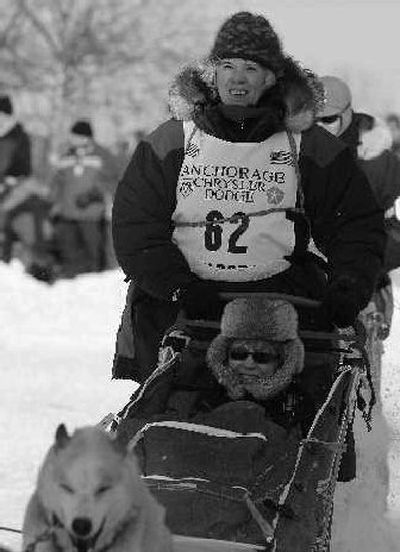
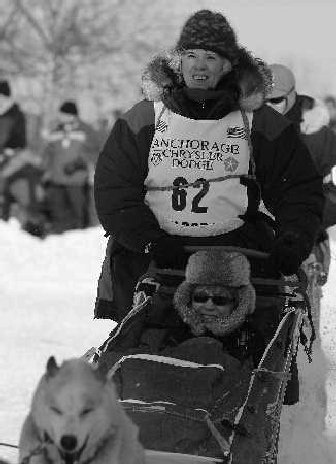
TAKOTNA, Alaska – A 61-year-old rookie Iditarod musher turned up on the wrong trail Thursday, hours after race officials started to search for the woman thought lost along a treacherous stretch.
Deborah Bicknell of Juneau, Alaska, was spotted from the air driving her team through Ptarmigan Pass, a route formerly used in the race, said race spokesman Chas St. George.
“It appears she took the wrong trail,” St. George said.
She was seen driving her dog team 18 miles from the Rohn checkpoint. Both she and her dogs were tired but otherwise in good condition, race officials said after she arrived in Rohn.
Bicknell, who was in last place before getting lost, planned to rest before analyzing her situation Friday, St. George said.
Sandy Bicknell, the musher’s husband, was with Iditarod officials in Anchorage, Alaska, when he received the news that she had been spotted.
He heard varying estimates of how many extra miles his wife had mushed by taking the wrong trail, but said it was at least 50.
The Iditarod race marshal has the authority to remove mushers from the race if they are out of the competition, but St. George said reaching the Rohn checkpoint would indicate Bicknell could still race.
Another musher also mistakenly took the Ptarmigan trail in the race.
Musher Aliy Zirkle, 37, of Two Rivers, Alaska, said a lot of the teams went the wrong way out of Rainy Pass because one of the trail markers got knocked down. She said she was among them, losing 1 1/2 hours of run time and forcing her to rest her team longer. In all, she estimates the mistake cost her three hours Tuesday.
An aerial search was started for Bicknell after she failed to show up at Rohn. Bicknell was last seen at 9:12 a.m. Wednesday, leaving the Rainy Pass checkpoint, 224 miles into the race from Anchorage to Nome, said Megan Peters, a spokeswoman for the Alaska State Troopers.
The search for Bicknell included an Alaska State Troopers helicopter and two planes affiliated with the race.
It was not known if she carried any tracking device or two-way communications, but for her to do so would have required prior approval from race officials.
Eighty-two teams started the race Sunday in Willow. Since then, 15 mushers have withdrawn, with many citing either poor trail conditions or weather. The winner usually arrives in Nome nine or 10 days after the start.
As far as the race was concerned, there was little movement among the leaders. Eight mushers were at the Iditarod checkpoint, the halfway point of 1,100-mile race from Anchorage to Nome.
Lance Mackey arrived at 12:11 a.m., followed 6 minutes later by Paul Gebhardt.
Ed Iten and Mitch Seavey arrived after 6 a.m., and Tollef Monson and Cim Smyth were two hours later.
All appeared to be taking their 24-hour mandatory rest period.
Two four-time champions, Martin Buser and Jeff King, arrived at Iditarod within minutes of each other in the afternoon.