Setting the table for eating right
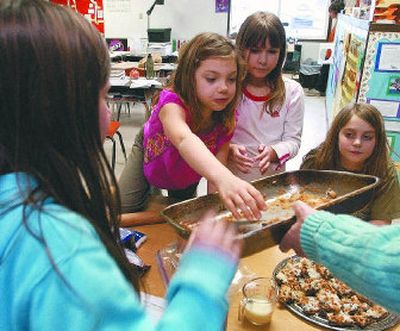
The clock is ticking down to Garrett LaRue’s dinner party and he’s as jittery as somebody after six lattes. “I’m nervous,” LaRue admits.
About anything in particular?
“Everything,” he says. “I’m thinking we’re all going to mess up. Maybe we’ll burn something.”
LaRue’s anxiety is understandable to anyone who has ever thrown a dinner party. He’s got 50 guests coming, after all. There are hors d’oeuvres to prepare, punch to mix, salads to plate, mountains of green beans to snap and pounds of potatoes to mash.
And then there’s the fact that LaRue is 9 years old, chomping gum and swinging his feet on a stool in the kitchen of the Old Church Cultural Center in Post Falls.
LaRue is one of about two dozen students from the Pioneer School in the Spokane Valley participating in The Dinner Party Project. The project is part of the New York-based nonprofit group Spoons Across America, which encourages children to enjoy family dinners and understand the connection between food and the land.
For the past eight weeks, the Valley third-, fourth- and fifth-graders have learned about kitchen utensils, recipes, the food pyramid, meal planning, cooking techniques and etiquette. They voted on a dinner-party menu, helped make shopping lists and have been whipping up all of the food (with some parental assistance) for the big night.
“I learned how to dip strawberries in chocolate,” says 8-year-old Abby DeNike of Liberty Lake. “And I learned how to make some sort of weird French dressing. It had like three cups of ketchup and one cup of mayo … It’s like, ewww.”
Schools across the country have taken on The Dinner Party Project in the past several years, but the group’s founder, Julia Jordan, would like to see it spread even further since planning the party incorporates so many different areas of learning – from math to social studies to science.
“The value of the dinner party isn’t giving the party,” says Jordan, a professor of hospitality management at the New York City College of Technology. “It’s having that lingering empowerment that children have … To value that connection with your food source, the connection of farm to table and also sitting around it, and not only appreciating what the harvest brings but understanding the conversation that comes from being around the table together.”
That’s all nice and everything, but right now 9-year-old Rachel Fricke is trying to make sure the dining room is in tip-top party shape, and the boys – those rambunctious, wrestling, bouncing-off-the-wall boys – are flopping on the floor like dying fish.
“OK, guys,” Fricke says, hands on hips. “We’re supposed to do a formal dinner party in like half an hour. So watch what you’re doing.”
Fortunately for the young cooks, the parents are not particularly demanding diners. While the elementary-school attention spans wane, the parents prepare green beans, stuff chicken breasts, mash potatoes and corral the kids into helping and, if not helping, at least not causing trouble.
“This sweater is stupid,” one blonde-haired boy whines to his mom.
Even though the kids aren’t exactly preparing every morsel of the meal, the parents still gave The Dinner Party Project a thumbs-up.
“It’s a fabulous experience for the children,” says Sandra Evans, a Greenacres resident originally from Germany whose 10-year-old, Sean, helped make the dinner. “It’s like a fast-living time. People don’t take time any more to get proper ingredients.”
Sean Evans, meanwhile, set to work on the mounds of green beans, sorting out a few yucky ones and popping the ends off the rest.
“It snaps like Silly Putty,” he says.
The Dinner Party Project has fit into a schoolwide study of the human body, says Pioneer School founder and principal Betty Burley-Wolf.
The students did blind taste-testing of sweetened and unsweetened juices. They tried trans-fat free potato chips and got “tricked” into eating vegetables when they wrapped them into Japanese spring rolls, Burley-Wolf says.
Each kid even designed his or her own apron, covered in stick-on body parts like lungs, bones and a heart.
“The idea is that food is fresh and healthy, versus so much packaged stuff,” she says. “Everything doesn’t have to come in a package. … The hope is that families will cook and eat dinner. Helping prepare the food gets them more interested in eating the food. If it’s fresh and appealing, kids are more likely to try it and eat it.”
Each student brought in a favorite family recipe. Those were combined with the recipes from last week’s dinner and bound into a cookbook for everyone to take home at the end of the night.
In the few minutes before dinnertime, the kids burned off nervous energy in the kitchen. But, with parents seated at the tables the students had set, complete with place cards they created, the young hosts and hostesses snapped into action.
They carefully placed plated mixed-green salads in front of each adult, offering up one of three dressings they had made. They made sure parents had plenty of apple juice, water or coffee to drink. And they offered breadsticks to each diner, using tongs to set one of the buttery creations on each plate.
Ten-year-old Cailey Metcalf nibbled one lettuce leaf as she sat next to her mom, Cheryl Colligan, of Coeur d’Alene.
“This is wonderful,” Colligan says. “She’s not a big eater. This has helped to get her a little more excited about food.”
Colligan pauses, feigning confusion over which fork to use for her salad. No problem. Metcalf learned all about that. She knows it’s the small fork, the one with the funny indent between the tines.