
Growth hits CdA close to home
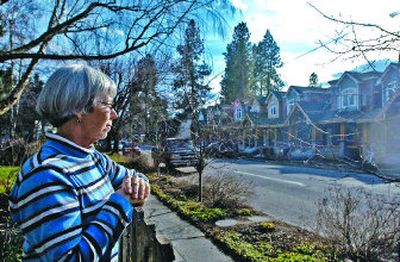
Three years ago, Joe and Lynn Morris bought a vintage, cottage-style home in one of Coeur d’Alene’s older neighborhoods. The couple – baby boomers in their downsizing years – knew they were moving into an area on the cusp of change.
All around their Mullan Avenue neighborhood, people were buying older homes and fixing them up. Rising property values, the couple realized, would eventually lead to a new housing development on the trailer court across the street.
Within a year, the trailers were razed to make way for 24 row houses. The Morrises co-exist peacefully with the Craftsman-inspired development – although “we lost our view of Tubbs Hill and 45 minutes of sunlight,” Joe Morris said. But they and the neighbors have fought three other projects.
On Tuesday, the group will ask Coeur d’Alene’s Planning Commission to reconsider aspects of its housing infill ordinance, designed to encourage dense residential development in the city’s older residential neighborhoods.
“We’re not against multifamily housing,” said Morris, acting president of the East Mullan Historic Neighborhood Association. “But it should be done in a style that fits the neighborhood.”
Their request comes amid developers’ growing interest in Coeur d’Alene’s older residential areas. Empty lots and older homes are starting to get snapped up for new condos and apartments.
Welcomed in some blighted areas, the redevelopment has raised concerns in others. The East Mullan neighborhood is an area of mostly single-family homes built in the early 1900s. Thirty-five families have joined the neighborhood association, citing concerns about the long-term impacts of pricey condos replacing the area’s affordable housing.
“The unforeseen consequences of the changes occurring in Coeur d’Alene, partially facilitated by the infill designation … will be that in five years, no child will live within a mile of the new library and kids will need to be bused to Sorenson Elementary School for it to remain open,” Morris, who is CEO of Kootenai Medical Center, wrote in a letter to the Planning Commission.
But Dennis Cunningham, a developer who owns a half-dozen lots in the East Mullan area, said it’s too soon to make sweeping judgments about the infill ordinance.
“We haven’t had it in place long enough to test it,” he said. “Let’s let the thing have some life and some more projects before we make a decision.”
The infill ordinance was adopted in late 2004 with the goal of spurring new housing downtown.
Nationally, interest in downtown living is on the upswing. People want to be near shopping, restaurants and recreation. The trend, local officials figured, could help strengthen Coeur d’Alene’s central business district.
A goal of 100 new housing units was set by Coeur d’Alene’s urban renewal agency. In addition to encouraging redevelopment, the infill ordinance was designed to ensure that the new units blended gracefully into established neighborhoods, said Dave Yadon, the city’s planning director.
Many of the areas are already zoned for condos and apartments, he noted. When developers preserve large trees, enhance alleyways, build underground parking or include other amenities the city wants to encourage, they get credits that allow them to increase the number of units on the lot.
“We were trying to avoid buildings plopped into a sea of asphalt,” he said. “It’s a carrot approach to getting projects like the Ice Plant.”
The 24 row houses – known as the “Ice Plant Townhouses” – were one of the first infill projects. Developers David and Susan Schreiber waited for the ordinance to pass before they started construction. Past zoning allowed 15 units on the 1.3-acre parcel. By adding details such as brick facades, front porches and parking in the rear, the Schreibers were able to increase the number to 24.
About half of the two- and three-bedroom row houses have sold for prices ranging from $279,000 to $439,000. The buyers are mostly empty-nesters, though some young professionals have also expressed interest, David Schreiber said.
The Ice Plant, which occupies its own block, generated little controversy. But neighbors weighed in heavily on the nearby Trail’s Edge condo project. Most opposed the developer’s request for a 3-foot variance to the height limit.
Same when Dr. Tom Walsh wanted to replace the 1910 home on Sherman Avenue that he uses for an oral surgery office with a multistory office/condo structure.
In an application for a height variance, Walsh said building up would allow him to keep a narrower construction footprint, preserving more of the older trees on the property.
Nearby residents flooded the Planning Department with objections. The 80-foot-plus building, with its glass-and-concrete design, simply didn’t fit the architectural character of the neighborhood, they said. Adjacent homeowners said they didn’t want the shade from the tower, or the loss of privacy in their backyards.
Neighbors also turned out en masse when the owners of Shady Pines Apartments on the northeast corner of Eighth and Mullan applied for a rezone. If granted, the rezone would have allowed them to build a structure up to 200 feet tall on the site.
Trail’s Edge condos received a 2-foot height variance. The other proposals were turned down.
After fighting three height variances in two months, Morris said the neighborhood association decided it was time to ask for changes to the infill ordinance.
The requested changes are specific to the city’s downtown east infill area, which encompasses the East Mullan neighborhood. Association members are asking for stricter architectural design controls, so the new construction retains the character of older homes. They also want building height limits dropped from 38 feet to 32 feet and setbacks to ensure that condos aren’t butting up against single-family homes.
The neighbors should have a voice in how the area changes, said Dwight Bershaw, an association member.
Bershaw and his wife, Ali, bought a house on Front Avenue eight years ago. Their Realtor tried to steer them to subdivisions, but a tract home on the prairie didn’t fit the couple’s lifestyle or ethics, Dwight Bershaw said.
“I have reservations about suburban sprawl,” said Bershaw, a landscape architect. The couple wanted to raise their children in an area where the family could walk to the lake and run errands without hopping into the car.
“We’re not trying to be negative,” Bershaw said. “We’d like to see downtown continue to develop in a positive way.”
Cunningham, the developer, expressed similar sentiments. “I like downtown because of its assets. You’ve got the park, Tubbs Hill, the beach and the water, the post office and the new library,” he said. That’s precisely why more people want to move downtown and why developers are planning housing projects, he said.
Cunningham and a business partner recently submitted a project review application to the city for “Mullan Cottages” – a cluster of four houses with a courtyard on a 7,700-square-foot lot. He envisions replicating the project elsewhere in the infill district.
Mary Jo Brooks lives next to an empty lot on Bancroft Avenue that sold for $200,000. She said she’s had several offers from developers who want to buy her house and tear it down for a larger development.
“I like my house,” said Brooks, who built it in the 1980s with a covered porch to match older homes in the neighborhood. “I want to continue living there.”
The Planning Commission can consider changes to infill ordinance, but they can’t keep property values from rising, noted John Bruning, the commission’s chairman. Along Front and Mullan avenues, the land underneath some of the older houses has become more valuable than the homes themselves.
“We can’t stop people from buying those lots and tearing down the older homes,” Bruning said.