
Insurers’ profits raise a storm
NEW YORK — The headline numbers were eye-popping: Allstate reported a record $5 billion profit for 2006. State Farm Insurance’s profit climbed 65 percent for the year. St. Paul Travelers’ earnings rose sixfold in the fourth quarter. American International Group’s rose eightfold.
A year and a half after Hurricane Katrina devastated the Gulf Coast, profits at the nation’s major property-casualty insurance companies soared — and are expected to be strong again in 2007, according to estimates by the A.M. Best Co. rating agency.
Critics charge that the insurers are doing well financially by shorting the people who bought their products — including hundreds of consumers who still haven’t gotten settlements for their Katrina claims. The industry, in turn, denies taking advantage of consumers, crediting its growing profitability instead to fewer storms last year and improved business procedures.
One of the harshest critics, J. Robert Hunter, director of insurance for the nonprofit Consumer Federation of America in Washington, D.C., accuses the nation’s insurers of using Katrina and other major hurricanes to try to justify “overpricing insurance, underpaying claims and reaping unjustified profits” at the expense of homeowners and business owners.
Hunter, a former Texas state insurance commissioner, added that he expects the industry to continue to do exceptionally well because it is pushing more risk and more cost onto policyholders.
“They’re making homeowners and business owners take on more of the risk through high deductibles, caps on replacement costs and other limitations,” he said. “And they’re refusing to renew tens of thousands of homeowner and business property policies, especially along the coasts.”
Hunter argues that state regulators “have not done the job to control excessive prices” charged by the insurers.
For consumers, the situation is both frustrating and financially burdensome.
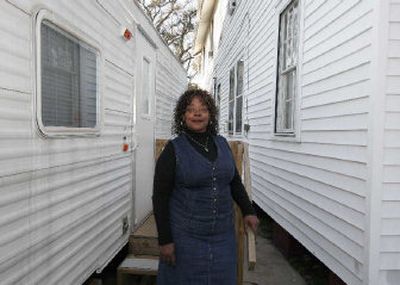
Joyce Ridgeway, whose four-family house in the Esplanade Ridge neighborhood of New Orleans was damaged when Katrina hit in August 2005, is still waiting for a final settlement from British-based insurer Lloyd’s. She’s so far received just $30,000 toward the $85,000 needed to cover alternative living expenses and to repair the roof, gutters and wood siding wrecked by the storm.
Ridgeway, a 52-year-old public health worker, is frustrated that she’s still living on the property in a trailer provided by the Federal Emergency Management Agency. Tenants are back in just two of the units.
“I’ve been doing bits and pieces as I can to get repairs done,” she said. “I took my savings, I take my paychecks — and I have a good contractor who is working with me.”
But, she added, “I’ve waited so long. It just doesn’t seem fair.”
A Lloyd’s spokesman said that if a claim couldn’t be resolved locally, it could be referred to the company’s dispute resolution department. He added: “We have not received any formal complaint on this matter so are unable to comment any further.”
Industry experts argue that the property-casualty insurers did amazingly well in handling Katrina — the most costly catastrophic event ever in the United States — and the other hurricanes in 2004 and 2005.
Robert Hartwig, president and chief economist with the New York-based Insurance Information Institute, points out that the industry has so far “paid $41 billion on 1.74 million claims for Katrina alone — and for the combined 2004-2005 hurricane season, we paid about $81 billion in insured hurricane-related losses.”
The industry’s profits rose in 2006 in part because there were far fewer storms, Hartwig said.
He added: “But the good results have more to do with fact that insurers saw good results in auto insurance, workers comp and a variety of other areas and in states that don’t have a coastline.”