
A group approach to growth issues
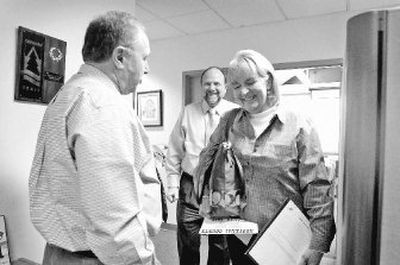
Huckleberries and beauty attracted Bev Twillmann to North Idaho four years ago.
Now her retirement has taken a different course, one of late-night meetings and poring through binders of sewer plans, road alignments and wetland reports.
As the face of Neighbors for Responsible Growth, a watchdog group that wants to preserve Kootenai County’s rural areas, Twillmann has become a familiar presence at Kootenai County Commission meetings. Her name is often in the newspapers, enough that grocery store clerks ask if she’s “that woman.”
Her advocacy has become so consuming she rarely has time to search for those elusive mountain berries.
“This is taking up my huckleberry time, my ATV time, retirement,” said Twillmann, a professional storyteller and former teacher who grew up in the Midwest and moved to Kootenai County from Knoxville, Tenn.
Twillmann and husband, Norb, initially considered moving to Montana, but traffic in the Bitterroot Valley discouraged them. They checked out Coeur d’Alene and found their 70 acres of meadows and trees with an expansive view of Lake Coeur d’Alene’s Carlin Bay. They liked the privacy and quiet, the monthly neighborhood potlucks and the old-fashioned feel of nearby Harrison, where the town shuts down the state highway for parades on main street.
The Twillmanns still love those things but feel they must fight to keep them from being lost to endless housing developments and golf courses. The goal of preserving the North Idaho rural lifestyle is worth all the hours and money, they say. “I’m willing to give my time and life to a community if it’s helping people,” Bev Twillmann said.
She isn’t alone. In fact, Twillmann is leery of being singled out as a leader in the explosion of neighborhood groups spreading across the county, as more and more developments are proposed in rural areas. The groups don’t unilaterally oppose growth. They advocate for projects that preserve large chunks of farmland and timberland and oppose putting hundreds of homes in remote areas with no services. They also don’t appreciate developers who ask the county for exceptions to land-use rules.
Twillmann gets the majority of attention because she’s the de facto spokeswoman. With that comes personal attacks, name-calling and attempts by the group’s detractors to discount her reputation.
Twillmann admits it’s often frustrating and uncomfortable. On this day, she wore a turtle necklace and used the analogy that a turtle must stick its neck out to move forward.
The real power of Neighbors for Responsible Growth, she said, is the dozens of other people who work behind the scenes spending countless hours researching laws and rules.
The group’s motto is to present facts, not emotion. Twillmann said that’s been a lot more successful because it gives the county commissioners – the ultimate decision-makers – the information needed to make good choices about how the area should grow.
“This isn’t about Bev Twillmann,” she said at her home, occasionally interrupting herself to point out an eagle soaring over the lake. “This is about the cause.”
Groups blossom
And it’s not just the residents living on the east side of Lake Coeur d’Alene. There are small groups across Kootenai County concerned about development – from Mica Bay to Bayview and nearly every nook in between. The trend started about 2003, the height of the county’s growth boom.
All the group leaders share the same passion as Twillmann and have given up other joys to become activists. Like Twillmann, they argue the result is worth the work, even though they too must deflect personal attacks.
Jai Nelson, of Coalition for Positive Rural Impact at Rockford Bay and Loffs Bay, got her start opposing the expansion of Black Rock, Kootenai County’s original gated luxury golf retreat. The Kootenai County native is a single mother and registered nurse who owns an interior design business. Instead of recreating and spending more time with her 7-year-old son, Nelson is busy protesting applications for developers to pump more water out of Lake Coeur d’Alene. She’s also concerned about water quality.
Nelson, who interrupted a mini-vacation at a Montana hot spring to talk about her involvement, said as a native she doesn’t receive as much criticism as newcomers like Twillmann. She said that’s unfair because many of the transplants have seen other areas destroyed or at least forever changed by rapid, uncontrolled growth, and they bring the benefit of hindsight and perspective.
Bob Gustafson is the organizer of the latest watchdog group, United Citizens for Responsible Growth. It includes members from almost all of the smaller neighborhood groups across the county. The idea is to take their collective experience and help other residents interested in protecting their neighborhood by offering an educational clearinghouse on how to navigate land-use issues.
Gustafson retired from a career in computers. In 2000, he moved to five acres off Nunn Road in the northern part of the county to build a home with his wife. The couple has owned property in Kootenai County for 30 years and lived in Moscow and Spokane.
The catalyst for his involvement was a proposal to transform the old Rickel Ranch into a town with hundreds of homes near Silverwood Theme Park. Now he sees a broader need in the county: for residents to continue the conversation about how to grow.
“We plan on being effective long-term,” said Gustafson, who said he would spend more time finishing his house and hiking if his activism hadn’t become a part-time job.
Developers respond
All this interest by the so-called neighborhood groups has sparked the creation of another coalition. This one includes developers, builders, real estate agents and other residents who often have a different take on growth and development.
Former Kootenai County Planning Director Rand Wichman, who now has a private land-use consulting business, helped bring the new coalition together. In its infancy, the group has met for two weeks but doesn’t yet have a name, board of directors or mission statement.
“We’ve already been painted as a pro-growth group, but I don’t know if that necessarily will be the case,” Wichman said.
He said the idea is to present information to the county commission and spark dialogue, much like the neighborhood groups wish to do.
Newly-elected Commissioner Todd Tondee said all the groups are welcome. He thinks the neighborhood coalitions have matured and are doing a better job of presenting facts instead of raw emotion.
“The more input we get, a better decision that’s made,” Tondee said.
The neighborhood groups were active in last year’s commission election that resulted in two ousted commissioners, opening the door for Tondee and Commissioner Rich Piazza. The groups take credit for the change.
Tondee said it’s tough to say exactly who had the most impact on the election. He likes to believe that residents as a whole were tired of former commissioners who didn’t listen to the people. The new commission’s goal is to make sure people are heard and treated fairly, not give any one group more say, he said.
“I think if people are treated fairly and heard they can better swallow whatever the decision is,” Tondee said.
Wichman declined to give specifics about his new group until the details are solid. But the idea blossomed after Twillmann’s group raised the ire of developers earlier this month by proposing a one-year building moratorium along the state Highway 97 corridor along the east side of Lake Coeur d’Alene.
Within days, the county commission quashed the idea and declined to discuss it or have a public meeting. Officials said a moratorium isn’t the solution and could ultimately hurt the economy.
Twillmann attributes the commission’s decision to pressure from developers.
Private concerns
The move also brought attention to Twillmann’s own property and dealings with the county’s Planning and Building Department.
The day she proposed the moratorium, sources who didn’t want their identities revealed began tipping off local reporters that the county in November 2004 ordered the Twillmanns to stop work on the construction of their driveway because of erosion problems. The callers also highlighted that the Twillmanns had divided their property into four lots.
County site disturbance records confirm that work was stopped for three days but don’t specify the problem.
Twillmann characterized the revelation as an attack and said she has nothing to hide. She said her initial concerns with how the county handled development was sparked by that very situation.
Norb Twillmann wrote the county a letter at the time saying the treatment they received bordered on “harassment” because they were never told what was wrong with the project.
The couple consulted an attorney, then hired Cheri Howell, the current interim county planning director. Back then, Howell was doing private land-use consulting work.
County Planner Sandy Young inspected the driveway and issued the stop work order. Young said Thursday that the steep hillside driveway had erosion problems that sent sediment into a ditch and ultimately into the lake. She added that it’s not uncommon to have such problems with those types of driveways.
Howell said the problem was corrected immediately. Twillmann said Young never told them of the erosion problems and she still believes nothing was wrong with the road. That’s why the red tag was lifted so quickly.
Games and scare tactics, Twillmann said, won’t slow her or the others residents; it ignites their fire.
“People don’t realize we are trading off our future,” she said.