
John Blanchette: Campbell ready to be No. 2
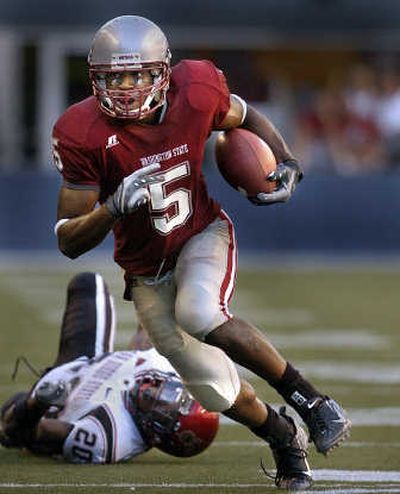
For a football season of such modest achievement, a fair amount of Wite-Out has been applied to the Washington State record book.
The next name to go under the goop: Hugh Campbell.
Sometime tonight against California, presumably – or certainly next Saturday – Michael Bumpus will catch a pass that will nudge Campbell back to No. 2 on the Cougars’ career receptions list. The noteworthiness here is that it is the last of Campbell’s major receiving records at Wazzu, so you’d think there might be a twinge of regret when it happens.
“No, I think I can cope with that,” he laughed.
Well, he has had 45 years to get used to the idea.
Call it just one more reminder of how special Campbell was, in his time or any. None of the various career marks in WSU’s record book had near the durability of Gluey Hughie’s receiving standards. It was only last year that Jason Hill picked off the yardage record, and the year before that he passed Campbell on the touchdown list. And, of course, there’s the fact that Campbell’s 176 receptions, 2,452 yards and 22 TDs were amassed in three varsity seasons from 1960 to 1962, the limit in those years.
“Michael’s worthy and I’m happy for him,” Campbell said, “but I have to admit I think his record will get broken quicker.”
Since the Cougars have been married to a spread passing attack of some kind since 1987, that’s altogether likely. But there wasn’t anything likely about Campbell or the Cougars attack that coach Jim Sutherland concocted in an era when running two sweeps in a row passed for innovation.
It wasn’t just that Sutherland had the Cougars throw the ball – though doing it upward of 25 times a game was considered not ahead of its time, but sacrilege. It’s that he offered his pitchers and catchers unprecedented improvisational latitude that only in recent decades has become acceptable.
That is, he offered it to Campbell. Sutherland had already developed some exceptional receivers – Bill Steiger, Don Ellingsen, Jack Fanning and, of course, Gail Cogdill. But in 1960, a former high school quarterback whose job it had been to hand off in an Oklahoma-style offense turned Cougars football upside down.
Campbell caught 66 passes that year – exactly half the number quarterback Mel Melin and triple-threat halfback Keith Lincoln completed. Ten went for touchdowns – another mark that wouldn’t fall for 37 years.
“As I got older, I was given more freedom in finding an open area,” he said. “They’d call a route, but I could adjust it based on the defense. We would have never suggested it at the time, but that was the start of receivers reading the defense and adjusting their routes – which is now commonplace.
“I’m sure it would seem very primitive now – I know it is. But one of our plays by the time I was a senior just called for me to get open – and if you knew Coach Sutherland, you’d believe it. He was different than most. He’d call that, (quarterback) Dave Mathieson would call a certain type of blocking and that would tell me whether I would have time to go 5 yards or 15 yards.”
Campbell’s skills won an unlikely convert. Two years after he graduated and during his off-season from the Canadian Football League’s Saskatchewan Roughriders, Campbell was hired by Washington coach Jim Owens – whose passing game was token, to be sure – to tutor receivers during spring drills, in particular Dave Williams, who would go on to play seven NFL seasons.
“That’s when I really started thinking about coaching,” said Campbell – who would get his true start reviving football at Whitworth over the course of seven years (“a great job,” he said, “if I could have afforded to raise four kids on that salary”) and go on to win five Grey Cups as head coach of the Edmonton Eskimos, followed by jobs in both the NFL and USFL.
And still one of his favorite coaching memories was a game that didn’t count.
The Cougs of Sutherland and Bert Clark’s era had erratic success – aside from the Cardiac Kids of 1965. But they were still peopled by a surprising number of accomplished players – Cogdill, Campbell, Lincoln, CFL rushing great George Reed and San Diego Chargers defensive back Kenny Graham among them. In the spring of 1967, Campbell was asked to put together an alumni team to play the varsity at Albi Stadium in Spokane.
“I said, ‘Give me a $10,000 travel budget and I’ll get everybody,’ ” Campbell recalled. “And I did. Almost every guy we started on defense was playing in the NFL or CFL, and we had Keith and Larry Eilmes and Mel Melin, who were pros, in the backfield.
“We drew 18,000 people, I think. One of our conditions is that we wouldn’t do special teams, so they did special teams against backups and ran back two punts.”
The alums lost 16-15, and blamed it on the fact that they’d been working out for four days – and working out on the town for four nights.
That one’s not in the record book, although it probably should be.