
Sunni leader allied with U.S. killed in explosion
BAGHDAD – A charismatic tribal leader who allied himself with the United States and rallied fractious Sunni groups against extremists who claim links to al-Qaida was killed Thursday when a bomb exploded outside his house in Anbar province.
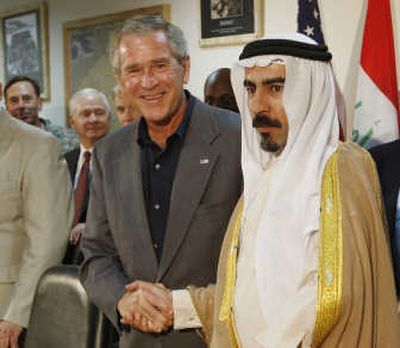
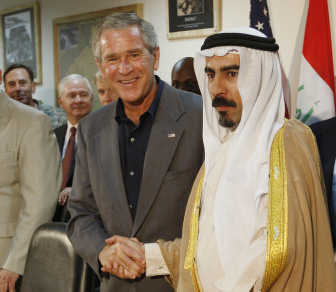
The efforts of Abdul-Sattar Abu Risha became the centerpiece of the Bush administration’s campaign to prove its troop buildup in Iraq has been a success. President Bush, during a visit to Anbar last week, met with Abu Risha and said the province suggested “what the future of Iraq can look like.”
Abu Risha was regarded by Americans as a rare leader willing to stand defiantly alongside U.S. forces, while able to both cajole and intimidate his fellow Sunnis into agreement.
His Anbar Salvation Council organized tribal rivals into local defense forces united against the Sunni insurgent group al-Qaida in Iraq, making the province less violent and encouraging U.S. commanders to promote similar efforts in other parts of the country.
At a time when Iraqi leaders have been all but unable to achieve political progress, U.S. officials saw the council as a sign that Sunnis could be persuaded to work with the government.
Abu Risha’s death “is a tragic loss,” said Gen. David Petraeus, the top U.S. commander in Iraq, during a meeting with Washington Post reporters and editors in Washington. “It’s a terrible loss for Anbar province and all of Iraq. It shows how significant his importance was and it shows al-Qaida in Iraq remains a very dangerous and barbaric enemy.”
The vast western desert of Anbar province stretches from Baghdad to the Jordanian border and has been a stronghold of the Sunni insurgency and al-Qaida in Iraq. The predominantly Sunni population makes it unique in Iraq, a factor that some believe makes its tribal alliance difficult to replicate elsewhere.
Abu Risha’s public profile made him an obvious target. He had survived assassination attempts before Thursday’s attack, which came on the first day of the Muslim holy month of Ramadan and one day shy of the first anniversary of the council.
The explosion occurred about 3 p.m., apparently from a buried bomb, while Abu Risha was talking on his cell phone behind his house in the provincial capital, Ramadi, according to U.S. military officials and tribal colleagues. Two bodyguards and another man were also killed, police said. A spokesman for the Interior Ministry said a car bomb also detonated in the area.