
Mine work moves ahead
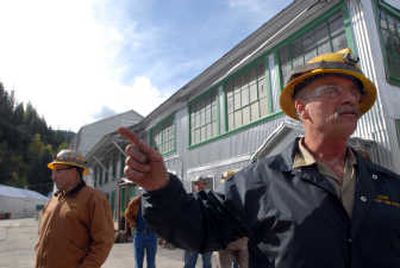
BIG CREEK, Idaho – The Sunshine Mine bustled with activity Saturday morning, a forerunner of things to come.
Accompanied by the rumble of heavy equipment, men in hard hats scurried back and forth across the mine’s “Main Street,” a cement courtyard that leads to the portal, hoist room, maintenance shop and employee lockers.
Come December, “you won’t be able to stand at the bottom of that stairway at shift change,” predicted Mike McLean, the Sunshine’s general manager. “You’d get run over by people heading out to their cars.”
Sterling Mining Co. anticipates reopening the Sunshine Mine in December with a staff of 125. It’s a second chapter for the underground silver mine, which closed in 2001 amid the financial troubles of a previous operator.
“You don’t often have a historic mine brought back to life,” said Ray De Motte, Sterling’s president. “A lot of the miners here have a lot of emotion for this mine. When the Sunshine closed, they thought they’d never work here again.”
First staked in 1884 by two bachelor brothers who homesteaded in Big Creek, the Sunshine Mine is a storied part of Idaho history. The mine produced more than 360 million ounces of silver, making it one of the U.S.’s richest silver mines. It was also the site of one of the nation’s worst hard-rock mining disasters, when 91 men perished in the 1972 Sunshine Mine fire.
By 2001, however, the Sunshine appeared played out. Silver was trading at a low of $4.25 per ounce. The operator, Sunshine Mining and Refining Co., had lost money on the mine for years and couldn’t extend its credit line.
McLean was one of the 130 Sunshine employees who lost their jobs when the mine closed. He worked for a manufacturing firm in Coeur d’Alene for three years before being hired by the new owners.
“I wanted to see it back in production,” McLean said. “We didn’t close for lack of ore. There were other company circumstances that we here had no control over.”
De Motte is the force behind the Sunshine’s comeback, a $15 million endeavor for Sterling Mining Co. A burly man who favors Marlboros, De Motte was born into a coal mining family in Newcastle, England, and immigrated to the United States as a kid. He spent 25 years in finance and accounting, some of it with Bechtel Engineering, planning nuclear power plants.
De Motte moved to North Idaho from California in 1998. A longtime investor in mining stocks, he took over Sterling Mining, then an inactive penny stock. Under De Motte’s direction, the firm began amassing mining claims in Idaho’s Silver Valley.
In 2003, Sterling gained control of the Sunshine Mine by paying the mine’s back taxes. The company leases the property from Sunshine Precious Metals Co., with an option to buy the mine.
Silver is currently trading around $13 per ounce, making mining more profitable than it was in 2001. De Motte said he’s also attracted to the idea of helping revive one of North Idaho’s original industries.
“The coal mines closed in England under Margaret Thatcher,” he said. “The Silver Valley, when I first saw it, was very poor and depressed. It reminded me of home. You change the accents of some of these men, and they could be my uncles.”
But not everyone applauds De Motte’s management style. A former investor sued the company in 2005, accusing De Motte of fraudulent business practices. Efforts to reach a mediated settlement failed this summer. A trial is scheduled for next year.
De Motte said his record speaks for itself, noting that during his tenure, Sterling’s stock price has risen from 25 cents per share to $4 per share.
“I think that’s a reasonable return for a long-term investment,” De Motte said.
Over the past four years, Sterling has worked quietly and methodically to lay the foundation for long-term operations at the Sunshine, he said.
The company pumped water out of the mine’s lower levels, purchased a new fleet of diesel vehicles, and completed a study of the mine’s silver reserves. In July, the firm applied for a federal permit to discharge wastewater into the South Fork of the Coeur d’Alene River.
Sterling hopes to reopen the Sunshine under an old discharge permit while the new permit is pending. The Environmental Protection Agency will review the request this fall and make a decision, said Mike Lidgard, a permit administrator for the EPA in Seattle.
Steven Gravelle, an electrician, said he’s glad to be back at the Sunshine. He started working at the mine in 1968, shortly after he graduated from high school.
“I had been working for the railroad. We were over in Butte, Montana, and it was 51 degrees below zero. That was the day I quit,” Gravelle said. “I came here to winter over. It turned out to be a long winter – 35 years,” he said.