
Ford’s big bet
Automaker says it doesn’t need bailout money, believes its strategies set it apart from GM, Chrysler
A decision Ford Motor Co. CEO Alan Mulally made during his first months on the job may turn out to be the automaker’s saving grace. In 2006, the chief executive, fresh from Boeing Co., wanted to concentrate on making smaller, more fuel-efficient cars, matching production with consumer demand, and focusing on the Ford, Lincoln and Mercury brands.
The company has announced the closure of 17 factories and eliminated 50,000 jobs since its latest restructuring started in 2005, many through buyout and early retirement offers. It sold non-Ford brands Jaguar, Land Rover and Aston Martin and is studying the sale of Sweden’s Volvo. Smaller cars produced by its European unit are coming to the U.S. starting in 2010.
But to fulfill that vision for the company, Mulally needed at least $17 billion. He took his plan – one very similar to the one Ford submitted to Congress last week – to 40 banks at a time when credit flowed freely, and he ended up raising $23.5 billion. He bet all of Ford’s buildings, stock, intellectual property, stakes in foreign automakers, and even its trademark blue logo as collateral.
“At the time people were wondering if we were being too aggressive to leverage assets,” Mulally said in an interview. “I erred on the side of being conservative on financing.”
The move to secure credit proved to be key to Ford’s assertion that it doesn’t need an emergency loan from Congress now like General Motors Corp. and Chrysler LLC do. While the company boasts how its fleet and future vehicles set it apart from its Detroit competitors, its ability to maintain operations through 2009 without government aid is a key differentiator.
The company had $18.9 billion in cash on hand on Sept. 30 and still had about $10.7 billion of its credit lines available.
Yet Ford could be standing on a melting iceberg. The company spent $7.7 billion more than it took in the third quarter as U.S. auto sales fell, reaching an annualized sales rate of 10 million in November, the lowest level since October 1982.
Should industrywide U.S. auto sales drop to new lows in 2009, Ford says it would need to come to the government for help. In the plan it submitted to Congress last week, it asked for access to a $9 billion line of credit just in case.
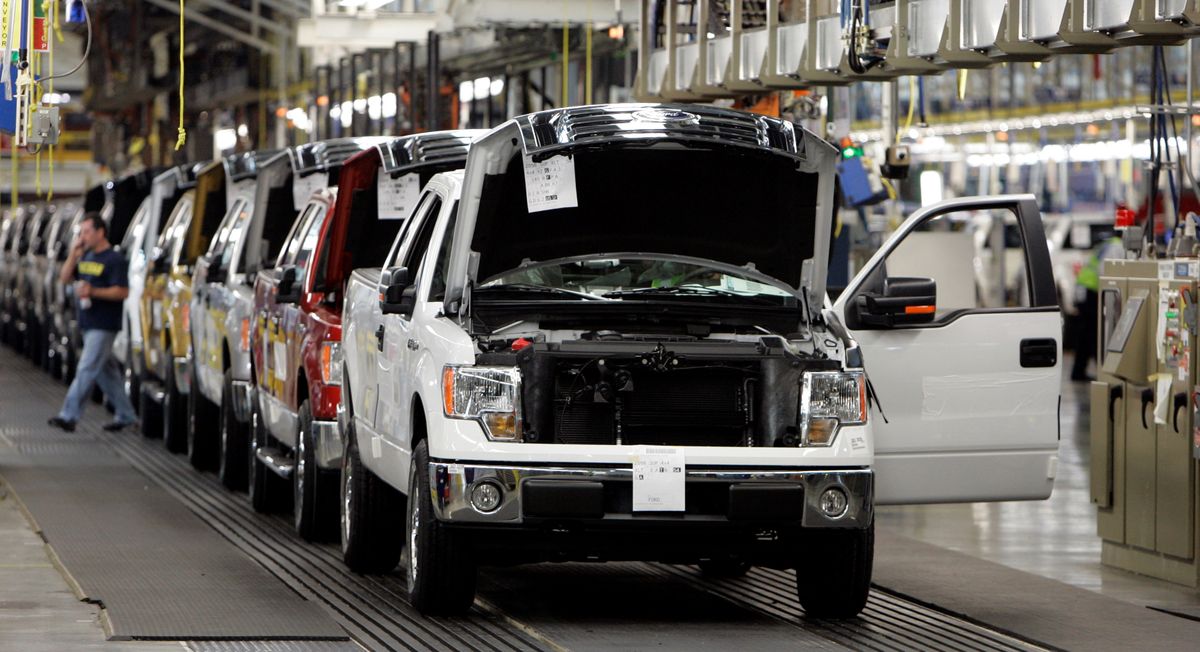
Ford’s F-series pickup trucks are still the best-selling vehicles in the U.S. But the company needed to slim down from its steady truck and SUV diet, as $4 gas scared consumers away from the vehicles.
The company announced plans in July to transform three North American truck plants to make small, fuel-efficient cars that it already sells in Europe. A plant in Wayne, Mich., that made Lincoln Navigator and Ford Expedition SUVs will start churning out Ford Focus compacts in 2010.
The company’s goal is to take leadership in fuel economy with direct-injection turbocharged engines, new hybrid gas-electric powertrains and eventually electric vehicles. Competitors, including Chrysler, GM, Toyota Motor Corp. and Honda Motor Co., have or are working on similar technologies.
Besides upgrades of the conventional models, Ford rolled out new versions of its Fusion and Milan sedans, including hybrid models, at the Los Angeles Auto Show last month with fuel economy that beats current offerings from Toyota and Honda.
“Longer term, it looks as if these are the right moves for Ford,” said Aaron Bragman, research analyst for automotive marketing for IHS Global Insight in Troy, Mich.
But in the short term, Ford needs U.S. consumers to regain confidence in the economy and return to showrooms, said Bragman, who thinks even a minor dip below next year’s expected sales level of 10.5 million to 11 million would force Ford to take government aid.
“It all depends on how spooked consumers are in 2009 to buy enough cars to keep them off the government dole,” he said.
If GM, Chrysler or both declare bankruptcy, it could drag down parts suppliers and force Ford into the same situation, Mulally said. Any long-term gains in market share would be overshadowed by short-term pain in a disrupted supply chain, and negative customer perception.
“I can’t predict the future, and this thing might degrade further. Even Ford with its dynamite plan might have to need a small bridge loan,” Mulally said. “We don’t need it now.”
In that sense, Ford appeared to take a back seat at Congressional hearings in November, and it reiterated the changes it is already making when Mulally returned to Washington last week.
Mulally said his pilgrimages to Congress had little to do with Ford’s position, but more of a gesture to “stand tall” with the U.S. auto industry.
“I have a plan; it’s a solid plan. I have the money, but I’m there standing with the industry,” he said. “My competitors said they’re in dire financial straits. Having a bridge loan and keeping it going is right for the economy and right for the United States.”