
Selling gun much safer than firing it
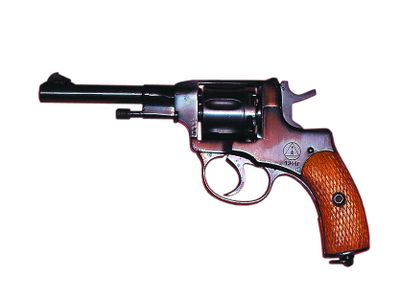
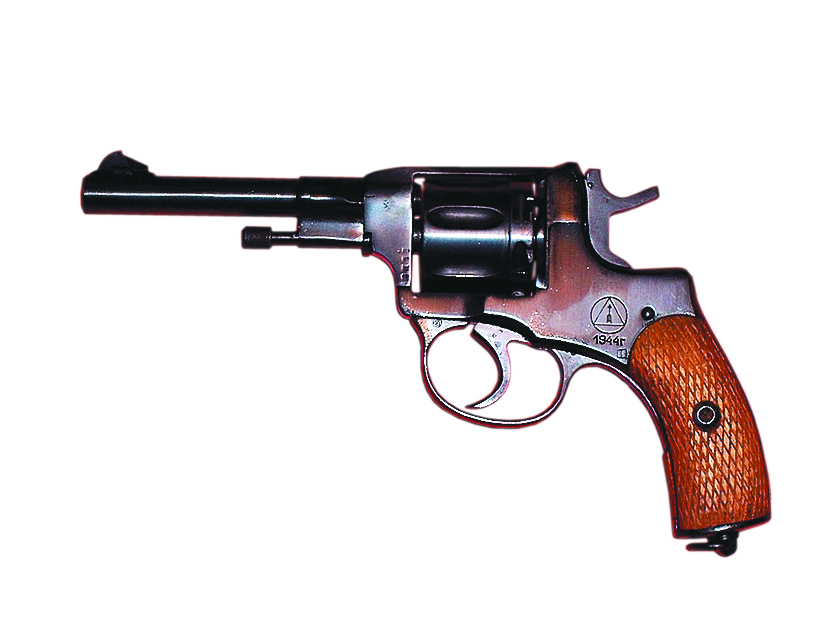
Dear Collector: We inherited this revolver from a relative who served in World War II. He may have gotten it in a trade with a Russian soldier, though we can’t confirm that, and since ammo’s not available we can’t even test fire it. What is it worth?
Because the photos you included were of such poor quality, I took a snapshot of my own M1895 for illustration. Since the fall of the Soviet Union, surplus military firearms have flooded markets worldwide. Unlike your pistol, mine had been sent to an arsenal for rework and storage before coming into my hands a few years ago. It’s difficult to reload due to poor design, but all in all, not a bad gun.
Your Nagant gas-seal 7.62x38 mm seven-shot pistol came from Tula, Russia’s giant arms-making center. I can’t put an exact date on it because I can’t read the serial number, but we know it’s vintage.
Ammunition is obtainable; you just have to know where to look. However, if you do intend to fire this gun, please have it checked out by a competent gunsmith first. Better to be safe than sorry.
Just a few years ago, this gun’s value would have been three to four times the current value of $70 to $90.
Dear Collector: We have a vase with this mark (one “W’ imposed on another), and want to know its age and value.
This interesting backstamp belonged to “Wiener Werkstatte,” which translates to Vienna Workshops, a porcelain maker who operated from 1905 to 1932. Your piece dates to the 1920s. Comparative value is a conservative $50 to $75.
Dear Collector: I have a 1969 set of U.S. coins sealed in plastic. Is this something issued by the Mint, or was it a hobbyist?
Since 1947, the Mint has produced a number of sets typically consisting of samples of each coin struck that year. Some sets offer uncirculated cash, while others consist of higher-grade coins such as mint or proof.
Your partial set (usually there are examples from two mints) would have sold for $2.50 when new and complete. There’s little value in an incomplete collection, probably $3.
Dear Collector: This Popeye/Wimpy glass belonged to my father. It’s dated 1936, but Dad was born in 1943, so it had a little age before it came into his hands. What might it be worth?
Wimpy (the “lend me a hamburger” guy) and Popeye were creations of cartoonist E.C. Seegar in 1929. Still around today, Popeye and pals feature in books, comics, videos and toys. Your father’s tumbler may be worth $100.
Dear Collector: I got this old electric clock at a yard sale more than 20 years ago. My question is, can you me its value and true age?
Research shows this Telechron wall clock was produced between 1952 and 1956. Described as the “Originality,” this model had a retail price of $8.95, and nearly one-half million units were made. Current value is listed at $40 to $50.
Recommended reading: “Doll Values: Antique to Modern,” Linda Edward (Collector Books, 2009, $16.95).