
Mamou knows Mardi Gras
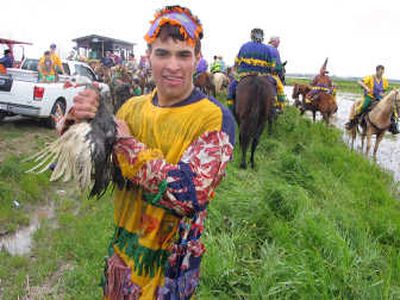
MAMOU, La. – The teenage boy is covered in mud, literally from head to toe. After wading through a flooded rice field to catch a wayward chicken, he wipes mud from his eyes.
“I almost had him,” he says to a friend with a shake of his head, and shrinks back to his horse.
Welcome to the home of the Cajun Mardi Gras, where men dance on horseback, chickens are their prey, and frivolity is the rule.
Mamou is a small town plopped in the middle of farming fields in the center of Cajun country, three hours northwest of the state’s most famous Mardi Gras reveling town, New Orleans.
There is one high school here, one stoplight and no Wal-Mart. The population of 3,500 is generally divided into halves – white or black, Baptist or Catholic, young and old.
Mamou – my hometown – has a few claims to fame. Fred’s Lounge, a bar in the center of town where Cajun musicians gather every Saturday morning for a live radio music show and dance, is one.
There’s also the annual Cajun Music Festival – a given for a town claiming to be the “Cajun Music Capital of the World.” It birthed Steve Riley and the Mamou Playboys, an internationally renowned Cajun music band that often returns home to play the street dance the night before Mardi Gras (which arrives early this year, on Tuesday).
But there is nothing more famous here than the Courir de Mardi Gras.
In the courir – which literally means “the run” – on Mardi Gras day, men dress in costume and ride horseback from home to home in the countryside, “collecting” ingredients for the town gumbo.
And by collecting, I mean chasing after live chickens and catching them with their bare hands.
The tradition started in the 1800s in rural south Louisiana, but was suspended during the Civil War and in World War II. It was revived in Mamou in the 1950s and is practiced in several other towns around the area.
Local historians say the rural run was a way for the community to share in a pre-Lenten celebration, especially when times were difficult and the ingredients for a large gumbo hard to come by.
It has evolved, however, into a sort of Cajun bar mitzvah. Teenage boys, usually around age 16, run the Mardi Gras as an informal entry into manhood.
While thousands of tourists flock to Mamou each year to enjoy the Cajun music and four-day festival in town, few venture out into the rural prairies to follow the Mardi Gras riders.
But they should – that is where the area’s truly unique traditions can be found.
The Courir sticks to old, some would say arcane, rules. It is all-male and unofficially segregated (there is an all-black Mardi Gras group that runs a different route on the same day), and requires all riders to be in costume.
When I went last year, I brought my boyfriend, my roommate and her boyfriend – Chicagoans who had never seen the festival – and convinced the men to ride.
We arrived at the meeting hall just about 7 a.m. and joined a line of men and teenage boys, all bleary-eyed and anxious. Some had not slept at all since the previous night’s fais-do-do, or street dance.
Most were dressed in the traditional Mamou Mardi Gras costume – colorful, long-sleeved shirts and pants, accented in fabric fringes, with required masks. Some were wearing the capuchon as well, a tall, pointed, dunce-like cap decorated to match their costumes.
One teen, upon finding out that he must have a hat, ran outside to grab an empty Miller Lite box and placed it on his head.
Before they can ride, their costumes are inspected by the capitaines, men who have run the Mardi Gras for many years and serve as the chaperons for the day. The capitaines do not drink and are not masked, though they wear purple, green and gold capes, the colors of Mardi Gras.
The riders pay $25 and sign a liability waiver, which reads, in part, that they are aware there will be large animals involved in the day’s events, and they will not sue for any injuries they might incur.
After a large crowd of riders gathered, a capitaine asked if I was signing up a rider (parents can register their underage teens).
When I said I was not, I was promptly told to leave the room. “No women allowed,” he bellowed with a snicker.
The doors closed, and the riders were given a few rules, which my friends divulged later in the day: no talking to women (“This is a man’s day!”), and no knives. That’s it.
The riders tumbled out of the meeting hall and onto their horses. As they had no horses, my friends climbed onto the back of the “drunk wagon,” one of three open-air trailers for Mardi Gras riders who can’t ride their horses any longer.
In the front of the parade, on a partially enclosed wagon, the band began to tune up. This collection of local men follows the Mardi Gras riders all day, playing Cajun music tunes including the traditional “Mardi Gras Song.”
It’s a beautiful, haunting Cajun French tune played so often during the day that every participant, and every local, knows at least some, if not all, of the words.
The capitaines led the way, starting a parade through town past locals who waved at the departing riders.
There is only one stop within city limits: a short show of sorts at the hospital’s nursing home. Then it was on to the outskirts of town, to the field next to the Piggly Wiggly, where the riders disembarked for the first real run of the day.
The tradition calls for the owner of the home or property to “receive” the riders. First, the capitaines approach and ask permission, usually in French, for the riders to run. If the property is large, the capitaines will wave white flags to the horse riders, who charge onto the property and perform for the residents.
They dance on their horses, do headstands and generally act like buffoons. They also grab women and young girls to dance a two-step. The traveling band plays and sings.
Then, the owner stands atop something to throw the chickens.
The riders are competitive, and run full-speed after the chickens, which they grab mostly by landing on top of them. Caught chickens are handed to the capitaines, who keep score for awards given at the end of the day.
One absolute rule is observed: No chicken is allowed to get away.
At one of the first stops on the route, a chicken somehow dashed into a ditch culvert, and the riders scrambled into it as far as their bodies would go. Two other riders walked on top of the culvert. Minutes later, they returned, hooting, chicken in hand.
Behind the Mardi Gras riders, locals and tourists follow along in a parade of trucks and trailers, equipped with beer coolers and grills. One enterprising group of LSU students even had a port-a-potty.
My roommate and I followed in our rented truck, fortified with a few cans of beer and boudin, a spicy Cajun sausage stuffed with rice and pork.
My boyfriend did not take well to chasing the chickens. I watched as he stood on the sidelines, beer in hand, watching the other men and teens jump in puddles and ditches, fall over the chickens and toss them in the air.
At a lunchtime break of beer and boudin halfway through the route, he told me he felt bad for the animals, and decided to root for them. He winced as he told me he watched one man bite the head off a chicken, unsure if it was dead or alive.
I could understand his reticence. For outsiders, it might be a strange, perhaps even uncouth tradition.
But it is also an integral part of the community here. It is a rite of passage, a day of celebration of Cajun culture, food and music. It’s also one last gasp of fun before the restrictions of Lent set in.
By day’s end, even my boyfriend was won over. He marveled at the friendliness of his fellow riders, at the fortitude of their hard-drinking souls and began to cheer for a young rider whose skills won him a number of chickens. Once, he even chased after a chicken, if only for a short run.
A little after 4 p.m., after miles of riding and one injury (a horse riled up and dropped a rider on his head), the Mardi Gras riders returned on horses and the drunk wagon to the center of town for a street dance.
Locals and tourists lined the sides of Sixth Street, cheering them on. They converged under the one stoplight in town, where the band played a few songs in their honor.
We left the party to go back to the hall where we started for bowls of gumbo. As we walked away, we heard the strains of the accordion and the cheers of the revelers as they danced once more, hours before the fasting of Lent would descend.