
Case courts big attention
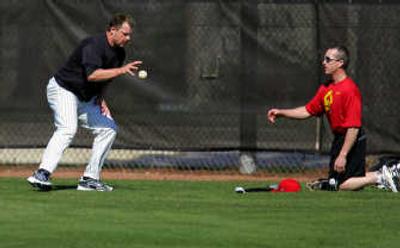
In terms of big-game strategy, star-power players and underdog surprises, the Roger Clemens-Brian McNamee showdown is at least as compelling as most of the winter’s sports fare. It’s also potentially a lot more revealing of Real Truth than, say, New York Knicks basketball or the Roady’s Humanitarian Bowl, now that Congress is calling for the pitcher and his former trainer to testify under oath this month.
What so far has been going on, legal experts agree, is a public relations campaign evolving into a get-out-the-vote effort. Tonight’s “60 Minutes” CBS ratings-grab is intended by Clemens to serve his late-developing denial tour – attempting to discredit the month-old Mitchell Report on steroids in baseball, as well as accuser McNamee – but there is growing evidence that citizens already are caucusing in overwhelming support of McNamee.
An unscientific America Online poll Friday found that more than 60 percent believe McNamee’s assertion that he injected Clemens with illegal performance-enhancing drugs more than a dozen times in a span of several years. Given that McNamee’s lawyer promised last week that a defamation suit will be triggered by any Clemens contentions that McNamee lied during the Mitchell investigation, there is widespread anticipation of dramatic developments to come.
“This,” said Willamette University College of Law professor Dean Richardson, “is great spectator sport.”
For now, the closest anyone will get to testifying under oath in the matter is when celebrity interviewer Mike Wallace counters Clemens’ steroid/HGH disavowals tonight with “Swear?” Richardson, who teaches a course in sports law, said he will be watching the taped interview “less for technical, legal distinctions; I’ll look for a sense of emotional attitude. Is he outraged? Is he calm? I’ll be looking for performance.”
Clemens and McNamee have made a show of hiring high-powered legal eagles, guaranteeing a fair amount of hectoring and obfuscating as the dispute plays out. Still, Columbus, Ohio, attorney Craig Calcaterra, who applies his lawyerly expertise and baseball passion to a blog called “ShysterBall” and knows pettifoggery when he sees it, admitted some surprise at McNamee attorney Richard Emery’s threats of a defamation suit against Clemens.
“The cardinal rule in litigation,” Calcaterra said in a telephone interview, “is you don’t make a threat you can’t back up. When you say you’re going to sue, you’d better do it.
“McNamee’s motivations are most interesting to me. Remember, he got immunity to talk to Mitchell and anything he said to Mitchell, he had a huge incentive to be truthful. So McNamee must be worried that people will think he’s lying, even if he isn’t.”
Perhaps, said Jeff Yates, who teaches criminal law at the University of Georgia, McNamee “feels wronged and employment is going to be tough the rest of his life. Maybe he’s groping for a book out of this. Also, he has to worry about his agreement (in testifying to Mitchell); if the Mitchell people believe Clemens, they might say, ‘Let’s look back into this’ ” and the immunity deal with McNamee could be off.”
The whole affair is muddied by the apparent absence of hard evidence, beyond McNamee’s word. But past episodes of steroid use by star athletes – who denied, denied, denied using them until the world learned otherwise – already is echoing around Clemens. (His vitamin B-12 sounds too much like Barry Bonds’ flaxseed oil.) Enough so that Clemens appears to be taking a risk, Calcaterra said, by following his argument of innocence, first through his lawyer and then via an Internet video, with the “60 Minutes” plea.
“Even if you’re right and someone is lying,” Calcaterra said, “that’s difficult to prove, and with a public figure, there’s a higher standard. So Clemens, if he never took steroids, could file suit and lose. And when you’ve lost, the public thinks you were lying. So why not just say ‘I didn’t do it’ and hope the anger fades?”
On the other hand, Clemens’ risk in continuing his public protests “is a risk with a lot of upside. He’s seen what happened to Mark McGwire and Barry Bonds and he doesn’t want to be in that club.”
Yates calculated that even should McNamee proceed with a defamation suit and win, “maybe gets a couple hundred thousand (in damages) and Clemens probably would gladly pay that, because Clemens has a lot at stake: The Hall of Fame, endorsements, his legacy.”
A lawsuit against Clemens “could peter out or get settled quietly out of court,” Calcaterra said, “and Clemens can say there never was a judgment against him. Or even if there were, he could write a check to McNamee for what, to him, isn’t that much money, and turn around and say, ‘You know lawyers; they jobbed me like they job everybody.’ “
All that is certain now is that Friday night’s news of Congress asking to hear from Clemens, McNamee and Andy Pettitte, who already acknowledged getting HGH injections from McNamee, clearly thickens the plot.
“I’m betting,” Yates said, “there’s a bunch of guys out there watching this very carefully, thinking, ‘Man, I don’t want to be put under oath.’ “
Swear.