
Plowing ‘tough in wintertime’
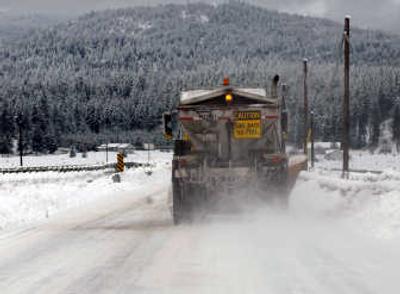
Snow plows were operating at full strength this week in Spokane Valley, but staffing levels sometimes depend on whether plow operators want to work.
Business owner Richard Behm discovered that when he slid through two intersections on South University Road Jan. 20, on his way to a grocery store about 3 p.m.
Behm said he was going downhill about 10 mph with his pickup in the low range of its four-wheel-drive transmission, but “it was impossible to stop” for a red light at Eighth Avenue.
“Fortunately, the cross traffic avoided me,” Behm told the City Council last week. “By the time I got my breath back, I was at Fourth Avenue, and the same thing happened. It was so slick you couldn’t have stood up on that street.”
The following Monday was “almost as bad,” Behm said.
He said he complained to city Public Works Director Neil Kersten, who told him plowing and sanding under the city’s contract with Spokane County was limited because plow operators don’t have to work on weekends or holidays under ordinary circumstances.
“I don’t think that’s acceptable,” Behm told council members. “It was dangerous and accidents occurred because of it. People may have been injured, I don’t know.”
Spokane Valley police recorded 18 collisions on Jan. 20 and 17 on Jan. 21, almost all weather-related.
County officials said a total of six plow operators worked 35 hours in two shifts that Sunday, and 10 operators worked 64 1/2 hours in two shifts on the following day – the Martin Luther King holiday, which is a regular work day for road crews.
The county Public Works Department and Sheriff’s Office get a floating holiday instead of Martin Luther King Day.
The Spokane Valley council took no action on Behm’s complaint, but Councilman Bill Gothmann later said he agreed that county plowing service over the King holiday weekend wasn’t adequate.
“I work with what I can work with,” county Road Division Operations Superintendent Wayne Storey said.
Plow operators’ union contract doesn’t require them to work unscheduled overtime, he said. During snow season, they’re already on overtime – working 12-hour shifts in two groups to provide round-the-clock weekday service.
Usually, Storey said, about 60 percent of operators turn out for time-and-a-half pay on a snowy weekend, and “that cuts a pretty fat hog.” Weekend crews generally focus on main arterials, he said.
When it snowed on Christmas day, though, “it was somewhat tough getting people out,” Storey acknowledged.
He said officials decided to “kind of tough through it,” figuring traffic would be light.
“Sometimes family comes first, and these guys had been working 12 hours a day for quite some time,” Storey said.
Kersten said the city’s contract calls for county crews to meet the city’s plowing schedule.
When four inches of snow accumulates, main arterials are to be plowed within 12 hours. Secondary arterials are to be plowed in the next 12 hours, followed in 16 hours by residential hills.
After that, crews have 60 hours to plow residential streets on the valley floor when “functional traffic flow is substantially inhibited.”
However, continued snowfall could interrupt the schedule and force plows back onto main arterials.
The plan specifies the number of employees and the amount of equipment for each task, but Kersten said getting the job done is all that counts.
“As far as I know,” Kersten said, county crews were in compliance with the contract on the days Behm cited. “I believe by the end of Sunday they had the main arterials done and, by Monday, they had the secondaries.”
Even if University Road had been plowed and sanded, wind and continuous snowfall may have undone the work by the time Behm made his hair-raising trip to the grocery store, Kersten said.
“It’s tough in wintertime,” Storey said. “Recurring snowfalls make life very difficult for us, and it also makes life very difficult for the commuter traffic and the people who have to go to work.”
This week, “they’re doing a good job,” Kersten said. “We’re pretty happy.”