
Older same-sex couples’ time has finally arrived
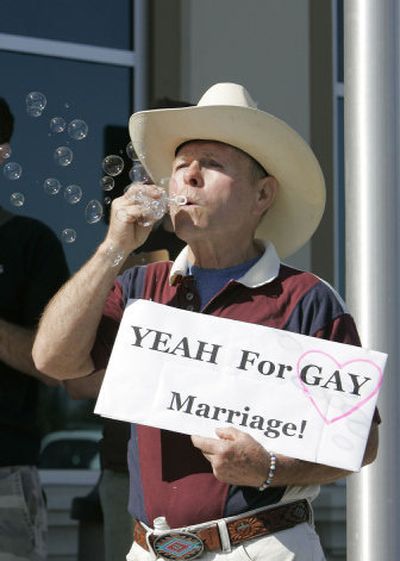

OAKLAND, Calif. – In the 1950s, Mona’s jazz club in San Francisco was the spot where gay women and men gathered – under deep cover.
Back then, there was no such thing as “gay pride.” No LGBT social mixers at the ballet or the theater. No gay teen alliances in public high schools.
This was almost two decades before the 1969 Stonewall riots in New York that launched the modern-day gay rights movement. Gay men and lesbians were persecuted and prosecuted all across America – solely because of their sexual orientation.
Bobbie Jarvis, 74, of Fremont, Calif., remembers the frequent police raids at Mona’s.
“If you didn’t wear at least three pieces of women’s clothing you could be arrested for emulating a male,” Jarvis said. “I had a lot of friends who got arrested like that.”
For seniors who were gay before Hollywood decided that gay was chic, the California Supreme Court’s decision to strike down the state’s ban on gay marriage is especially significant. They lived through the kind of prejudice and bigotry that those in their teens, 20s, 30s and even 40s, can’t imagine.
Many gay people in their 60s, 70s and older never thought they would live to see the day same-sex couples would be afforded the same legal right to marry as heterosexuals – at least in the state of California.
“I knew some day it would happen, but long after I was gone,” said Meg Bruynell, Jarvis’ partner of 32 years.
Bruynell and Jarvis had a commitment ceremony on Jarvis’ 70th birthday. Now, they plan to marry Aug. 10 in Monterey when Bruynell turns 70.
“I want to do it before one of us departs,” Jarvis said. “It just seems like it would solidify our relationship and put the cherry on top.”
Since marriage for gay people was illegal in California, John Ellefsen, 75, of Hayward, Calif., and his partner, Lawrence Fincham, went to Vancouver, British Columbia, two and half years ago to tie the knot, after eleven years together. Ellefsen’s two adult sons, his daughter-in-law and his newest, 6-month-old grandson, were in attendance.
At 5:01 p.m. Monday – the precise time same-sex marriage officially became legal in California, the couple’s Canadian marriage license also became legal, affording them full marital rights. Since they are now legally married, they won’t have to go through another ceremony.
“We’ll still be single as far as the federal government is concerned, but it feels like it is a validation of our relationship,” Ellefsen said. “What I’m hoping is that like in Massachusetts people got used to it and realized that the larger issue was that people love each other and take care of each other.”
The state high court ruling came too late for Marvin Burrows, 72, of Hayward and his partner, Bill Swenor.
Swenor, 66, died March 7, 2005. He and Burrows had been together for 51 years.
They registered as domestic partners in 2000. On their 50th anniversary in 2004, the day after Valentine’s Day, the couple was married by Mayor Gavin Newsom – who had defied California civil law that only allowed same-sex couples to have civil unions. Thousands of gays and lesbians had descended on the city to get married, but those unions were quickly overturned. Burrows and Swenors’ legal marriage was history after six months.
“It was still worth going through the whole process because we were together for 50 years,” Burrows said. “We were both so surprised we got so emotional when we said the vows out loud to other people. It was really a surprise to be so happy.”
Burrows has long advocated for the rights of same-sex couples to marry. A Web site he created remembering his partner is titled “Why can’t we marry after 50 years?”
“I am so happy and full of joy for everyone else, but I also have a touch of envy,” Burrows said.
This time, though, Burrows is optimistic the court ruling will hold up – despite a constitutional amendment to ban same-sex marriages that will go before California voters in November.
“I don’t know why people don’t get it that this makes families and marriage stronger,” Burrows said.