
Superdelegates keep their options open
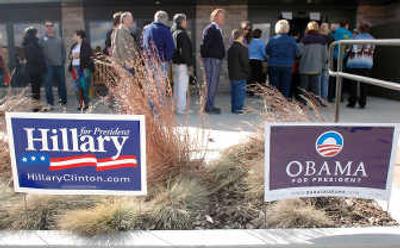
WASHINGTON – Sen. Hillary Rodham Clinton’s trio of victories over Sen. Barack Obama last week appears to have persuaded a sizable number of uncommitted Democratic superdelegates to wait until the end of the primaries and caucuses before picking a candidate, according to a survey by the Washington Post.
Many of the 80 uncommitted superdelegates contacted over the past several days said they are reluctant to override the clear will of voters. But if Clinton, of New York, and Obama, of Illinois, are still seen as relatively close in the pledged, or elected, delegate count in June, many said, they will feel free to decide for themselves which candidate would make a stronger nominee against Sen. John McCain, R-Ariz., in the fall.
“You’re going to see a lot of delegates remaining uncommitted,” said Rep. Mike Doyle, D-Pa., who has not endorsed either candidate. “There’s a sense that this is going to Denver not resolved.”
At the Democratic National Convention in Denver in August, there will be 796 superdelegates – members of Congress, governors, mayors, and state and national party leaders who have automatic seats – and more than 300 remain uncommitted.
A total of 2,025 pledged delegates and superdelegates are needed to win the nomination. That is, unless Michigan’s and Florida’s delegations, now barred because the states violated party primary rules, end up being seated at the convention. Then the winning number would be higher, depending on how many delegates the two states are awarded.
Pat Waak, who chairs the Colorado Democratic Party, expressed the view of many uncommitted superdelegates who hope the remaining primaries and caucuses will produce an obvious winner. “My hope is that there’s a clear lead among pledged delegates and the popular vote before we get to the convention, so that the automatic delegates can reflect what’s happening nationally,” she said. “I’m just very hopeful that it’s not up to us.”
But Oregon Secretary of State Bill Bradbury said that if there is no clear leader, he is prepared to exercise his judgment. “If the pledged delegate total is within 100 votes or whatever, I don’t think there’s a great deal of significance in that,” said Bradbury, who also represents other secretaries of state as a superdelegate. “I just believe that the determining factor for superdelegates shouldn’t be, ‘Well, 49 percent voted for Hillary and 51 percent voted for Obama, and that decides it for us.’ Sorry, but that’s not how it works.”
Party rules allocating delegates on a proportional basis make it virtually certain that Obama will finish the primary season with more pledged delegates than Clinton. But neither he nor his rival can clinch the nomination without the superdelegates.
So far Clinton, with 242 superdelegates, has had more success soliciting their support than Obama, who has the backing of 210.
In addition to the 719 superdelegates whose identities are already known, a group of 77 “add-ons” will be named later by state party leaders.
In interviews, superdelegates described calls from the candidates or from Clinton’s husband, former President Clinton. They described pressure to endorse coming in e-mails, phone calls and even old-fashioned letters from allies of the campaigns.
“I’m thinking of changing my phone number,” joked Doyle, who had supported New Mexico Gov. Bill Richardson but is now uncommitted. He said he got a surprise call from Bill Clinton on Super Bowl Sunday while cooking osso buco for his family. Tony Podesta, a Washington lobbyist who is one of Clinton’s top organizers in Pennsylvania, called from Istanbul at midnight recently inviting Doyle to dinner.