
Preaching style
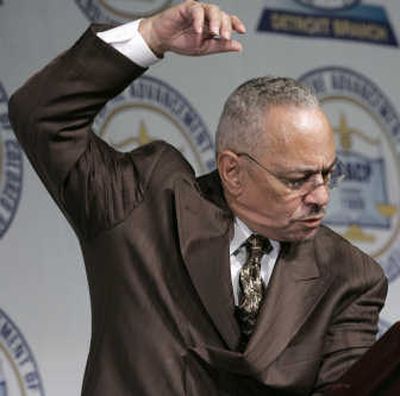
The Rev. Calvin McKinney is the first to admit his preaching can cause discomfort.
“It may sometimes be against the grain of your expectation,” he said during a recent weeknight prayer meeting at Calvary Baptist Church, a predominantly black congregation in Garfield, N.J.
“It may not be to your liking. It may not be pleasing to the ear.”
But McKinney, his smooth voice rising to a hoarse shout, declared: “It’s good for redemption, it’s good for correction, it’s good for a right relationship with God.”
McKinney was trying to explain why African-American pastors like himself closed ranks behind the Rev. Jeremiah Wright, the Chicago minister whose fiery sermons fueled weeks of headlines and a rebuke from Democratic presidential candidate Barack Obama.
Wright, Obama’s former pastor, became a political liability after snippets of his sermons – including one in which he angrily declared, “God damn America” – circulated widely and left him vulnerable to charges he was preaching a rage-filled, anti-American message.
Wright has since receded from view, and Obama is on the verge of becoming the Democratic nominee.
Nevertheless, McKinney and other black clergy members say the controversy highlights a little-discussed racial divide in America.
Simply put, he says, white America doesn’t understand the black church, where themes of personal salvation and racial justice are often fused in a cathartic and boisterous call for redemption.
“It’s a culture clash,” says McKinney, an influential New Jersey pastor. “Our brothers and sisters of European persuasion are suddenly paying attention to how we preach, and they don’t understand it.
“They think it’s harsh. They think it’s bombastic. They think (Wright) is a hate preacher. But if they, in their misunderstanding, visited most of our churches, they would think that that was true for us.”
McKinney says his preaching style emulates that of Jesus, who sided with the most marginalized members of society. He says it also follows the tradition of the Hebrew prophets, who loved the Israelites but railed against their transgressions.
“It’s almost like, when my parents would discipline us, they would say, ‘I’m doing this because I love you,’ ” McKinney says.
“We don’t hate the objects of our sermons, it’s that we love them and want to bring them in line with the will of God.”
Several prominent black pastors in New Jersey, each trained in what they call the prophetic school of preaching, agree.
“Jeremiah Wright didn’t just start preaching that way – it’s part of the tradition of the black church,” says the Rev. M. Frances Manning of New Hope Baptist Church in Hackensack, N.J.
“And it started with those Old Testament prophets speaking truth to power when they thought justice was not being done.”
The Rev. Greg Jackson of Mount Olive Baptist Church in Hackensack says news reports focused only on Wright’s most incendiary statements, but missed the context of his sermons.
When Wright said “God damn America,” for example, he was concluding a sermon in which he noted that America had made progress in addressing racism. But he also said the nation will fail if it doesn’t mend its ways or confront past mistakes.
“I thought he was unfairly characterized,” Jackson says. “The coverage just focused on the sound bites and did not reflect the man I know.”
A member of the African Methodist Episcopal Zion Church says there’s a good reason why Wright and other pastors are so intense.
“How do you wake the person on the street, or the lazy, I-don’t-care member in the back pew?” asks George E. McKain II, a Ridgewood, N.J., native who is public affairs director for the denomination.
“Everybody has to wake up and take responsibility, and that’s how we get our little corner straight again.”
McKinney, 58, says the preaching was very different when he was attending church as a youngster.
“They preached fire and brimstone so emphatically that you could almost feel the flames,” he says. “Their argument was, ‘Get right with God or go to hell.’ “
But with the advent of the civil rights movement, led by pastors such as the Rev. Martin Luther King Jr., social justice became a staple.
“The church looked around and realized that as we are ushering people to heaven, that God has promised his children to bless them in this world,” McKinney says.