
High food costs hit area colleges
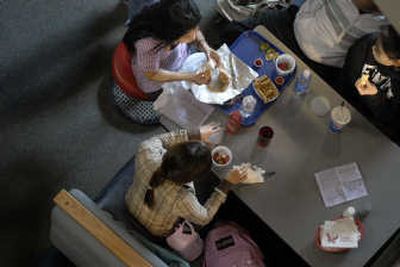
Like home cooks, regional college dining officials are struggling to deal with the rising cost of food.
Students at Inland Northwest colleges mostly avoided big price increases this year, but their meal plans will be more expensive when classes resume in the fall.
At Eastern Washington University, students saw modest price increases for sandwiches and coffee drinks this year, but the school avoided widespread price increases in meal plans. Washington State University avoided price increases by following tried-and-true methods of economizing, shifting to some generic products, scouting for bargains, and reducing waste.
But both schools are planning to raise food prices by at least 5 percent starting in the fall.
“Over the last 18 months we’ve seen about a 17 percent increase in our raw food costs,” said David McKay, director of dining services at EWU. “It’s been going up 1 percent a month.”
Food-service officials are looking for bargains, finding cheaper ingredients for recipes, and passing along some of the costs to students. Gary Coyle, head of dining services at WSU, said his team has looked for ways to save everywhere – nothing is too small.
“Make sure you get everything out of the cans before you discard them,” he said.
The University of Idaho raised prices on some items during the last academic year, and plans to raise its meal plan prices between 4 percent and 7 percent for next year, said Michael Jolly, assistant vice president for auxiliary services. He said the UI has been watching what students are eating – and not eating – closely, to try to make sure it spends money efficiently on food.
U.S. food prices rose more than 4 percent last year, the biggest increase since 1990. Around the end of 2007, certain staple food prices skyrocketed. “Last fall, our bread prices and our milk prices jumped as much as 30 percent,” Coyle said.
Colleges around the nation have struggled to deal with the increases, which are made even trickier since schools budget months in advance for food expenses. At some campuses, trays have been eliminated and portions reduced, in efforts reduce the amount of food thrown away.
Harvard found itself caught between higher prices and student demands for good food when it tried to eliminate a number of whole-grain foods to save money. Students were up in arms, and the university relented.
Officials at regional universities said they’re seeing increased demand for organic, natural and sustainable foods – which are often more expensive than the alternatives. Part of EWU’s strategy in dealing with higher-cost items is to charge students a premium – an extra $1 for the steak night at the food court, for example.
Those premiums will likely get bigger in the future – steak night’s coming with a $1.25 “upcharge” next year. McKay said the inclusion of organic and sustainable options will likely have to follow a similar path.
“Will students be willing to pay for that? I don’t know,” he said. “We want to offer those things.”
Daniele Moser, a residence hall adviser and senior at EWU, said that while the impact this year hasn’t been great, students’ food budgets have gotten tight as the quarter draws to a close. Relatively small price increases can show up in a big way over the course of a full term.
“I know a lot of people are very low in their money toward the end of the quarter,” Moser said.
EWU spent $2.9 million on food this year, McKay said. Its arrangements with vendors provide for a certain profit margin – from 5.25 percent to 6.5 percent – so wholesale costs get passed to the university.
The university has eight food-service operations, including its food court at the Pence Union Building and a new restaurant, The Roost, at the newly opened recreation center. McKay said the university is trying to offer more items on an a la carte basis; that way, if students want to pay more for certain items, they can do so and the university can price individual items accordingly.
EWU is wrapping up its spring quarter now. McKay said meal plans and other prices will be going up 5 percent to 8 percent next year.
WSU is looking at a 5 percent increase next year, Coyle said. He said that he was proud the university had been able to find ways to keep costs under control during the past school year – the university’s spending for each student on a meal plan rose from $832 in 2006-07 to $852 in the academic year just concluded.
“We made a lot of changes early in the school year, so we could keep food costs in line through the year,” he said.
At the UI, Jolly said that trying to reduce waste and find ways to identify local foods – which could save in transportation costs – are part of an overall effort to be more efficient.
“We spend a lot of time listening to our students, watching our students,” he said. “Seeing what they’re picking up and, more importantly, what they’re throwing away.”