
Doll brawl takes toymakers to court

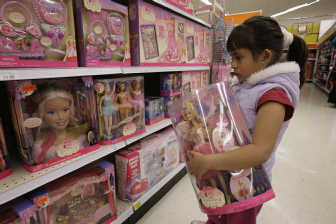
LOS ANGELES – Four years ago, Mattel Inc. exhorted its executives to help save Barbie from a new doll clique called the Bratz. “The House is on Fire!” said an internal presentation on the decline of its iconic Barbie doll franchise. Market share was dropping at a “chilling rate,” the presentation said. Barbie needed to be more “aggressive, revolutionary and ruthless.”
That call to arms has led to a federal courthouse. In a lawsuit set for trial today in Riverside, Calif., Mattel accuses MGA Entertainment Inc., the maker of Bratz, of essentially stealing the idea for the pouty-lipped dolls with big heads. Mattel is trying to seize ownership of the Bratz line, which analysts estimate racks up annual sales of more than $500 million. MGA denies wrongdoing and accuses Mattel in a separate suit of copying Bratz.
Last week, the former Mattel designer who sold the Bratz concept to MGA, who was also a defendant in the lawsuit, agreed to a confidential settlement with his former employer. Mattel had accused the designer, Carter Bryant, of dreaming up the hit doll while on Mattel’s payroll. Mattel didn’t disclose the terms of the settlement but said the agreement will bolster its case; MGA says its position isn’t undermined. Bryant declined to comment.
The Bratz-Barbie brawl has major ramifications for both companies. The Bratz line, which hit stores in 2001 and swiftly became the industry’s hottest doll, accounts for about half of revenues at closely held MGA. It has become a major threat to the Barbie franchise, which produces annual worldwide sales estimated at about $1.25 billion. Mattel has been telling investors it’s working to solve Barbie’s problems, but sales of the Barbie line declined 12 percent in the U.S. in the first quarter as competitors chewed away at its market share.
Recently released court records reveal just how nasty the multiyear fight has become. Rattled by the success of Bratz, Mattel hired private investigators to spy on one of its own executives whom it suspected of leaking secrets. And MGA, possibly fearing the kind of litigation it now faces, tried to keep quiet Bryant’s role in creating Bratz, internal e-mails show.
The dispute hinges in part on when Bryant first came up with the idea for Bratz and sketched it in his notebook. Bryant has said he wasn’t working for Mattel at the time. Mattel has hired forensic experts to test his notebook in an effort to undermine his story, court records indicate. MGA has argued in court that too much time has elapsed for Mattel to even bring such an intellectual-property claim.
Bryant, 39, designed clothes for Mattel dolls until 1998. He left the company and moved back to his parents’ home near Springfield, Mo., according to sworn statements by Bryant and his parents. Driving past Springfield’s Kickapoo High School, he said in a deposition, he had a “eureka” moment involving fashions and hairstyles.
The local teenagers, he said, “were wearing kind of, you know, oversized clothes, big, baggy jeans … just got me to kind of thinking, you know, wouldn’t it be cool if there were some characters that kind of accurately represented today’s teenager.” Bryant said he went back home to sketch an idea: sassy girls with frizzed hair, bare bellies and arms akimbo.
By 1999, Bryant had returned to the Los Angeles area and signed a new contract with Mattel. He designed clothes for Barbie, including its “collector” lines.
In his deposition, he said he began thinking about the Bratz again after returning to Mattel, and even had the sketches notarized to make it clear Bratz was his idea. He said he didn’t believe Mattel would be interested in the characters, and he didn’t show them to his employer.
On Sept. 1, 2000, Bryant took a day off from Mattel to meet MGA founder Isaac Larian. Bryant arrived with his Bratz sketches and a small model of the doll.
Larian said in his deposition that he expressed concern about Mattel: “I asked him if this was something that he was doing at Mattel … and he said ‘No.’ ” About two weeks later, Larian called the designer at home and said he was interested in the project.
In the weeks that followed, Bryant continued to discuss the idea with MGA. Many of the calls took place from his desk at Mattel, according to phone records and his deposition. He continued to work for Mattel even after Larian asked him to quit. In October 2000, when he finally gave notice to Mattel that he was leaving, he refused to say where he was going.
He joined forces with MGA, and the Bratz project shifted into gear.
When the doll landed on store shelves in 2001, it generated buzz in the media, on Wall Street, and most importantly, among young girls. Sales took off, yielding a bonanza for Bryant, who received a royalty of 3 percent of sales on the Bratz lines he worked on. Mattel later claimed that he received more than $30 million from the agreement.
By 2004, the Bratz line was notching steady sales with girls 8 to 12 years old, and its appeal was spreading to children as young as 5, Barbie’s prime territory. Mattel tried to update its lines by introducing urban-chic dolls under the names “My Scene” and “Flavas.”
In a 2004 e-mail under the heading “Confidential: The Barbie Call to Action,” Timothy Kilpin, head of Mattel’s girls division, lamented that Mattel had “been out-thought and out-executed.” He expressed surprise that shelf space for Bratz at Wal-Mart had increased 180 percent, while Barbie’s had declined 39 percent. Visits to important retailers, the e-mail said, had shown that “the Barbie business is in serious decline.” Fixing it would require “grenades,” he wrote. “Complacency will kill us.”
Mattel began to investigate its rival. An undated internal Mattel file, which turned up in pretrial discovery, contains detailed information on Larian’s personal life. In April 2004, Mattel sued Bryant for his involvement with an unnamed “competitor” that allegedly received Mattel intellectual property. In 2005, MGA filed a complaint against Mattel, claiming its updated Barbie line borrowed from Bratz. That case is set to go to trial this fall. In November 2006, Mattel added MGA and Larian as defendants in its lawsuit against Bryant.