
Scoring at record pace
Quality QBs in wide-open offenses piling up points
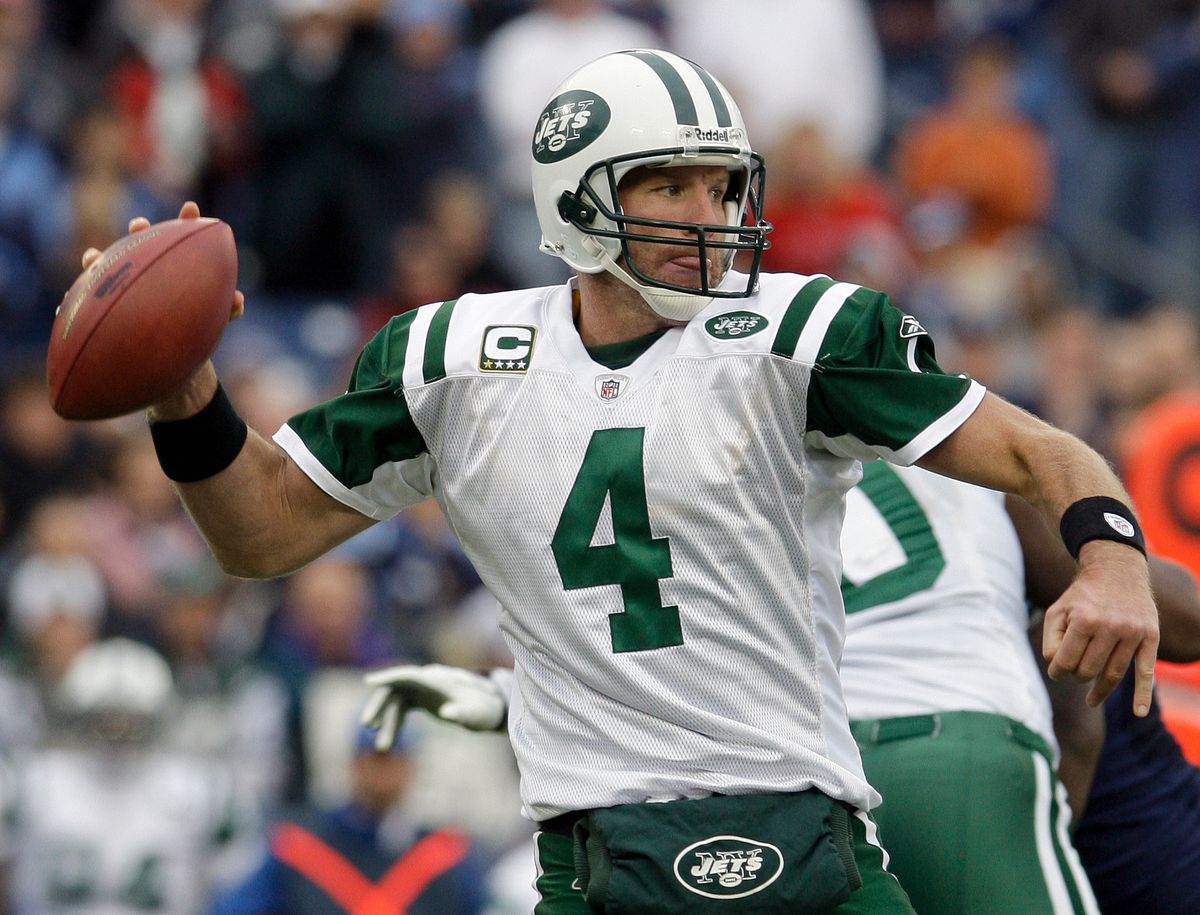
Brett Favre seemed surprised to hear the statistic that captures just how effective offenses have been this season. When told that scoring is at an unprecedented pace, Favre seemed at a loss to explain why.
“I don’t know the exact answer to that,” he said. “But that’s what people want to see.”
They’re sure seeing it.
Through Week 12, games were averaging 45.0 points, the highest total through the same period since the AFL-NFL merger in 1970. If that figure holds, it will be the highest output ever, surpassing the average of 43.7 in 1983.
A record 837 points were scored last weekend, the first time in league history that at least 800 points were scored in a week’s games. Week 12 featured 18 teams scoring at least 27 points, the most for a single week in NFL history.
Entering Week 13, the Giants led the NFL with 329 points in 11 games and the Jets were next at 323. They’re on pace to set franchise records for most points in a season.
Several factors appear to be behind the uptick:
•More wide-open offenses.
“You’re starting to see more exotic offenses, the ‘wildcat,’ more empty, spread-them-out type; what you’re seeing in college, more or less,” Favre said. “Then it becomes a matchup issue. It’s hit-or-miss in those formations. Up to this point, I guess it’s been more hit.”
This trend toward spread formations has been growing for the last several years, and it’s not uncommon to see teams use four- and five-receiver sets. Teams also have run more effectively out of sets that appear to show pass. The theory is that if you look as if you’re going to pass the ball – and thus spread out the defense to counter it – there is more running space.
•More competent quarterbacking.
Favre’s continued success, combined with the contributions of other veteran quarterbacks such as Kerry Collins, Drew Brees and Kurt Warner, have helped to improve several teams’ offensive output.
•The class of 2004.
The continuing maturation of this class, featuring Eli Manning, Ben Roethlisberger and Philip Rivers, has enhanced the points production.
A greater supply of quality young quarterbacks.
In addition to the Class of 2004, youngsters Jay Cutler, Matt Cassel, Matt Ryan and Joe Flacco give the NFL one of the best groups of young quarterbacks in recent memory.
•Sacks are down, completion percentages are up.
Pass protection has improved dramatically this season, as evidenced by the paucity of sacks. Sacks are down to 4.18 per game; that would be the lowest total since 1994 (4.18). Not coincidentally, completion percentages are way up.
Entering Week 13, a dozen AFC quarterbacks had completion percentages of at least 60 percent, and nine NFC quarterbacks were over that mark. It wasn’t long ago that a 50 percent completion percentage was considered solid. Hall of Famer Joe Namath’s career completion percentage was 50.1.
Turnovers are down, too. The average of 3.1 turnovers per game is on track to be the lowest total ever, reflecting more efficient play from quarterbacks.
•Reduced quarterback injuries.
The NFL’s recent emphasis on quarterback safety appears to be paying off. In the NFC, 13 of the conference’s 16 teams went into this week’s games with the same quarterback who entered the season as the starter (if Marc Bulger of the Rams plays; he has a concussion). The Vikings and 49ers voluntarily made quarterback changes because of performance. In the AFC, 10 of the conference’s 16 teams went into this week’s games with their opening-day starters.
•Improved field-goal accuracy.
Kickers have converted 84.9 percent of their field-goal attempts, the highest percentage at this point in a 16-game season.