
Plagued by weeds
Trail users learn their role in dealing with the noxious weed invasion
Invasive weeds are taking over sacred ground accessed only by trails.
And hikers, mountain bikers and other trail users are part of the problem.
Whether you’re cruising the Spokane River Centennial Trail or backpacking into a remote wilderness, you’ll see the ravages of weed infestations.
The people who build and use these trails are unknowingly giving weeds a boost toward crowding out wildflowers and filling the landscape with plants that are not palatable to native wildlife.
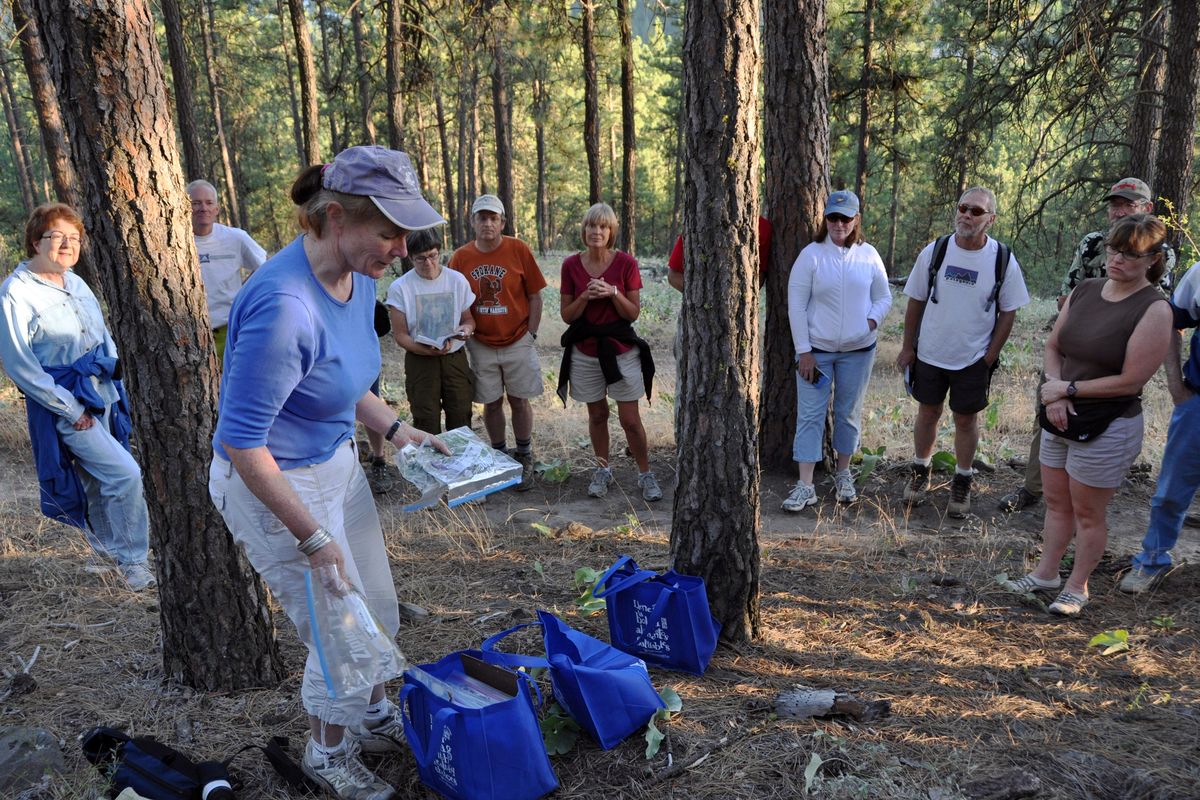
About 30 people joined Diana Roberts, WSU Spokane County Extension agronomist, on Monday evening for a weed education foray on the South Hill bluffs off High Drive.
The outing could have found just as much subject matter in any quadrant of the city or county.
“I brought along some leafy spurge, but don’t open the plastic bag,” Roberts said to the group as she passed out weed specimens. “I collected it in Riverside State Park, where it’s a real problem, but I haven’t seen it here on the South Hill, so let’s not be introducing it.”
Weeds engulfing portions of the wildly popular South Hill bluff trails don’t need any more company.
The bare soil banks formed and left unseeded by trail construction volunteers have been magnets for weeds. The trails paralleling High Drive near Bernard, for example, are lined with cheatgrass and a nasty green seemingly leafless invasive species called rush skeleton weed.
Trail users brush against the plants and join the wind to help spread the weeds along the pathways and beyond.
“A weed is a plant out of place,” Roberts said.
Noxious is a term given to aggressive, difficult-to-eradicate non-native weeds that take over sites and displace native plants.
“Noxious is a legal definition (applied to certain weeds) that enables the county weed boards to require landowners to control it,” she said.
However, city, county and state public land managers contacted by The Spokesman-Review said they are woefully underfunded for fending off weeds, even in parks.
Managing weeds is a matter of priority, Roberts said.
The blooming bluish bachelor buttons that have been delighting most hikers along the South Hill bluffs this month are non-native weeds, but not considered aggressive, she said.
Hairy vetch, the low-growing vine with rows of purple-blue blooms, are flourishing following the unusually wet spring throughout the region’s lowlands. But it’s not considered a noxious weed, Roberts noted. “It’s a ground-cover, a legume that adds nitrogen to the soil,” she said. “It has its benefits.”
But noxious weeds – such as leafy spurge, rush skeleton weed, purple loosestrife, bugloss and the knapweeds – have virtually no benefits to the native landscape and wildlife. They deserve everyone’s attention, including that of trail users, she said.
These noxious weeds are in the region to stay, but that’s no reason to stop trying to deal with them, Roberts said, noting that containment and control can be very effective.
“People can start by recognizing weeds,” she said after handing out the booklet “Noxious Weeds of Spokane County.” The Weed Board in virtually every county makes these publications available for free, she said.
Fields of oxeye daisies, with their yellow centers and white petals, have been featured in Idaho travel brochures highlighting the beauty of the state’s natural areas, she noted. Yet the daisies are an unpalatable noxious weed that infests range land and decreases forage for livestock and wildlife.
Campers often ogle at the saturated color of orange hawkweed as though it were a harmless wildflower.
Land managers are beginning to appeal to recreationalists to do their part to fight invasive species.
Idaho and Oregon are requiring boaters to buy invasive species stickers to pay for mandatory boat inspections and efforts to curtail invasives such as Eurasian watermilfoil.
“I was mountain biking recently near Corvallis, Ore., and there was a sign at a popular trailhead warning bikers to clean their bikes to prevent spreading the seeds of a particular weed,” Roberts said.
Prevention is the No. 1 effort trail users can contribute to weed control, she said.
“Start by cleaning your bikes and shoes at home,” she said. “Don’t pick the burrs and seeds off your dog or socks in the field.”
Involvement is another option that would be a boost to public land mangers who have limited resources for controlling weeds.
Hikers and bikers could help contain and reduce the spread of weeds by forming groups to help fund the release of bio-controls, such as insects that target weed seeds, or manually or mechanically controling weeds under the guidance of a public land manager.
But you need to know what you’re doing, she said.
Some weeds are stimulated by hand-pulling. Some have chemicals in the stems that can blister your hands. Knapweeds quickly adapt to mechanical cutting and will send up new shoots that can bloom and go to seed just under the height of your mower.
But the spread of skeletonweed can be slowed by cutting its stem 6 inches above the ground just as the plant begins to flower. The plants should be bundled and left as a feast for any bugs that might have an appetite for them.
“Bio controls are just being developed,” she said.
At the end of her weed foray, Roberts volunteered to help coordinate a small-scale skeleton weed harvest on the bluff trails in a week or two when the timing is right, and a dozen people signed up to help.
But South Hill resident John Douglas said he was self-motivated long ago by the explosion of Dalmatian toadflax in the Hamblen Park area.
Hand-pulling is not usually a recommended control for the tall, skinny noxious weed with the buttery-yellow “snap dragon-like” blooms. But taking advantage of sandy soil and good timing, Douglas said he was able to single-handedly check the plague in a prized neighborhood natural area.
“I just went out and did it,” he said.