
Talking trees: what’s an environmentally-conscious Christmas fan to do?
‘Real’ trees have advantages but also can be wasteful
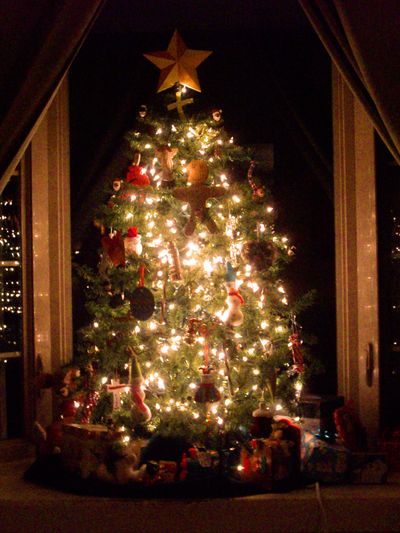

For the past 10 years, our household has discussed whether to buy an artificial or real Christmas tree – except for this year. This was the year I finally prioritized the conversation to focus on conservation, and found that when it comes to sustainability, there really is no competition.
“Every time you purchase an artificial tree, it’s made in China, highly toxic, they’re shipped overseas, burning petroleum, in boxes made from wood…they’re non-recyclable, non-biodegradable,” said Chad Stark, part owner of Spokane Boys, Inc., who sells cut and potted Christmas trees and wreaths during the holiday season. “People think they’re caring for the environment when they choose an artificial tree but it’s the exact opposite.”
Christmas trees within our homes became all the rage starting in the early 1900s, when the first affordable electric tree lights were invented. Initially, people liked the idea, which led to a dip in the national supply of evergreens.
President Theodore Roosevelt declared there were to be no cut trees in the White House during Christmas. Conservationists realized they’d better take measures to stop a rapid decline of our forests and encouraged homeowners to use artificial trees. It also sparked interest in Christmas tree farms.
The first artificial Christmas trees were wooden, tree-shaped pyramids or feather trees which, although extremely flammable, weren’t quite the toxic trees that exist today — ones made from PVC (polyvinyl chloride) and laden with lead. Some artificial trees made in China are required by California Proposition 65 to carry a warning label disclosing high lead content.)
The PVC that commonly makes up artificial trees is dangerous to human health and the environment throughout at the factory, in our homes, and in the trash, according to the Campaign for Safe, Healthy Consumer Products.
Throughout the entire PVC lifecycle, poisonous chemicals are continually released— like mercury, dioxins, and phthalates—which may pose irreversible lifelong health threats. When produced or burned, PVC plastic releases dioxins, or potent synthetic chemicals which can cause cancer and harm immune and reproductive systems.
On the tree farm side, there are about 500,000 acres in production in North America, growing about 33 million trees intended for Americans’ homes, according to the U.S. EPA.
In order to ensure a healthy supply of trees each year, growers must use sustainable farming techniques. For each tree harvested, one to three seedlings are planted the following spring, ensuring a healthy supply.
Granted, there are environmental impacts to consider when you purchase a real tree such as the pesticides and herbicides being used over a period of 12-15 years—the typical lifespan of a Christmas tree before it’s consumer-ready. There’s also the watering, soil erosion and the energy used to maintain the crop to consider. But unlike their plastic competitors, I have decided—after weighing the pros and cons—that the benefits of real trees far outweigh the negative impacts.
Each acre provides the daily oxygen requirements of 18 people and about 93 percent of those trees are recycled through more than 4,000 available recycling programs.
If you’re not able to recycle your own tree, check with your municipality to find the nearest tree recycling program. Some advice: tinsel or fake snow spray are hard to remove and may make your tree ineligible for recycling.
Christmas tree mulch can be used for landscaping and gardening, or chipped for playground material, hiking trails, paths and walkways. Mulch can also be used for beachfront erosion prevention, lake and river shoreline stabilization and fish and wildlife habitat.
Stark said Spokane Boys has been selling Christmas trees for 17 years, selling about 50 organic potted trees every year. He said that number may be higher if we lived in a warmer climate.
Purchasers must first dig a proper hole, preferably before the ground freezes. Then you must keep the refill dirt somewhere warmer until you’re ready to plant. The potted tree will also need gradual transition to the interior climate, and then again when it goes back outside.
“Live trees can stay no more than a week indoors or they’ll wake up from dormancy and begin to grow again in the warmth,” Stark said. “If this happens there’s a good chance the tree won’t survive once it’s returned to the cold winter outdoors.”
If a live potted tree is not the feasible option, and you don’t want to go cut tree route either, you may consider making your own tree, be it from feathers or maybe books (Visit here for a very inspired “lit” tree), or whatever unique resources you can dream up.
Collect dramatic dormant branches from your back yard, set in a large, weighted vase, and decorate. Or make that large ficus in your Family Room festive, by hanging a few of your lighter ornaments here and there, and stringing mini lights throughout. The ideas are as endless as your imagination.
For me, I’m somewhat of a traditionalist, so I’ve decided to go with a cut tree from a local tree farm. I remind myself that trees are renewable, provide habitat for wild animals, absorb carbon dioxide and create oxygen, and the industry provides 100,000 U.S. jobs. That I can live with.