In one sense, we are supposed to let art speak for itself. It exists for its own sake. No need to hyper-interpret the play, film, painting, or poem.
On the other side of coin, it’s always productive to hear from visual artists engaged in a group project, what many in the general public still do not recognize as art – the installation project.
Installations are modern explorations of putting various mediums together to evoke a collage or montage, and sometimes a three-dimensional installation on the wall or in the round can be accompanied by performance.
Installation art events from the 1960s were “happenings,” where things collected off the street, so to speak, brought real life into the studio.
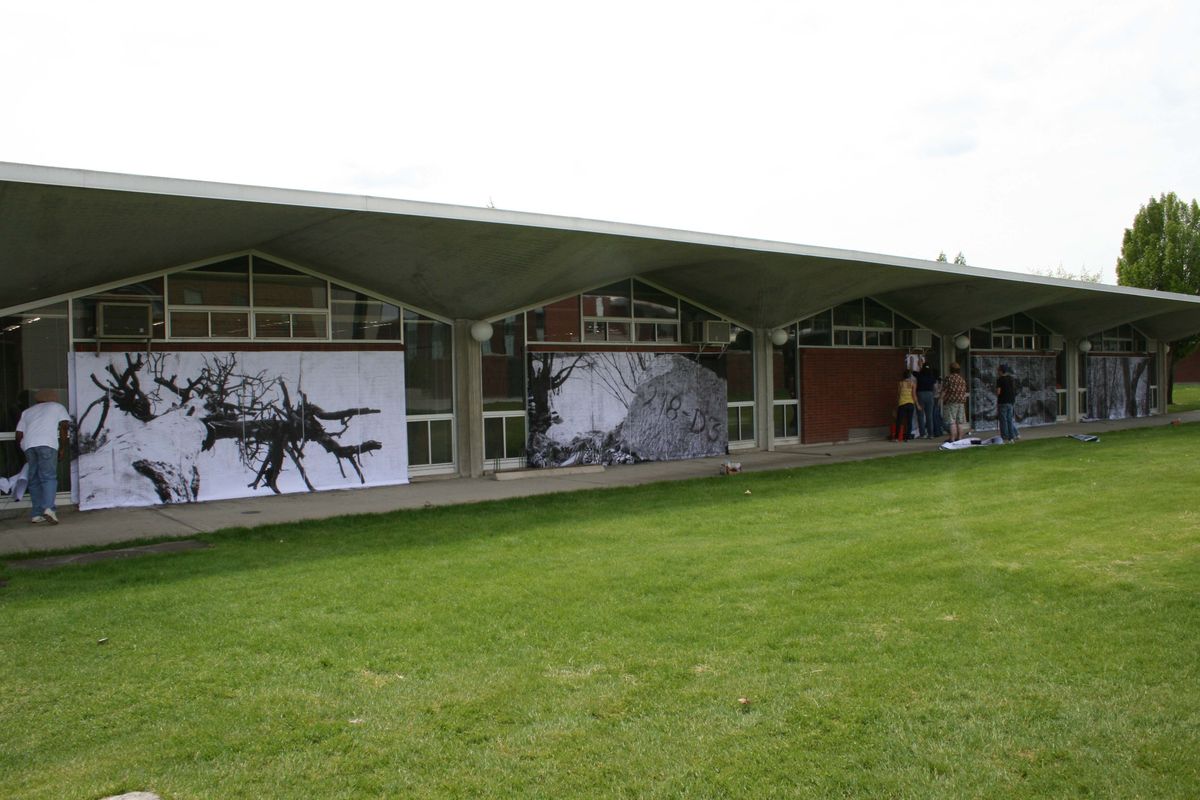
This Friday, the public is invited into a space at Spokane Falls Community College where art and hands-on crafting have taken place in a decommissioned building about to meet the wrecking ball.
“No Vacancy” opens Friday, June 10, in Building 4 and continues until June 17.
“One thing that tied this installation together was the river,” said Tom O’Day, lead art instructor at SFCC.
Art students and faculty early on took a trip down to the Spokane River, which has laid down cutbank after cutbank and dynamic rapids and eddies for thousands of years — below where the college campus now is. They took photos and brought back natural and man-made things, O’Day said. Some of those will be in the “No Vacancy” show.
The students also began to understand the power of nature over the ephemeral hold of man’s creations, including architecture and art.
These old classrooms have acted as creative hubs for lively student and instructor artists. The project, O’Day emphasized, also involved having students visit places in town, into the built environment, with an eye toward mapping these excursions.
What visitors will notice as they explore the building/installation is a dry riverbed of clay throughout the building’s hallway. Each step taken will be infused with one artistic twist after another.
There are many ways to preface the project’s “no vacancy” undertone or how installation art fits into Building 4’s July 2011 demolition.
“Together we have created a visual environment that speaks of ideas of mapping and site, the relationships between the natural and the built environment and the impermanence of what we make and build,” O’Day said.
The reality is that modernism and post-modernism have created some rotten and functionally-challenged spaces, and when SFCC was breaking ground in the 1960s, the powers-that-be made decisions with little forward thinking in terms of population growth and future building needs, so these one-story wavy- roofed buildings popped up.
Building 4 was where the business program worked from for decades, and has been the temporary place for the music program when its old building got rehabilitated and retro-purposed.
This SFCC learning community has found both art and the built environment as temporal, anchored onto nothing solid, other than generational context and how culture – the public – sees art in motion.
Students were given leeway to reinvent the space, a gloomy building involved in a gloomy discipline – economics. The reality is our state and educational leaders are showing the limits of their own creativity, and cutting classes, firing teachers and raising tuition to make way for new buildings. The business model of “new classrooms and fewer students” highlights the Peter Principle the political class and education administrative echelon are mired in.
I asked O’Day about the space staying as an artist’s space. As an artist and educator, that would be ideal, but the building –along with much of the installation art – will be taken down to the foundation.
For the learning community – students from different classes and disciplines working with faculty – installations like “No Vacancy” represent “a real way of working” in a real space, as opposed to the playful nature of much art creation, O’Day said.
“It [installation art] allows the viewer to be in the piece as opposed to just looking at something,” O’Day said. “Installations push the boundaries of more traditional art by activating other senses through sound, moving images, scent or touch. The surrounding environment, whether manmade or natural, becomes an integral part of the artwork.”
Some of the detachable art will be recovered before bulldozers plow over walls. The reality of today’s artist, while believing in the unrecoverable force of art symbolized in its literal demolition, is to also capture/record/document/reinvent things not only on film, but digital video.
I am sure a film or two will come out of this project.
As mentioned at the start, sometimes words do matter when it comes to visual art, so here are some of the 22 students sharing how and why this project is what it will be and why it will never stay beyond July:
Does a place exist just because you think about it? Matt
The collaboration of many minds, unleashed upon one building. Amanda
This experience was an opportunity to dive headlong into the practice of adjustment and humility. Chrissa
We have argued, cried, debated, compromised, shared ideas and meals, ignored insults. We have become a group. Andree
Welcome to No Vacancy where chaos has been controlled and cats have been herded. Ethan
Working and changing the plain white walls…..we can see now how very different we are from one another. Alex
A building with a deeper meaning. No Vacancy is the re-birth of Building #4, just before its demise. Evan
No Vacancy began as an abandoned building with nothing in it but potential. Elise
No Vacancy: unused =unusable Jessica
The project is about bringing the river back into this space. To allow for many different viewpoints. To re-animate the building. Brendan
Thematically, it touches upon humans, their environment and the fleeting nature of our toil. Even the most brilliant expressions and most permanent structures will not stand forever.” Robert
Imagine you got lost somewhere you know nothing about. When you finally figure out where you are and how to get back, you have a story of a journey you took. This is our story. Tasia