TV take: ESPNU broadcast does well to critique Washington State’s ‘phantom’ pass interference call against Stanford
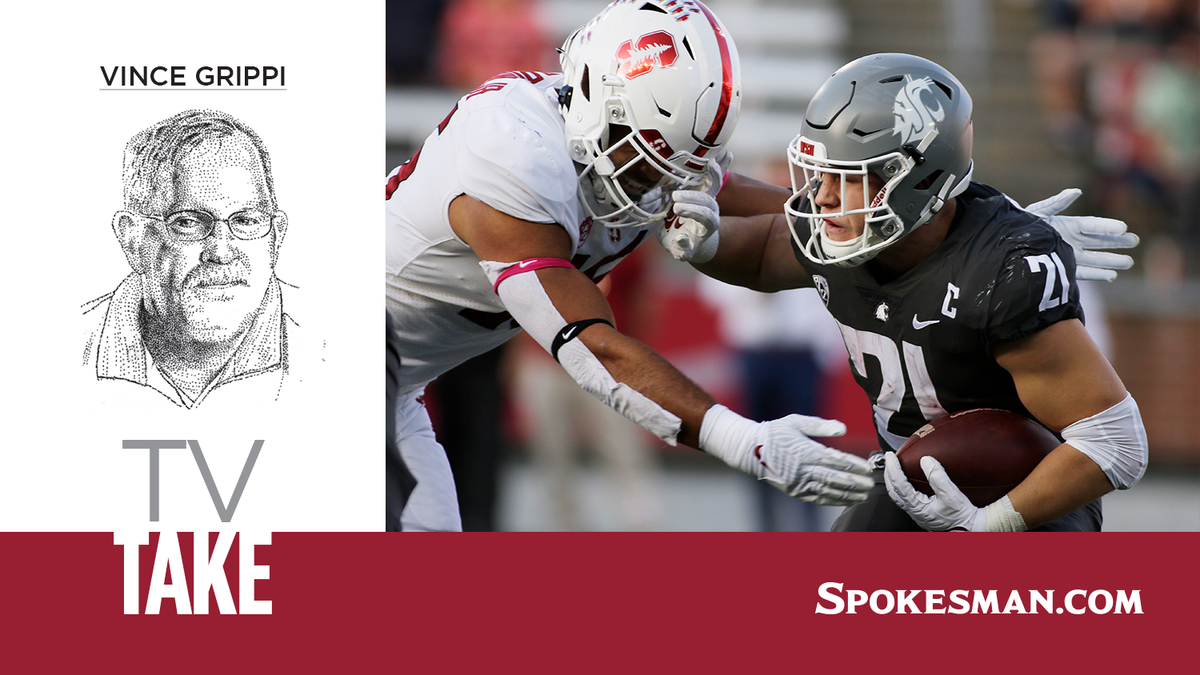
It was impressive of ESPNU to understand it was Family Weekend in Pullman as the Cougars hosted Stanford at Gesa Field.
And considerate of the network to allow commentators Kevin Brown and Hutson Mason to describe the down-to-the-wire game from home, avoiding the long trip to Washington.
After all, they were not only able to “change diapers,” as Mason described one of the main parts of his life, they were able to deliver one of the better broadcast efforts of the season.
And it came in the third consecutive better effort from Washington State, as the Cougars defeated Stanford for the fifth consecutive time, this one 34-31 Saturday.
What they saw
• Just about everything. From the off-field issues that “swirl around the Cougar program,” as Brown described Nick Rolovich’s vaccination stance, to the targeting call against Jahad Woods that cost WSU its leading tackler, the duo seemed to be well-informed and more than willing to share their information.
Though neither was perfect, Brown and Mason did a good job of setting up the game – Mason highlighted Stanford tight end Benjamin Yurosek, who caught five passes for 99 yards, including a 45-yarder down the middle to start the scoring – and describing what turned out to be “a wild win over Stanford,” as Brown termed it.
Even more important, both were willing to critique or praise the action without hesitation, which came into play after Washington State (4-3, 3-2 Pac-12) had built a 27-16 second-half lead. That’s when momentum changed.
• Another Stanford (3-4, 2-3) game, another questionable pass interference call against its opponent that changed the game. Two weeks ago, it cost Oregon a victory as Stanford got an extra play, scored the tying touchdown and won in overtime.
This time, an even worse PI call cost Washington State eight points – and control it had built over the middle two quarters.
Facing a third-and-5, Stanford quarterback Tanner McKee, under pressure, threw a ball in the direction of Bryce Farrell. But the ball sailed well over Farrell’s head and out of bounds.
How far out of bounds? The pass nearly hit a sideline photographer, who are kept 10 feet from the sideline.
That didn’t deter field judge Jeffrey Yock, who threw his flag regardless.
“I’m surprised that flag was thrown there,” said Mason, who obviously doesn’t watch a lot of Pac-12 football, “because the ball has to be catchable. I don’t know if that ball was catchable.”
His partner had an idea how.
“Maybe it was catchable if Farrell had a step ladder,” Brown said before calling it “a pretty shaky PI call” and, later, a “phantom” call.
Instead of punting, Stanford finished off a 74-yard drive, converted the 2-point conversion and cut WSU’s lead to 27-24.
Before Washington State started its next drive, ESPNU showed the entire pattern. Both Mason and Brown commented on the lack of contact.
After the Cardinal had erased the Cougars’ 11-point lead, Brown noted “we still don’t know why” the call was made as it was shown again.
• When Jayden de Laura tried to hit Travell Harris in the end zone late in the game, trailing by four, Mason was also willing to point out there was more contact by Stanford’s Kyu Blu Kelly than there was by WSU’s Derrick Langford Jr. on the key pass interference call.
No matter. Two plays later, Max Borghi scored the winner.
“What a game this has been,” Brown said. “My gosh.”
What we saw
• Though the announcing crew wasn’t in Pullman, that doesn’t mean it didn’t do its homework. Or talk with the coaches prior to the game.
When Woods was ejected for a first-quarter targeting penalty – not called on the field but by replay – Brown mentioned they had spoken with David Shaw about the rule that has received quite a bit of criticism nationally. Turns out Shaw’s second job is as the chairman of the football rules committee.
Mason wondered how Shaw felt about targeting, sharing the Stanford coach thought the NCAA was in “a good place” with the rule. But the analyst didn’t stop there. He added his thoughts, which didn’t jive with Shaw’s.
Mason felt football needs to learn from its basketball brethren, who have two levels to their flagrant fouls. That way, a hit like the one Woods delivered, which seemed less egregious than many targeting calls, would not result in an ejection.
• No analyst the past year and change has caught de Laura’s abilities better than Mason, the former Georgia quarterback.
He spoke often of Stanford’s need to “take (de Laura’s) cleats away,” a vivid way to describe how important it was for the Cardinal not to let the elusive second-year starter make plays on the run.
They couldn’t much of the game – he was sacked just once – and that allowed de Laura to make multiple plays outside the pocket, leading to his three touchdowns and 289 yards on 17-of-30 passing.
But even more on-point was a description Mason broke out in the second quarter.
He termed de Laura the type of quarterback that on one play you might say, “Wow, how did he do that?” followed by a play after which you might say, “Wow, why did he do that?”
Or as happened right after that nugget dropped, the same play.
Facing a fourth-and-1 at the Stanford 9-yard line, de Laura dropped back to throw. He was almost brought down by one Cardinal, avoided him, spun away from another that forced Mason to wonder how, then rolled left.
De Laura had room to scramble for a drive-extending short run but instead threw back across his body, trying to hit C.J. Moore in the end zone, a move that had Mason wondering why immediately.
No matter.
The Cardinal fumbled on the next play, WSU recovered and de Laura connected with De’Shaun Stribling for a 10-yard touchdown.