
NW BachFest kicks off its spring series with a pair of astonishing concerts at Barrister
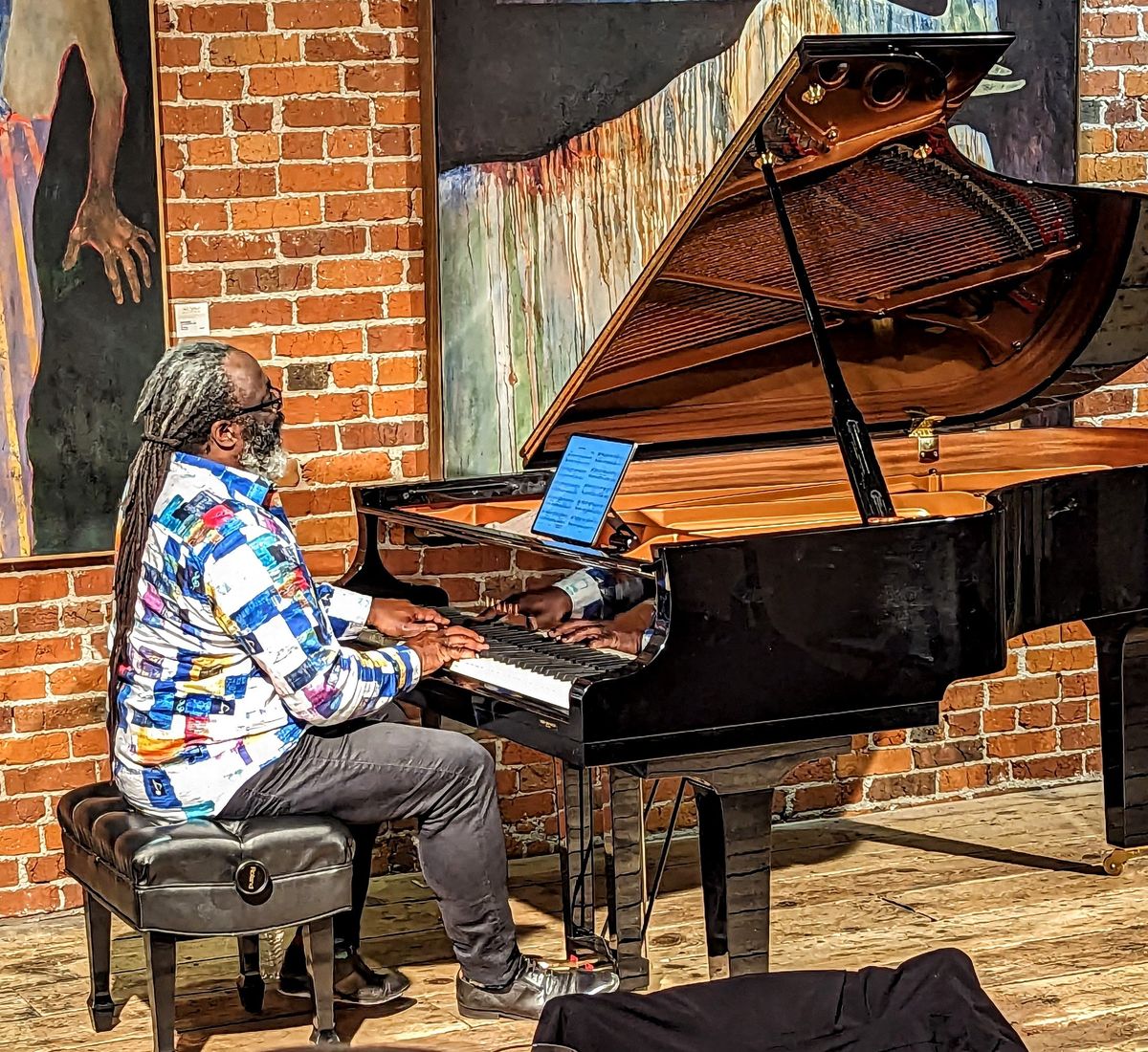
As though anticipating the chilly weather, Zuill Bailey, music director of Northwest BachFest, gave us ample opportunity this week to find comfort and the warmth of fellowship in the cozy environs of Barrister Winery by scheduling two pairs of recitals.
Each pair features a different pianist, both long-standing colleagues of Bailey. In the first, Awadagin Pratt returned to Spokane for a solo recital on Monday, followed by a duet recital with Bailey on Tuesday. Later in the week, pianist Matt Herskowitz, who dazzled the audience at Mozart at Manito two years ago with his improvisations, returns for a solo recital on Saturday and a duet recital with Bailey on Sunday, concluding with a performance of Shostakovich’s brilliant Cello Concerto No. 1, in which Herskowitz will take the orchestral part.
Kicking off this rich week of music-making, Pratt presented a recital program that challenged the audience almost as much as it did the performer, seeking to create a structured meditation in which the audience could gain deeper awareness of elements that underlie most music for piano, and much music in general. To do this, he chose seven keyboard works composed in eras ranging from the 18th to the 21st centuries, by composers originating in Poland (Frederic Chopin), France (Francois Couperin), Latvia (Peteris Vasks), the U.S. (Philip Glass, Fred Hersch) and Russia (Sergei Rachmaninoff and Pyotr Tchaikovsky). Despite the conspicuous differences among these works, Pratt, remarkably, was able to weave them into a coherent whole that revealed the fundamental elements of pitch, rhythm, harmony and melody from ever-changing, but still connected, points of view.
It was startling to realize how much Couperin’s “Les Baricades Misterieuses” (1717) could have in common with Vask’s “Castillo Interior” (2013), originally for cello and piano, or how naturally Hersch’s Nocturne for the Left Hand Alone (2020) segues into Rachmaninoff’s Prelude in D (1903).
Their harmonic and rhythmic similarities emerged as if by magic, partly because Pratt played them without pause, often improvising imaginative transitions from one to the next, but more important because he played with such consistently beautiful tone and sensitivity to the weighting of each note in a chord. His careful modulation between arm weight and finger weight permits him to make minute distinctions between p (soft), pp (really soft), and ppp (really, really soft), and then, in the next measure, to produce volumes of sound that are quite literally unbelievable from a 6-foot Yamaha piano.
There is no work in the literature that pays greater rewards to such mastery as Liszt’s Sonata in B minor, composed between 1849 and 1853. The performer must command every weapon in the arsenal of Romantic pianism: Thundering octaves, purling scales, delicate filigree, flawless legato; they are all found in the Liszt Sonata, and sometimes in the same measure!
Even with all of these, a performance will fall flat if the pianist lacks a genuine need to tell a story, to move an audience to laugh and cry, to (in the words of Fred Astaire) “lay ’em in the aisles.” Pratt has this in his bones. He took us by the hand on Monday night and led us from peak to peak of the Liszt Sonata with the assurance of Virgil leading Dante through the Inferno. This bath in pure Romanticism ended with a display of such brilliant virtuosity as to leave the audience feeling that we had just witnessed the transformation of sound into light.
For an encore, Pratt performed an arrangement for piano of the same piece chosen by Bailey as the encore to his appearance with the Spokane Symphony on Saturday night of Elgar’s Cello Concerto: the Melody of Orpheus, from Gluck’s opera “Orphee et Eurydice.” To Bailey’s surging passion, Pratt countered with a chaste delicacy suggestive of the wind chimes of heaven.
On the following evening, Pratt was joined by Bailey, his friend of 37 years, in a more conventional program, in part because it replicated programs the duo had given together in the 1990s. It consisted of the Concert Variations in D major Op. 17 (1829) by Mendelssohn, Beethoven’s Third Cello Sonata in A major Op. 69 (1809) and the Brahms Cello Sonata No. 1 in E minor Op. 38 (1865).
A concise foretelling of the collaboration between Bailey and Pratt was made by Brahms himself upon the publication of this sonata, when he specified that the piano “should be a partner – often a leading, often a watchful and considerate partner – but it should under no circumstances assume a purely accompanying role.” The two do more than play through a score together; they sing together with voices that are similar and that harmonize uniquely well.
The greatest performing musicians have more than skill and a good memory; they have a “voice” or a “sound” that distinguishes them no matter what instrument they play. The great violinist Mischa Elman used to amaze colleagues by walking into a pawnshop, bringing down a cheap fiddle from the wall, and producing from it the same gorgeous tone that streamed from his Stradivarius. Despite the differences between their instruments, their backgrounds and their training, Bailey and Pratt have voices that are warm, inviting, spontaneous and pitched around the F below middle C.
What is more, they use their voices in a way that imparts life to every phrase. There are always nano-variations of tempo and dynamics that indicate the player is listening and reacting to every note as it sounds, whether he or his partner has played it. When described in this way, such a procedure sounds impossible, but every person in Barrister Winery on Tuesday night experienced the truth of it for nearly two hours. It allowed Beethoven’s genius as reflected in the A major Sonata to shine more brightly than in any other performance in this writer’s memory, not excluding the excellent one Bailey himself has committed to disc. It blew the pallor of domesticity off the Mendelssohn Variations and then wiped away the dust of the academy that often dulls the effect of the Brahms Sonata, allowing both to shine as though newly minted.
Northwest BachFest’s spring series, reviewed Monday and Tuesday at Barrister Winery, continues through Sunday. For information on upcoming BachFest events, visit nwbachfest.com.