
How to turn a small outdoor space into a spot your dog will love
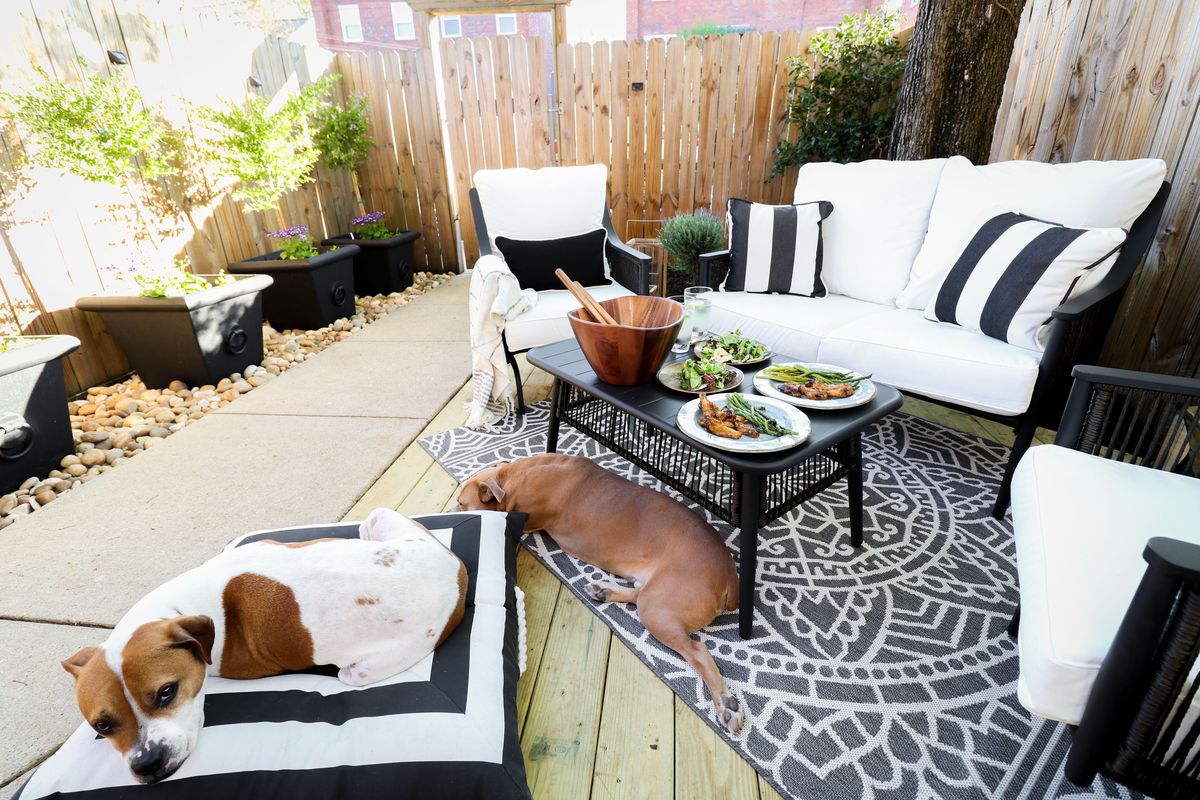
When Rashida Banks renovated the small rear patio of her Washington, D.C., home, she wanted to include a space where her pit bulls, Jax and Chase, could “do their business.”
“We, of course, walk our dogs,” she says, but in between those longer jaunts, she craved the convenience of just opening a door to let them out. Her solution: DIY-ing a section of artificial turf. “When they first encountered the turf, they sniffed it, walked around a bit, but went straight to doing their business,” she says.
A place to pee is one of many considerations when creating an outdoor oasis for a dog – and yes, you can create an oasis, even without a sprawling backyard. “Choose opportunities for enrichment that (your) particular dog or even potentially the breed of dog is more likely to want to engage in,” advises Ciera Moberg, a co-owner and behavior consultant at Instinct Dog & Behavior Training. In a compact space, dogs can still be fulfilled if you create surroundings that “mimic how they would engage with the natural environment on their own,” she says.
So, if you’re looking to turn a modest patch of the outdoors into a fun and safe environment for your pup, try including some of these expert-recommended components, all of which are designed to activate the canine senses. (And, of course, none of this is meant to replace taking your dog for a nice long walk.)
Designated potty area
Gravel or “a little patch of grass” are both viable options for a petite potty area, says Kristina Carmody, owner and training director at Indigo Dog Training, though she agrees that Banks’s use of fake turf was smart since the material won’t get muddy and is easy to sanitize. “But it does require maintenance, and it does get hot in the sun,” Carmody adds, suggesting that dog owners cool down artificial grass with water on especially warm days.
To install her turf, Banks and her husband dug 3 to 4 inches into the ground across a roughly 25-square-foot area, which became quite strenuous. “You might think, ‘Oh, that’s not a lot,’ but the whole area has to be dug out at that level, so it does become a bit laborious,” she says. They hand-tamped the soil before laying down a weed barrier and finely ground stone. After another round of hand tamping, they watered the subbase to ensure an even surface. Meanwhile, the turf was laid outdoors for about two hours, which “softens it up, gets all the wrinkles out and makes it more flexible to work with,” she says.
They secured the turf using 6-inch galvanized nails, then brushed sandlike infill over the top. The project took about four days of “working nonstop,” Banks says. (The materials would’ve cost her about $500, including a $140 wheelbarrow, but Banks works as a design influencer and got the supplies gratis from Home Depot.)
Places to dig
If your dog likes to dig, consider creating a spot just for that activity. One method is to hollow out a pit in the ground and fill it with sand or crush-proof balls. But Moberg says a store-bought kiddie pool will also do the trick: “It’s kind of the easiest, temporary way, especially if you don’t want a permanent digging pit in your yard for the wetter months.” Plus, come summer, you can fill the pool with water to give your dog a place to splash and cool off.
Carmody says a children’s portable sandbox with a lid also works well for this purpose. “They’re really sturdy and it’s convenient because you can cover it if it’s going to rain.”
Opportunities to sniff
Tinctures and sprays that emulate scents of animals like possums, pheasants and raccoons can offer stimulation in the yard, “especially for dogs that live in urban environments and don’t necessarily pick up those scents as much as they would if they were living in a more rural area or if they had more land or a larger yard,” Moberg says.
A garden of interesting-smelling plants can also entertain a dog, says Carmody, who recommends rosemary, basil and dill. Keep in mind that herbs in your doggy garden should not be used for cooking. And most importantly, be sure to consult the ASPCA’s list of plants that are toxic to dogs, so you know which varieties to avoid.
If you want to plant herbs for personal use, Moberg suggests using hanging planters that your dog can’t reach, even when standing on her hind legs. “Make sure that wherever you hang, it is very sturdy so that there is no chance of it falling, especially if your dog’s hanging out in the yard,” she says.
Strategic plants
When Banks decided to add flowers to her patio, she chose to use large planters that Jax and Chase couldn’t get into. “There were bushes there before. but the dogs came and peed all over them and they died,” she explains. The new pots, which she surrounded with decorative rocks, have held up well.
Depending on your pet, Moberg says, you may want to keep in mind that some plants are better at attracting birds and other critters. “If you have a dog that has a good amount of predatory motivation, you probably don’t want to be attracting birds and squirrels and other small animals that your dog might see as prey,” she says.
Climbing objects
“Being able to go up and down can be enriching and fun for dogs and can give them more opportunities for exercise as well,” says Moberg, adding that climbing objects don’t have to be “permanent or expensive fixtures.” Logs, tree stumps or rocks can “mimic a larger outdoor environment,” she says, while benches or stools can also work for climbing over or under.
Carmody suggests recycling old car tires and stacking them to create a climbing platform. A single tire can also be filled with sand or gravel for another digging opportunity, or herbs for sniffing, she adds.
Make sure that any climbing object is sturdy, stable and a safe height for your pup’s size.
A place to rest
Just like humans, dogs love to lounge outside. Moberg recommends Kuranda beds for outdoor spaces, since they’re elevated off the ground and don’t hold onto moisture. “It can be really nice for them to smell the smells while laying in bed or hear outdoor sounds in the sun or shade outside,” she says.