‘Helping the sport grow’: Black players on Spokane Indians contemplate representation, accessibility in modern game
The percentage of Black players in Major League Baseball recently reached its lowest point since 1955, less than a decade after Jackie Robinson broke the color barrier. League officials hope that several initiatives to increase those numbers are starting to pay dividends.
One look at the Spokane Indians roster this season shows evidence of potential success.
On opening day 2024, just 6% of MLB players were Black American – the lowest percentage in MLB history, culminating a decadeslong decline. A study done by the Institute for Diversity and Ethics in Sport at Central Florida found Black players represented just 6.2% of players on MLB opening -day rosters in 2023, down from 7.2% in 2022. Both figures were the lowest since the study began in 1991, when 18% of MLB players were Black.
This year, that number ticked back up a couple of tenths to 6.2%. That might not sound significant, but it’s a glimmer of hope in growing the game into communities where baseball once flourished, but has floundered in recent memory.
“I would have thought it was a maybe a little higher. I wasn’t aware of that number, honestly,” Indians second baseman Tevin Tucker said.
“I think there’s a big misconception of when fans and just different people come to the stadium, they see all these darker players on the field and they kind of confuse some of the Latin (players) for being Black,” outfielder EJ Andrews, Jr. said. “We definitely know that the number is small.”
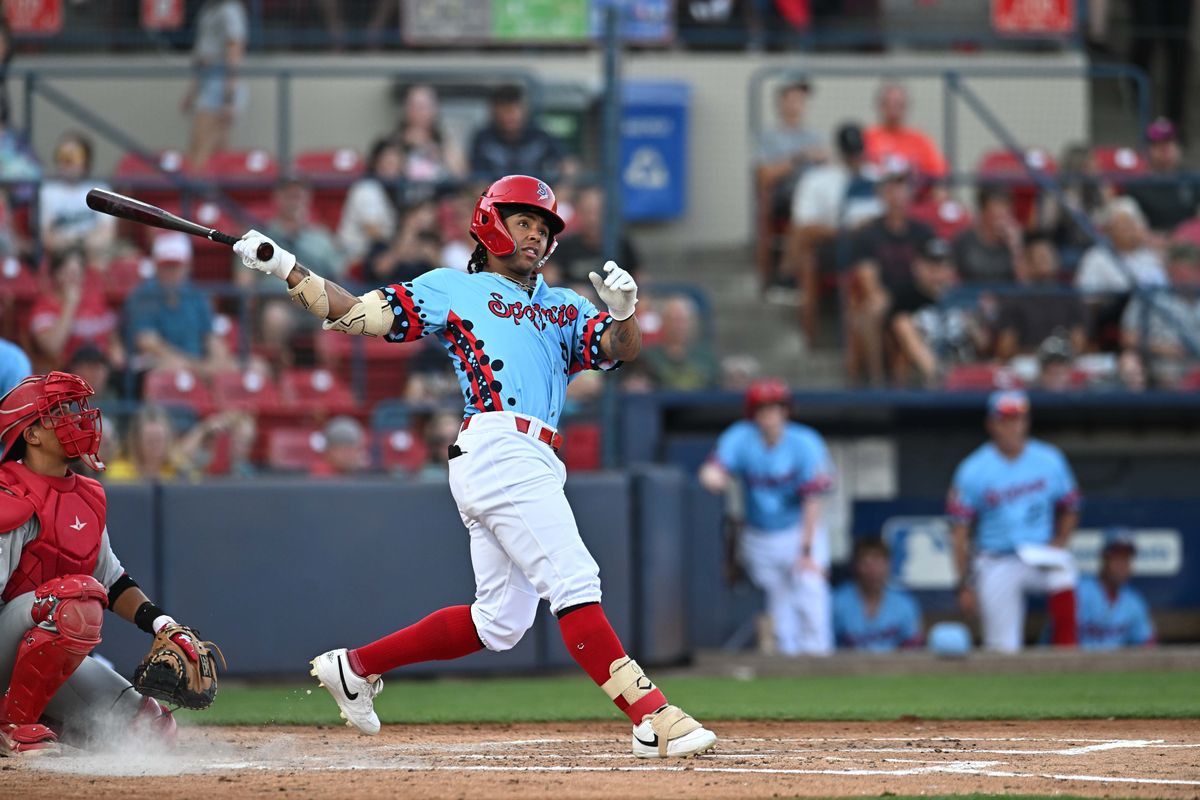
Tucker and Andrews, along with Caleb Hobson and GJ Hill, are among four Black players on the Indians active roster, with two others (Lebarron Johnson, Jr. and Isaiah Coupet) on the injured list. With six Black players out of 35 total assigned to the roster (17.1%), it puts the Indians well above the current MLB threshold.
“I think it is a unique situation this year where we have a few of us out here,” outfielder Andrews said. “(Overall) it’s definitely a small number. But with the Rockies, it seems like that number is higher, at least for one organization.”
The players on the Indians roster mentioned several barriers for young Black athletes who might want to play baseball, including cost and societal pressure.
“I think from a youth level, baseball is not the most accessible sport,” Hill said. “It takes a lot of money to play, you know, paying to play on teams, equipment, everything else. When you get something like basketball or football, you kind of just need a ball and you can go play with your friends.”
But representation and accessibility were the two reasons most predominantly brought up.
“I think obviously it starts with the youth, and making the game more accessible to young black players is the goal,” Hill said. “And I think there’s a lot of that now with, you know, the “Breakthrough Series,” youth academies, things like that. So I think MLB is doing a great job of kind of pushing that agenda, and you definitely are starting to see a lot more talented young Black players.”
The Associated Press reported in 2024 that between 2012 and 2021, 17.4% of first-round picks were African American players. That number spiked to 30% in 2022, when four of the first five selections were Black players for the first time ever – and all four were alumni of at least one MLB diversity initiative. In 2023, Black players made up 10 of the first 50 draft selections, or 20%.
Those gains haven’t bolstered MLB numbers much yet. But participation in MLB’s diversity-focused youth and amateur programming, including the DREAM Series, Breakthrough Series, the Hank Aaron Invitational and girls baseball/softball events, is making an impact.
“I definitely think it’s effective,” Andrews said. “I grew up back in Long Beach, so I was going to the urban youth academy in Compton out there. And I just think what they’re doing is so just great for the community, and also just helping kids get off the streets and invest in something that they love. And the game of baseball can be one of those things.”
“There’s a lot of hidden talent out around in the country, all over the place,” Hobson said. “You can’t find it if you don’t try to look for it.”
There are those outside the game that want to help grow baseball in Black communities as well. Tucker mentioned a group called Black Baseball Mixtape, which hosts podcasts and features promoting Black players from youth sports to MLB.
“It’s just something that, you know, we’re trying to help the sport grow,” Tucker said. “I think the more we can kind of come together and just show representation and show that it’s fun, I think it’ll grow.”
Hobson and Andrews both mentioned Pittsburgh Pirates outfielder Andrew McCutchen as someone they looked up to growing up. And Hill didn’t have to look far for an example – his father Glenallen Hill played in the big leagues for 13 seasons with 186 career home runs.
They all understand that they will be looked upon as role models and appreciate the responsibility.
“I take that really strongly, actually, just because my little brother – he’s 5 years old – looks up to me too and wants to go the whole baseball route,” Andrews said.
“He says me and Elly De La Cruz are his favorite players. So I know he’s watching every night. And just for that alone, I just want to be the perfect role model that I can for him and just any other young Black kids that are watching as well.”
“It is something that in the back of my mind comes up every once in a while,” Tucker said. “Kids probably do look up to me that are same color as me, and probably maybe view me in a way as how I viewed Tim Anderson or Derek Jeter.”
Added Hobson: “I try to be a role model for all little Black kids, even the adults at the same time. I try my best to be a role model in any aspect of the game – on the field and off the field.”