
Hooked on worms: Spokane couple casts new vermiculture business
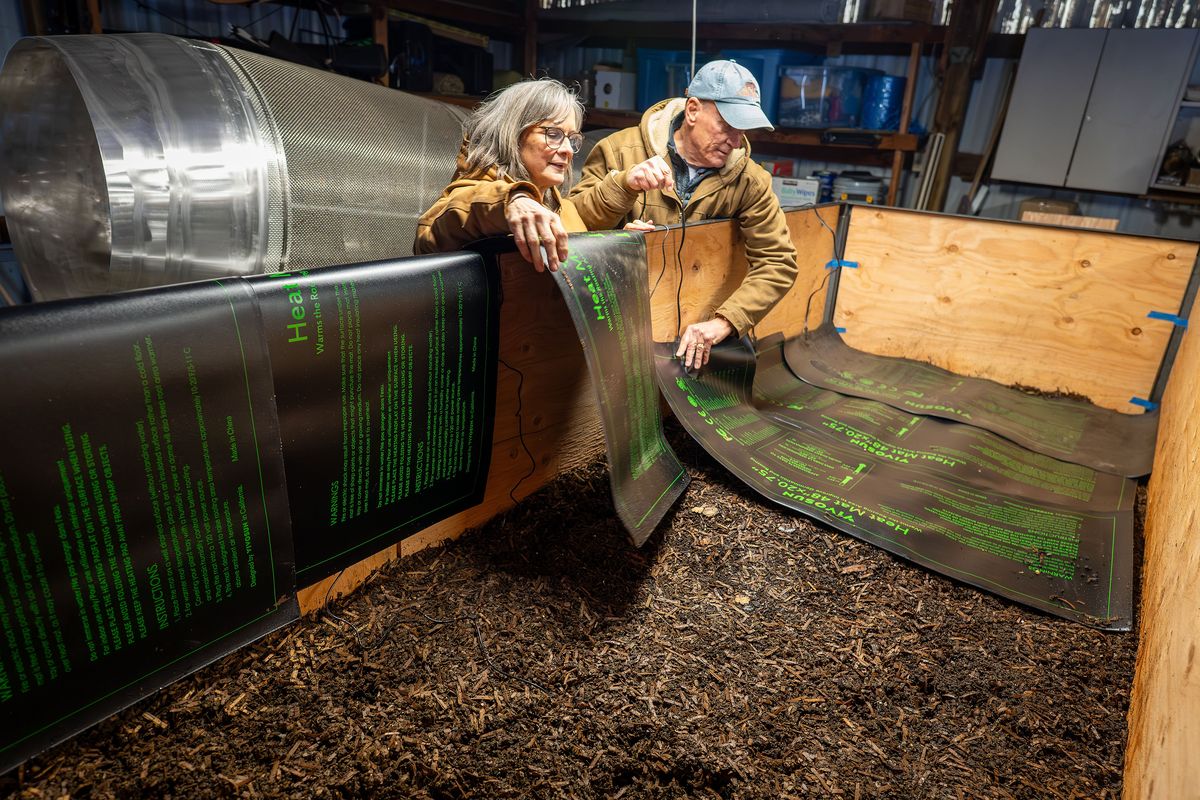
In a small Spangle workshop, immediately off of U.S. Highway 195, thousands of worms are slowly burrowing into their new home, nestled cozily under heated blankets with as much food as they could ever want.
George and Patti Anderson are deploying these spoiled annelids for their up -and -coming business, aptly named Spokane Worms, selling soil amendments, chicken treats and live worms for any purpose.
But how does a couple in their 60s stumble into farming a vat of worms in the first place? For the Andersons, it all started two years ago, when George Anderson, 68, booked the ticket for his very first worm conference.
“It’s one of those quiet interests I wouldn’t want to tell anybody because I didn’t want to get laughed at,” he said. “But it wasn’t a passion thing. It was, how does this work? How long have they been here? How do they do that?”
The conference was in Arizona, and Anderson came back to Spokane ready to begin his own worm-fueled compost bucket in his basement, with the support of his wife of 39 years, 63-year-old Patti.
Most at-home composters use what are colloquially known as red wigglers, or scientifically, Eisenia fetida. Like a 14-year-old boy with a Nintendo, Patti joked, this particular species of worm “just want to sit there and eat.” If you put any old worm from outside in a compost bin, she said, chances are they will spend all their energy trying to escape.
It was only a few months into caring for their bucket that George Anderson got the idea to sell the “castings” or “vermicompost” – essentially worm poop and degraded worm foods – that their wiggling friends left behind.
Adding worm castings – or alternatively, compost tea made by steeping worm castings in room temperature water – to soil is a way for gardeners to re-establish healthy soil food webs, Faith Moeser said.
Moeser is the owner of Soil Dynamix, a Spokane based soil evaluation company. By examining a soil sample under a microscope, she can identify components of the microscopic food web that lives in it, which is composed of bacteria, fungi, the single-celled protozoa and oft-miniscule worms called nematodes.
“Most soils have been disturbed and are not healthy. They don’t have all these organisms, so in order to get those back in, you have to inoculate your soil with them again, which you can get with worm castings.”
Disturbed soils may feature disproportionate populations of one organism over another, which can lead to nutrients getting trapped in forms plants can’t use. For example, if soil has a food web consisting of only bacteria and no bacteria-feeders, the bacteria can hoard certain nutrients that plants need to remain healthy. Adding worm castings won’t contribute to any existing imbalance, though, Moeser said.
“The cool thing about worm castings is that human pathogens, plant pathogens and even root feeding nematodes will not survive passage through a worm,” she said. “So it’s really safe to use worm castings because they eliminate the harmful things and only poop out your worm casting that has the good stuff in it.”
Soil amendments like worm castings are essential for healthy plants, she said, and everyone who grows plants should consider soil inoculation. The Andersons routinely get their vermicompost tested by Moeser to make sure organism levels are balanced.
“There are a ton of people who are just home gardeners, and they’re passionate,” George Anderson said. “Their passion leads to, ‘let’s get the best product. I want to do heirloom tomatoes. I want to make sure the money I spend for the seed, the time I invest in this – lets make it work.’ It’s worth the couple of extra bucks for the castings.”
“I personally have an ethos for good health,” he added. “It’s that kind of mentality – those are my people.”
It was the environmental aspect of composting that really won Patti Anderson over, though.
“I think for me, it’s this whole idea of sustainability, and ‘let’s leave things a little bit better for our grandkids.’ I think it started in the house, where I was trying not to buy single use plastic and really working on that,” she said. “And then when (George) is talking about it, I’m like, oh my gosh, this just slides right into my philosophy.”
A rising regenerative farming movement in the Spokane area – that is, farming with a focus on restoring soil health and ecosystem function – means that career growers are increasingly interested in the benefits that castings or compost tea can bring to their land, Patti Anderson said, but so too are ordinary people who just want a cleaner footprint.
“They don’t want to just put chemical fertilizer on their yard, they want something that’s going to sustain it,” she said.
In March 2025, the Andersons got licensing for their business, and almost right away Spokane Worms was one of 60 selected vendors for the new Scale House Market in Spokane Valley.
Though they hand-sifted around 50 gallons of vermicompost for Scale House’s grand opening on May 31, the Andersons couldn’t be there in person.
“We have a grandson graduating in San Diego, we can’t miss that. We’re not going to miss that,” George Anderson said. “Patti had just gone in and stacked everything at Scale House .”
“We didn’t even have nice signage or anything. Like, let’s just put this stuff up, because I had to get up in the air,” Patti said, continuing the thought. Later, George was driving up Interstate 15 from San Diego “and he hears me yelp in the back seat … A friend of ours had said she was at the Scale House Market and everything was gone. They had sold everything on the first day.”
Spokane Worms would have to grow its operation to meet the demands of the community, the couple realized then. A few months later, they found a temporary location in their daughter’s workshop, and their nephew built them a trommel – a large, spinning sieve to sift castings from rocks and larger soil chunks – and a specialized 3-foot deep, 4-by -10 bin in which the worms would live.
A continuous flow -through bin allows food – leftover produce and local cow manure – to be put into the system on top and the most processed soil – the vermicompost – to be harvested from the bottom. It is a horizontal blade that runs just above a hog wire bottom that allows around an inch or so of dirt to fall through into collection buckets below.
The worms just moved from their basement buckets into their new home at the end of November. The Andersons have been breeding worms for months to build up the supply.
“We’ll probably still do worm breeding in our basement, and that will be so people who want to have worms and just put them in raised beds – which is a great idea – they can just buy the worms from us,” Patti Anderson said.
Patti expects the bin will turn around 100 gallons of vermicompost per week.
With the equipment, George Anderson said running the business only takes an average of two hours a day, six days a week – a level of work that suits him well as he slowly transitions out of being a full -time physical therapist. He currently works three days a week at Providence.
“I’m at that age where a lot of my friends are retiring, and they are retiring into golf. They are retiring into other things,” he said. “I’m not that guy. I gotta have a purpose … so, I can play golf, but I can also do this. It keeps my brain going.”
Patti Anderson left her job as a sales representative for a quilt store in September as well, letting her focus on the marketing side of the worm farm. George Anderson said that she has an understanding of how to advance a business, “and I’m the cheerleader.”
“I love the game of business,” Patti said, adding that despite her marketing degree, social media wasn’t a thing when she was studying. “It’s a full-time job.”
The pair have moved around a lot in their lifetimes, and have called Spokane home for three years. They are “just looking to change direction a little bit” and meet new people in the area.
“We’re kind of at a pivot stage in our life,” George said. “We kind of wanted to dial it in here and see our grandkids and do all that kind of thing.”
Their granddaughter, 2-and-a-half-year-old Piper, loves the worms, Patti said. She mimicked Piper holding a wiggler in her hand and proudly proclaiming that “I’m not squishing.”
Spokane Worms also sells regionally sourced, dried black soldier fly larvae, which George said is “like cocaine for the chickens,” though they do not process the larvae in house.
The next step for Spokane Worms will be to get another bin for more composting and then eventually a more permanent workshop. The biggest concern is to make sure that there is enough product to go around.
“We really would like three of these and just to get the system down,” George Anderson said. “I think we know how to do it. But sometimes you just need to shove your nose in to really work it out and that’s where we are with it.”