
‘I’m just not that person anymore’: the business of removing tattoos lets clients create a clean slate
Hope Foster is not the same person she was when she got her first tattoo at 18.
For the past few years, getting rid of some of her tattoos sounded like a good – even great – but ultimately unobtainable idea.
It simply cost too much.
When Foster learned about Removery’s new location on North Division in Spokane, she consulted with them to look at getting one small tattoo expunged from her body. After learning about their prices and payment plans, she opted to get 14 square inches of ink removed.
Everyone has something they regret, like an ex-partner or an outdated belief. Any number of things have the potential to age poorly. For some people, regret doesn’t just linger in the mind – it stains the skin.
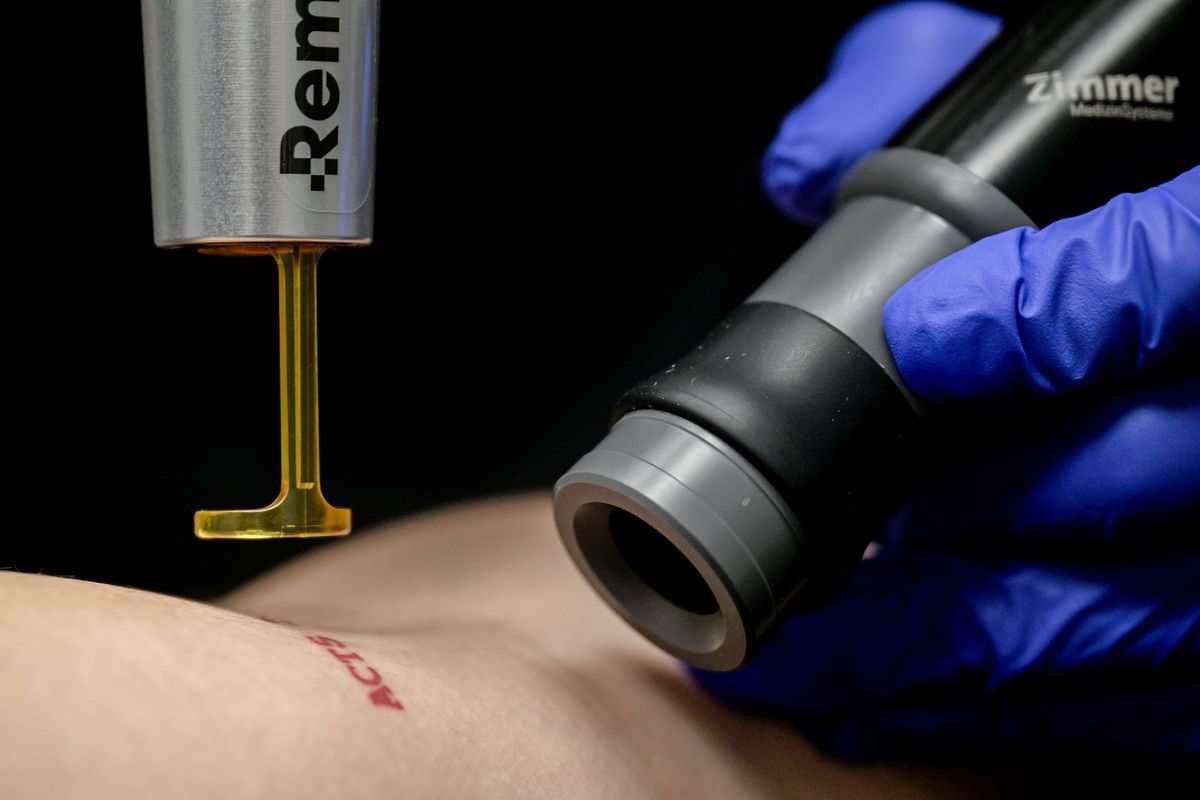
The 30-year-old waitress has elected to keep many of her tattoos, at least the ones with meaning. The tattoos she doesn’t want, like the red heart with a banner across it positioned on her leg, are slowly fading, not with time, but with the help of a laser.
The state-of-the-art laser that Removery uses is known as the PicoWay. Melanie Lawrence, the supervising nurse practitioner at Removery in Spokane, said the machine costs around $293,000. The Picoway uses ultra-short, “picosecond” (a trillionth of a second) pulses to break ink into tiny particles. Once the particles are broken down, the body can begin to absorb the ink into the bloodstream.
For the next two years, Foster is undergoing treatment every six to eight weeks to get rid of a variety of tattoos she no longer wants.
“This was an emotional cleansing thing for me,” Foster said. “I’m getting rid of that old version of me in those tattoos that aren’t serving me anymore. I’m excited that I can actually, like, wear a bathing suit and be able to show my skin and not have to worry about my tattoos. So I’m really excited for the next chapter in life.”
Ashley Sullivan, the sales consultant, relishes the opportunity to learn more about the backstory of each client and why they’ve chosen to get their tattoos removed.
She explained that while it’s difficult to know for certain, the majority of the tattoos that clients want erased are medium-sized, which, on average, cost $2,899. An arm sleeve, she said, costs closer to $4,800 for treatments spaced out every six to eight months over the course of a couple years. An extra small tattoo can cost as little as $63 a month over the span of 24 months, according to their website.
Flexible payment options are always available. Foster said she’s paying around $185 a month for the next three years to remove 14 square inches of ink.
There are also discounts available for military, police, firefighter and nurses, as part of their “hero discount.” For those looking to enlist, depending on the branch, Sullivan said they offer discounts up to 50% off. They’re willing to work with anyone to make the removal of tattoos affordable.
“Sometimes people are like, ‘Oh, they’re tattoo removal. They’re super anti-tattoo.’ We’re not anti-tattoo,” Lawrence said. “We are anti-tattoos -that -you -don’t -want. So, whatever tattoo, whatever art, whatever expression of your body that you want to do, we want to help you get there.”
Jo Kelton, a founding member and chief operating officer for Removery, was in London and 21 years old when she got her first tattoo. Her tattoo was, as she put it, a Chinese symbol whose true meaning is still shrouded in mystery, even years later.
As tattoos become more normalized in society, including in the military and among stewardesses on commercial airlines, there are fewer practical reasons for getting them removed. Now, Kelton said it’s more of a transformative act, representative of an evolution in one’s character.
What started as 33 locations in 2019 has grown into 165 Removery stores across the United States, Canada and Australia. Kelton said there are around 320 million people across those three countries over the age of 18. Of those people, she said around 35% have tattoos, and many have four or five pieces of body art. She said approximately 25% to 30% of those folks who have a tattoo no longer want them on their body.
“I think (Removery) enables them and empowers them to really show who they are right now,” Kelton said. “Secondly, I think there are other reasons that might also play into people’s desire to remove or change tattoos, and some of those might be a bad memory. So you might have a girlfriend, boyfriend, whatever. You might have a name or a wedding ring is a really common thing that people want to remove. But it all comes back to, ‘Hey, I’m just not that person anymore.’”
She and the Removery team identified Spokane as an ideal location based on population, the demographics of the population and the close proximity to universities with students who may no longer appreciate their tattoos.
Kelton got a tattoo of the company’s logo with the CEO when they first started and went through the process of expunging it to experience the “highs and lows” of tattoo removal.
Any sort of mechanical disruption of tissue, Kelton said, is going to result in discomfort. She equated the pain to a sharp pinprick. For Foster, she said the pain of getting a tattoo removed was a bit more jarring than getting stung by a bee. After treatment ends, the skin feels like a mild sunburn for about 24 hours. This is easily remedied with Vaseline or other kinds of skin ointments, Kelton said. The pain tolerance and age of a client, coupled with the size and scope of the tattoo, greatly affect the pain prospective clients can expect to feel.
Daniel Hagerty, the medical director for Premier Body and Laser in Spokane, said numerous factors determine how long it takes for the body to break down a tattoo. Age, skin type, sun exposure, density of the ink and the tattoo’s distance from the heart all play a part in how long it takes for a tattoo to completely disappear.
He compares getting rid of a tattoo to a person trying to demolish a block of concrete to make room for a new porch. Except in this scenario, the would-be demolisher is armed only with a shovel, a dust pan and a broom.
Since one can’t destroy a block of concrete with any of those tools, they must purchase a sledgehammer to break off chunks of concrete.
“The dust pan is the white blood cells of the body (that absorb the ink), and the sledgehammer is the laser,” Hagerty said. “And the sledge, the laser, is able to hit the ink without damaging anything else. So as you swing that sledgehammer, you’re not hitting the window, you’re not hitting the side of the house, you’re not hitting your wife’s rose bushes sitting next to the porch. You only hit the concrete. That’s the art and elegance of having a medical laser.”
Hagerty said Premier Body and Laser offers all sorts of cosmetic enhancements, including facial rejuvenation, hair removal and cosmetic liposuctions. But tattoo removal takes up the lion’s share of the work they do.
The smallest tattoo, about the size of half of a dollar, costs $300 for just one treatment, Hagerty said. For a sleeve, one treatment could cost anywhere from $600 to $800. Just like Removery, the actual cost of getting a tattoo removed is highly subjective, and subsequent treatments after the first are more then likely to occur.
Twelve years after first getting inked, Foster is excited for a blank slate, both physically and emotionally.
Women who are pregnant shouldn’t get tattoos removed, and a client should have someone drive them to their appointment, Foster said.
“I’m actually going to do this now, because it’s an obtainable thing,” Foster said. “Before, it kind of was just a dream. I was thinking about getting cover-ups, and some of them that I have would be kind of hard to cover up. I’m just ready for a clean slate, not something covered up.”