
Shoshone-Bannock culture spotlighted in PBS Kids’ ‘Molly of Denali’ episode
In recent episodes of the popular PBS Kids series “Molly of Denali,” Molly has been traveling across the U.S. in her “Molly’s Epic Adventure” spinoff series, exploring different tribal communities and educating viewers about different Indigenous stories and cultures surrounding volcanoes.
Shorts series co-writer and story editor Vera Starbard (Tlingit/Dena’ina), who was recently nominated for an Emmy for the show, said the mini-series was a great opportunity to introduce their Lower 48 Indigenous relatives to both Molly and their audience.
“Molly is able to see these dramatically different lands and languages and cultures – and yet she still experiences the historical ties that bring Indigenous people together across the world,” she said.
When Starbard was young, she remembered spending time in the Lower 48 and thinking it being dark at night in the summer was weird. In Alaska, summer meant midnight sun. As she grew older, she met more Indigenous communities, appreciated the differences of others and felt a lot of pride for where she came from. She hopes the series helps viewers see the outside world and their own neighborhood differently.
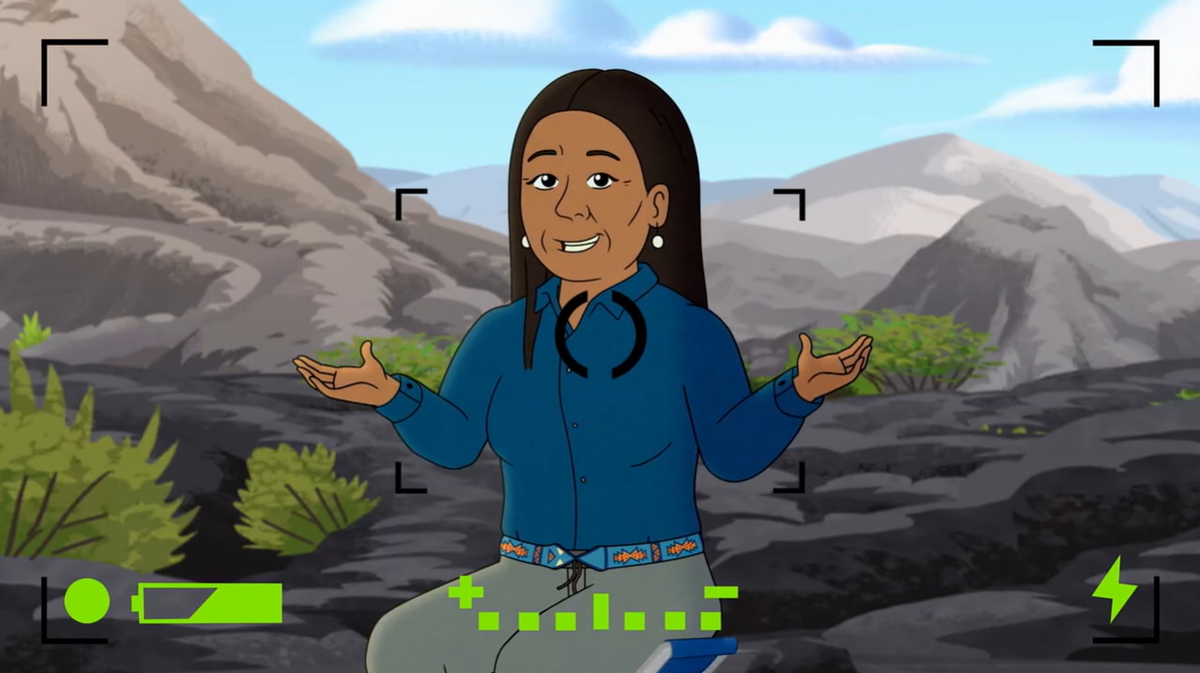
One episode of the mini-series is set in Idaho, focusing on the Shoshone-Bannock Tribes and featuring a character modeled after Rose Ann Abrahamson; Gagu Rose (voiced by Renaltta Arluk). In the episode, Molly learns about the Craters of the Moon National Monument and Preserve as she navigates through the cavernous lava tubes and later learns about the traditional story of Doe’gwo’ah, the giant snake that is said to have created the Craters of the Moon.
Rose was working for the tribe’s education program when her supervisor, Jessica James, asked her if she knew any Indigenous stories about the Craters of the Moon and lava beds. James knew she was a traditional storyteller and cultural consultant.
She was then told that people working on the PBS series were interested in a traditional story of the area for a storyline. She was able to share the story, find tribal citizens as characters, and work with language consultation and the storyline. The story that she shared was from the Agai Dika Shoshone, Sacajawea’s people. Rose is her great, great, grandniece.
“I am very proud of my heritage and lineage and like to share our Agai Dika ancestral knowledge. PBS wanted me to be the grandmother Gagu Rose, and I submitted my photograph (taken at different angles and sides),” Rose said. “I didn’t know how I would look or be until I saw the preview. At the premiere in Fort Hall, the tribal members recognized me and the children called me Gagu Rose in the community.”
The writer of the episode, Peter Ferland, said he was excited to meet Rose and work with her over Zoom, describing her as a terrific storyteller. He was fascinated that the volcanic eruptions that created the Craters of the Moon lava flows were witnessed by the Shoshone-Bannock people and how stories of it were handed down for thousands of years.
He also loved learning about the thrilling Indian Relay Races that were discussed in the episode, desiring to see them in person.
Rose said she really liked the way her traditional story was illustrated and presented and how her cartoon character looked. She added it also preserves the Shoshone word for grandmother – Kagu/Gagu.
“It feels wonderful to be able to share a Shoshone tribal story that is preserved in film for children and audiences, and to represent Indigenous people and our ancestral knowledge,” Rose said.
Some of the things she wished they were able to share in the episode include more stories about the lava beds. However, her character’s story can be found at the park.
Ferland also wished they could have included more beadwork in the episode. While there’s some beadwork inspired patterns in the artwork for the episode, he said it would have been fun for Molly to experience a total disaster doing beading around her Idaho aunties, spilling beads into the chokecherry pudding by accident or something along those lines.
Rose has acted before and worked as a consultant on other film projects as well. She is a member of the Screen Actors Guild and was in the sports movie “Edge of America,” made by “Smoke Signals” director Chris Eyre (Cheyenne and Arapaho Tribes), consulted on an HBO project in Canada, and has worked on three documentaries, one of which was written with Agai Dika Shoshone elders.
Despite the projects she has worked on, and Sacajawea making the Shoshone known globally, she said more projects need to be made because the world has not heard their stories, narratives and wisdom. The ancestral knowledge of the Shoshone has not been shared as much as other tribes.
This episode was a very different kind of work for her because she got to be an actress and consultant and work on storylines. She said she enjoyed working with the staff on recreating the Shoshone story into a cartoon.
This is not the first time the culture and history of the Shoshone-Bannock Tribes received accurate representation for TV audiences.
Her daughter, Lacey Marie Abrahamson, was a consultant on the Paramount+ series “1883,” where she helped bring authentic representation to the series. Lacey said she enjoys when her tribe is highlighted and depicted correctly, adding that it creates bridges of understanding. She also said seeing her mom as an animated character was legendary.
As to whether this episode of the PBS series and the Paramount+ series will help continue educating people about her tribe’s culture, Rose replied yes, describing it as the most powerful source of telling, sharing, and presenting their culture.
“The world today is visually connected, related and communicated,” Rose said. “We as Indigenous North Americans have a myriad of stories, narratives and knowledge that has not been tapped. Imagine if we created films of our stories, experiences, and knowledge. The world would see through our lens and laugh, weep, smile, and reach out and say ‘brother.’ ”
Rose hopes people who watch the episode of the PBS series will realize that the tribe’s ancestral knowledge is alive, powerful and full of wisdom – and their scientific and geological knowledge is shared in stories.
Rose continues to work on projects that seek to educate and hopefully inspire. She also consults on Lewis and Clark-related projects, works on Shoshone translation projects, does Indigenous cultural consultation and is co-coordinating the Intertribal Gathering of Nations Horse Parade in New Mexico.
You can watch the full episode on pbskids.org.