
Solar power and farming can co-exist on the same land. Just ask Cameron Krebs’ sheep
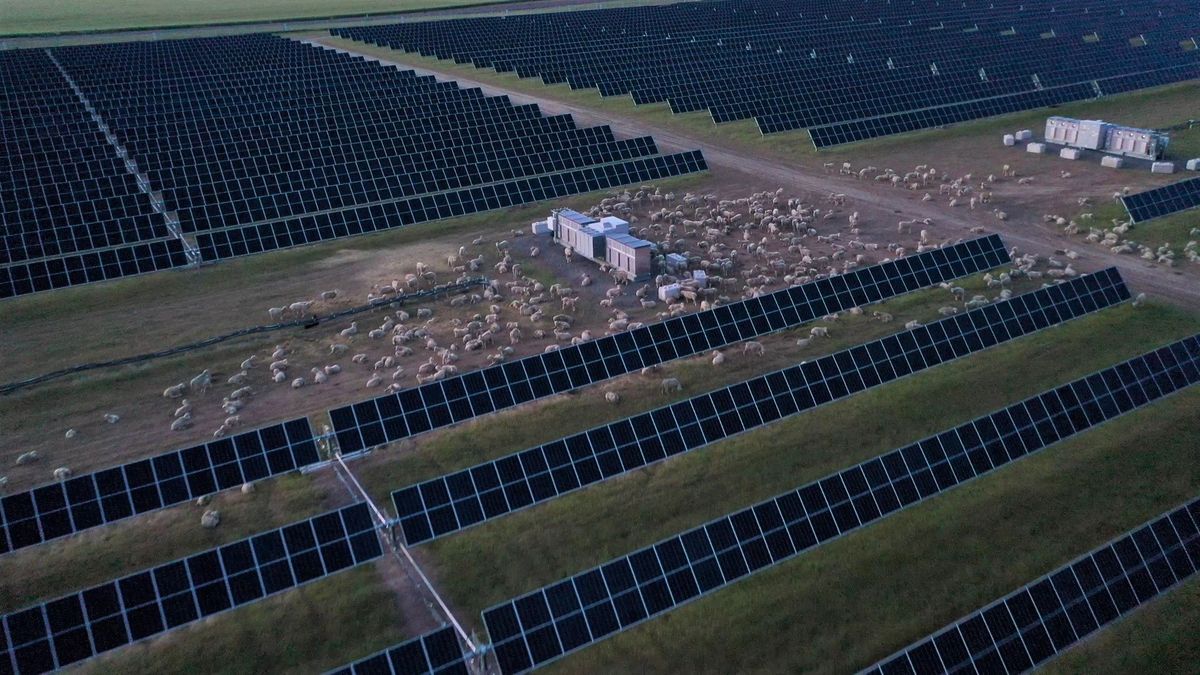
Cameron Krebs’ fleet of lawnmowers are a bit fluffier than mechanized models.
The four-legged, cud-chewing sheep, graze on grass under solar panels across 5,000 collective acres in the Pacific Northwest. Thousands of Krebs’ sheep rotate from one solar farm to the next, munching on greenery typically from March until June. Once the cute, wooly ruminants have eaten their lunch for the day, they settle down for a snooze under the shade of hundreds of thousands of solar panels. At least until their stomachs start growling again.
Krebs and his clients, like the energy company Avangrid, are a part of a new wave of farmers, innovators and investors interested in the concept of agrivoltaics and ecovoltaics.
Agrivoltaics is the dual-use of land for agriculture and solar energy generation. Farmland is prime real estate for solar panels because the area is often cleared, fairly accessible, flat and possesses the most crucial ingredient – access to sunlight.
Krebs practices ecovoltaics, which is slightly different from agrivoltaics, as it centers around vegetation management and ecosystem health rather than crop production.
“Our target is to remove that vegetation cover before the dry season, before the fire season,” Krebs said. “So we basically have a 90 day target treatment window.”
In a world rife with concern over the climate crisis and the need for more food for a growing population, supporters say agrivoltaics simultaneously feeds people and produces clean energy.
The Washington State Department of Ecology predicted that electricity needs will double in the state by 2050. This estimate does not include what enormous energy users need, like data centers for artificial intelligence.
Chad Kruger, the director of Washington State University’s Center for Sustaining Agriculture and Natural Resources, said Washington will be short somewhere between 10 and 30 gigawatts of power in the next 10 to 20 years. For context, one gigawatt of power is roughly equivalent to half of the power generated at the Hoover Dam in a year, according to the U.S. Department of Energy. Or for the more abstract thinkers, roughly 1.3 million horses, when converting horsepower to gigawatts.
Potentially cleaner sources of energy, like geothermal, nuclear, hydropower and wind are viable options, but often posses a variety of hiccups that stop them from being implemented on a mass scale. They either have too high of an upfront cost, are limited because of grid infrastructure, or are considerably less dependable than fossil fuels.
New and innovative means of attaining energy have numerous kinks left to work out, but not solar. Solar is ready now.
Kruger co-authored a report that found there are approximately 87,000 acres of farmland located within a mile of an electrical substation deemed suitable for an agrivoltaic installation. This equates to somewhere between 8.7 to 17.4 gigawatts of power, according to their report, “Low hanging fruit for Washington’s energy future.”
“About half of that 87,000 is orchards and about half of it is essentially irrigated improved pastures,” Kruger said.
Still, conflict and concern remains among farmers worried that solar development companies will strip the land solely for photovoltaic (solar panel) purposes, rendering the once fertile ground fruitless.
“It all comes down to this idea that putting solar panels on ag land means that you can’t produce food from it anymore,” Kruger said. “Then what happens is people start to realize you’re not talking about displacement, you’re talking about this dual benefit idea. They get curious and they start saying, ‘Tell me more about that.’ ”
One person who wanted to learn more is Jack Southworth. He owns a cattle ranch in Grant County, Oregon, that his great grandfather started in 1885. Since the 1980s, Southworth has practiced holistic land management and considers himself, like Krebs, a steward of the land he works.
In 2024, he planned on working with a solar developer to install solar panels on several 8-acre parcels of land, not to exceed 80 collective acres. Unfortunately, things did not work out the way he initially planned.
The company that Southworth and the would-be solar developer planned on selling their power to was not a local entity. Enter the middleman: Bonneville Power Administration. The middleman was supposed to transport the power from Southworth’s ranch about 17 miles to the buyer’s utility line. For this service, Bonneville charged a wheeling fee.
“That’s like if you owned a highway on your property and I wanted to haul my goods to market,” Southworth said, “You’d probably charge me to cross your property. That’s what the wheeling charge is.”
The wheeling charge was too steep of a price to make the project economically viable. Southworth said even if they could do just a little better than break even, he’d love to do it. But losing money on every watt produced, just doesn’t make sense.
While Southworth envisions an electric future littered with agrivoltaic installations, even electric tractors, it might not happen anytime soon. He said the current federal administration set an anti-solar tone, which makes attaining grants, funding and finding partners for such projects a struggle. And at the end of the day, if there is not even a slim margin of profit, then there is nothing worth investing in.
“I’m not going to be an evangelist for something that I can’t make economically feasible,” Southworth said.
While the practicality of agrivoltaics at scale may still be a work in progress in many instances, there are small research startups and demos popping up, many of which are overseas. More locally, a $2.4 million grant from the Washington State Department of Commerce recently funded a demonstration project on an acre near Wenatchee at the WSU Sunrise Research Orchard.
Max Lambert, the science director for the Nature Conservancy, said that perennial tree fruits, like apples and pears, along with berries are particularly suitable for agrivoltaics. Crops like wheat and alfalfa that require heavy machinery don’t work as well, because combines cannot fit under solar panels.
Central Washington stands out from the rest of the state as an ideal region for agrivoltaics. The tree fruits, grapes and berries that dot across Central Washington work well in dual-purpose solar settings. Portions of Western Washington, like Whatcom and Skagit counties, also have berries that could grow under solar panels. Many crops in Eastern Washington, like alfalfa and wheat, operate on a pivot irrigated system, which would not work well for dual-use solar installations.
Because Central Washington has a number of dams along the Columbia River, there are numerous substations and transmission lines available for potential solar projects. Lambert estimates that every mile of additional transmission line constructed costs approximately $1 million.
Another bonus of agrivoltaics, Kruger and Lambert said, comes from the shade of the panels. Depending on the crop, the shade can help the plants grow and avoid getting sunburned.
“You can get some cost savings from the many, many thousands of dollars that goes into trellising and shade cloth that’s added and taken down every season by having solar panels (instead),” Lambert said. “So the actual solar panel posts can act as a trellising, and then the panels themselves replace the shade cloth.”
The state-funded report that Kruger and Lambert worked on was divided into three parts. The first part was aimed at ascertaining the level of understanding among farmers about agrivoltaics, followed by gauging respective farmers interest. Kruger said that of the 100 farmers who were interviewed, few knew about agrivoltaics. But a little more than half of the farmers expressed modest to strong interest in the concept once they learned more.
Kruger said the study also modeled what agrivoltaic installations would look like on farms in Washington and assessed “likely lands on which agrivoltaics could be a plausible option.”
One likely and underused portion of farmland lies in the corners of center-pivot irrigation systems.
A center pivot is an agricultural system where water is pumped from a source like a well to a central pivot point. From there, the water is delivered outwards, typically in a circle, to sprinklers along the pipeline. In a 160-acre section, a center pivot usually covers about 130 acres. This means there are another 30 or so untouched corner acres where crops are not being grown.
The report, funded through an award from Washington State’s Department of Commerce, determined that there are more than 40,000 acres of corners in Washington that are within a mile of an electrical substation.
For Krebs, he has around 800 sheep munching at a time across a collective 5,000 acres of vegetation. The presence of his sheep between solar panels makes it considerably easier for the energy company, Avingard, because they do not have to spend time and money trimming grasslands with inorganic mowers.
Avangrid has four solar projects in the Pacific Northwest, three in Oregon and one in Klickitat County, Washington. Krebs’ sheep rotationally graze across all four locations. The solar farm located in Klickitat County, known as Lund Hill, is a 150-megawatt project that’s the state’s largest installation with hundreds of thousands of panels. An Avangrid location in Oregon, Pachwaywit Fields, provides power to 40,000 homes over the course of a year, said Avangrid’s communication manager, Keaton Thomas.
Thomas said Avangrid’s partnership with Krebs began with 500,000 solar panels during a trial run at Pachwaywit Fields in 2023. It took only a few weeks for Avangrid officials to realize they wanted sheep at more than just the one location.
“We estimated last year that we used about 5,000 sheep across all of our projects in total,” Thomas said. “When we’re building and operating these large-scale solar projects in these communities, we are always looking for ways to work with the community”
Krebs, a fifth-generation sheep farmer, said that he looks to partner with companies who have a high degree of social and environmental responsibility.
There’s no panacea to the looming energy issue, Lambert said, and challenges remain with agrivoltaics, particularly the high upfront cost, but as demand for renewable energy increases along with the need for more food, solar panels on farmland may be the most viable answer available now.
“We know how to manage the land better than we ever have,” Krebs said. “And I think there are companies out there that are recognizing this and are working hard to be great developers of renewable energy and also great land managers.”