
What the homes that survived the L.A. fires reveal
The damage to the fire-ravaged neighborhoods of Altadena, California, appears endless and unsparing.
But amid piles of debris and toxic ash, some buildings are still standing. Whether by design or accident, some homes had structural advantages that helped them survive.
It’s almost impossible for experts to piece together why certain homes burned – most of the evidence is ash. But in the aftermath of the Los Angeles fires, they are closely studying the homes still standing, searching for clues to how homeowners can cope with future wildfires.
In some cases, homes were built with noncombustible materials such as stucco, brick or cement, long before California’s building code took wildfire into account. In other instances, owners retrofitted their homes and cleared vegetation to prepare for the threat of a wildfire.
Building for fire
When Mark Schoofs and Jorge Santana Corona decided in 2021 to build an addition onto their 1960s bungalow, they sought to make their home as fire-resistant as possible; nothing on the outside would be flammable.
“When, not if, when a fire came here, we were going to be at risk,” Schoofs said. The couple was already fire-wary. They had seen a small fire erupt in the mountains above them years earlier and, in a separate incident, had fled thick smoke from another fire when their daughter was a newborn.
“Obviously, I certainly didn’t think it’d ever be like this,” he said.
Santana Corona did much of the work himself, digging the new foundation and studying the architectural plans at night. Although he had no background in home-hardening, the term used to describe adding fire-resistant features to a house, he learned the basics online. Santana Corona followed experts’ advice closely and said he sometimes went beyond California’s code requirements – coating the house in extra-thick layers of stucco, and adding an ultrafine mesh backing to the roof vents.
“We were doing more than what we were asked to do,” he said.
The house has dual-pane windows made of tempered glass, which is more fire-resistant than regular glass. Still, the homeowners had a close call: Heat from a neighbor’s burning home melted several windows’ vinyl frames.
The roof is fire-resistant and slated, allowing embers to roll off. The garage door is flush with the driveway, helping prevent embers from blowing inside. A fire started by embers inside a garage or attic could go undetected until it consumes the house from the inside.
Like the rest of the structure, the eaves are coated in noncombustible stucco, a plaster material used on home exteriors. Exposed eaves are vulnerable to direct flame contact and embers collecting in gaps and crevices.
At the back of the property, a cinder block wall may have prevented the neighbors’ burning hedge from blowing into the side of the house. Metal caps protect the wooden beams overhanging the cement balcony, preventing embers from igniting them.
The area immediately around the home is cleared of vegetation, significantly reducing the risk of an ignition near a wall.
Santana Corona was still putting finishing touches on the house in early January when the Eaton fire burst out of the San Gabriel Mountains.
While the house looks almost untouched from the outside, the real harm is invisible, said Schoofs, adding that it will be a long time before they are able to return because of the health risks from smoke damage.
“I don’t have words to describe the stench inside our home,” he said.
The couple are already thinking of ways they can make their home more fire-resistant. Upgrading to aluminum windows is in order, they said, and they are planning to extend the cinder block wall so that it surrounds them on three sides.
Minimal retrofits like this can be relatively affordable. But the cost of hardening an existing home can vary widely. According a study by the research group Headwaters Economics, it can run as low as $2,000 for minor upgrades to upwards of $100,000 for the highest level of protection.
“It’s not like you need to have a Ph.D. in architecture and fire-resistant material,” Schoofs said. “There is a lot you can do with a basic understanding of how a house actually burns down.”
Why some homes survive, while others burn
In the aftermath of a fire, experts said there are some things that can’t be known for certain, such as whether firefighters saved a home or if a sudden shift in wind direction spared another.
But photos from a damage assessment done by Cal Fire – where inspectors assessed the impacts of the fire on over 18,000 structures in Altadena – show possible ways the fire may have spread: from plants, fences or other combustible objects onto wooden sidings and roofs.
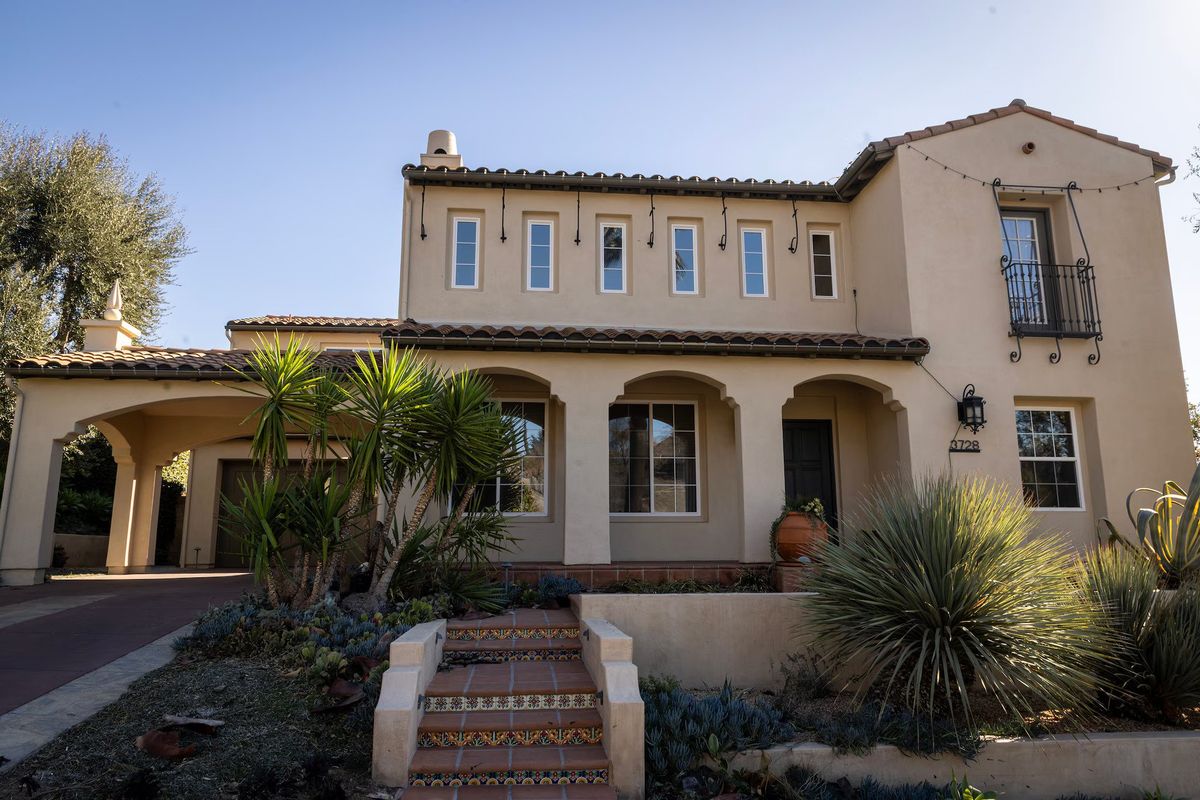
Not far from Schoofs and Santana Corona’s house, two adjacent homes had many similarities. They were about the same size and age inside the upscale gated community of La Viña. Both had stucco siding and cement tile roofs. They stood about 25 feet apart.
A key difference: One of them burned to the ground. And the other did not.
A home’s roof is its “most critical component,” said Steve Hawks, director of wildfire policy at the Insurance Institute for Business and Home Safety, a research group that studies how to strengthen homes against natural disasters. Hawks inspected homes that survived and didn’t after the Eaton fire, including the two in La Viña.
The most fire-prone roofs, such as ones with wooden shingles, are rare, he said. In newer subdivisions, such as La Viña, roofs tend to be made of fire-resistant materials, such as concrete and clay tiles, asphalt shingles or metal. The vast majority of homes in Altadena that survived, he said, had what are known as Class A roofs – the highest-rated to protect against fire. But that alone wasn’t enough – the two adjacent homes in La Viña both had Class A roofs, he said.
The bottom 6 inches of a home’s siding is also important, he said, as that’s where debris and embers can collect. Near the ground of the home still standing, there was a tiny overhang where the walls met the concrete foundation. Sometimes the underside of that lip is exposed wood, which is vulnerable to fire. In this case, it had been finished in stucco.
Fire often reaches a house by what’s adjacent to it – trees, shrubs, wooden fences, cars, trash cans – fuel that can connect a fire to a home. That’s why the first 5 feet around a house are the most important when considering ways to protect one’s home, Hawks said.
Charred embers lay on the ground all around the surviving home. But as Hawks walked the perimeter, he said the owner had done a “fairly good job.” There was pea gravel around the home and a limited amount of vegetation in the yard. But common plastic yard items, including a shed, garden hose and trash cans, presented a fire hazard.
“These tend to melt and become a liquid which is very flammable,” Hawks said of the shed.
In an interview, homeowner Olga Eysymontt said she had been “pretty vigilant” about maintaining the area around her home. When the fire department warned her that a pepper tree in her backyard was overhanging a wooden pergola, she cut it back immediately, she said. Still, she knew she hadn’t done everything right. The metal screens covering her home’s vents had too-large holes, which could have allowed embers to get in. By some chance, they hadn’t.
Her neighbor wasn’t so fortunate.
Safety in numbers
In the face of continued population growth in California’s most fire-prone areas, scientists and policymakers have emphasized that home-hardening works best at scale. It’s good for one person to equip their home with fire-resistant features, but it’s far better for an entire neighborhood or town to make these changes.
But what percentage of homes in a community need to be retrofitted to safeguard it?
Michael Gollner, an engineering professor at the University of California at Berkeley who studies wildfires in urban areas, said more research is needed to understand if there are safety thresholds communities need to reach. The science of how to prevent wildfires from spreading in urban areas is still relatively new, he said, and many California cities are only beginning to take wildfire standards on defensible space seriously.
New research by Gollner and Maryam Zamanialaei, a postdoctoral researcher, shows that hardening an individual home has only a moderate effect. But retrofitting all homes in a community “has the potential to cut the level of destruction in half,” he said. The research is not yet published and is undergoing peer review.
Nine out of 10 homes destroyed by the Eaton Fire were built before 1970, decades before the state adopted new construction standards in 2008 to protect against wildfire.
California, since 2006, has required property owners in high-fire-risk areas to create 100 feet of defensible space around structures. In 2020, after horrific wildfires, lawmakers passed a new measure: a requirement to create an “ember-resistant” zone free from flammable materials such as plants, garden sheds and propane grills within five feet of homes. Those regulations still haven’t been written, and there is no timeline for them to be completed.
Michele Steinberg, director of the National Fire Protection Association’s wildfire division, said that in places such as Southern California, where homes are right up against each other, relocating a wood pile or a propane tank often means moving them closer to a neighbor’s property.
“Some of this is very hard to achieve in already-designed communities,” she said. “What we do know is neighbors have to work together.”