
Bobby Jenks, champion closer with North Idaho ties, dies at 44
In the case of Bobby Jenks, a classroom washout who became a World Series hero, larger than life doesn’t quite cover it.
The briefly brilliant former Chicago White Sox closer, who lived a while in a Spirit Lake cabin, died Friday. Suffering from a pervasive form of stomach cancer, he was only 44.
Jenks loved baseball. Schoolbooks? Not so much. In two years at Rathdrum’s Lakeland High School and a pair at Timberlake High, he was eligible for only one season. If it hadn’t been for the summers he starred for the Prairie Cardinals, an American Legion team based in Post Falls, he might have remained in obscurity.
Instead, the Anaheim Angels made the tall right-hander their fifth-round draft choice in 2000. What had they seen?
In two Panhandle Legion seasons, he struck out 254 batters in 1731/3 innings. When he wasn’t on the mound, he was a power-hitting third baseman.
Jenks dominated the 1997 Legion season, striking out 17 in the semifinals as Prairie breezed through the district playoffs. Then, at the state tournament, on Aug. 2, he struck out 18 to defeat Idaho Falls. In 1999, he threw a pair of no-hitters, went 6-for-6 in another game and led Prairie with eight home runs.
“I like to think I’m a complete ballplayer,” he said. “I just like to be out there helping in every way I can.”
Logically, the Angels wanted him as a starting pitcher. But that summer with Butte of the Pioneer League, he was awful, finishing with a 1-7 record and a 7.86 earned run average. Parts of his next two seasons weren’t much better.
In 2003, he put together a 7-2 Texas League campaign. But he underwent elbow surgery the next year and, after he pitched only 191/3 innings, the Angels lost patience. They put him on waivers. For $20,000, the White Sox took a chance.
By then, Jenks had filled out to 6-foot-4 and at least 270 pounds. And he came with a history of disciplinary issues. But his fastball approached 100 miles per hour, and his curve was wicked.
During spring training, probably with the rebuilt elbow in mind, Ken Williams, Chicago’s general manager, asked Jenks what he thought was his quickest route to the majors. Relief, the pitcher answered. Williams said go to Birmingham, throw your fastball and curve for strikes, and we’ll see you sometime this summer.
On July 6, 2005, Jenks made his big-league debut, striking out two in a home victory over Tampa Bay. By season’s end, he was the closer. The best was yet to come.
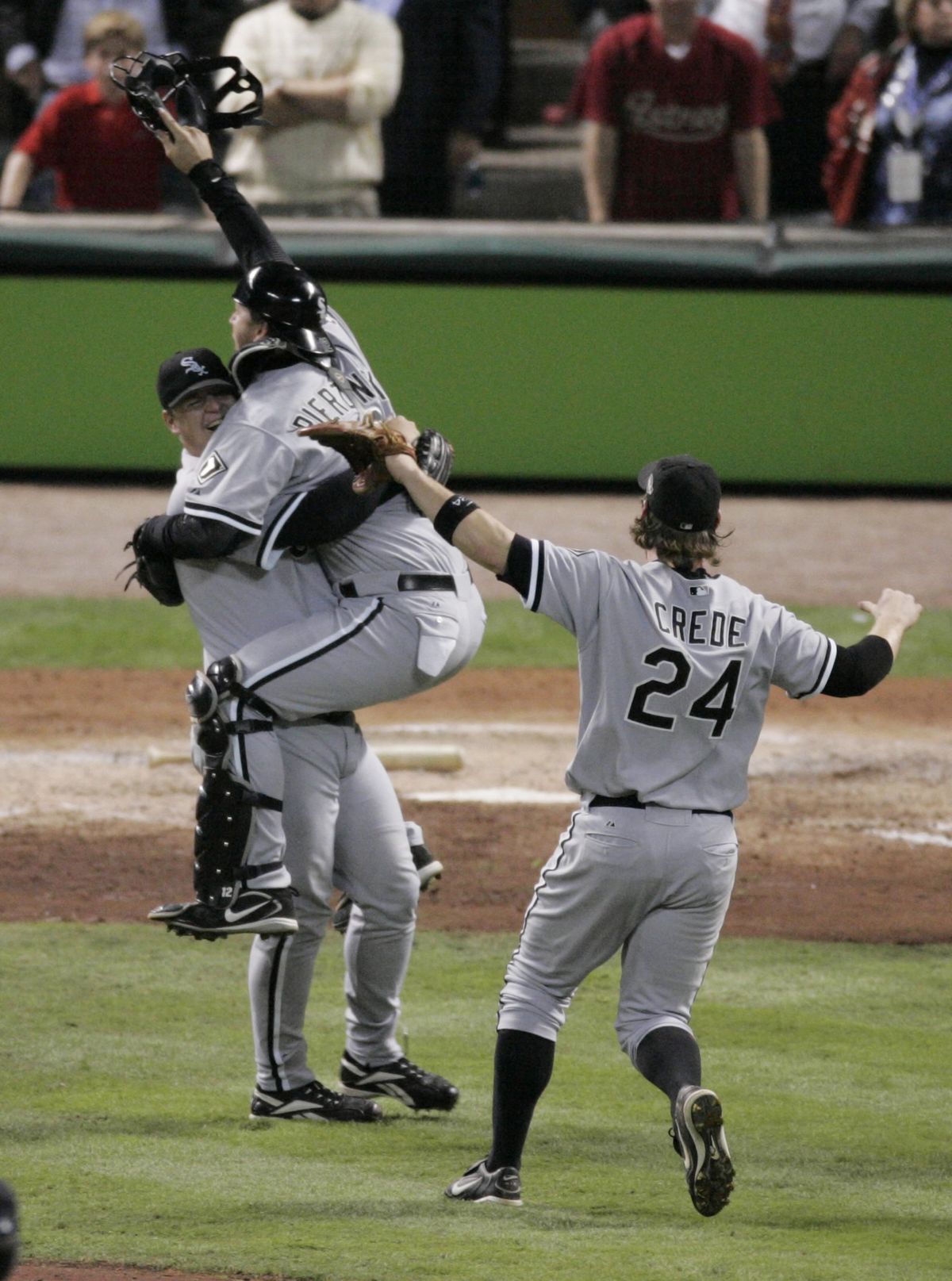
The unheralded rookie starred as the White Sox won the World Series for the first time since 1917. He saved two games against Boston in the American League playoffs and pitched in all four games, with two saves, as Chicago swept Houston for the title.
“I don’t know how the Angels let him go,” future Hall of Fame Sox slugger Frank Thomas said during playoffs.
Jenks saved 41 games in 2006, 40 in 2007, when he tied a record by retiring 41 straight batters, and 30 more in 2008. The next year, with his first multimillion-dollar contract, he saved 29. But, in 2010, he faltered, saving only 27 with a 4.44 ERA while battling kidney stones and injuries. And the White Sox did not offer him another contract. Released that December, he signed a two-year deal with Boston.
There, back problems limited Jenks to 19 appearances and 152/3 innings. Following two surgeries, he was still on the disabled list when he was arrested on five DUI counts during spring training. The Red Sox led him go on July 2. Jenks never pitched again.
The Mission, California, native, died in Sintra, Portugal, his wife’s home country. They moved there after their Southern California home and their possessions were lost in the Pacific Palisades fire. Jenks was hospitalized within weeks.
When he died, national news and social media buzzed with tributes.
“Bobby was a larger-than-life figure and fans related to him,” said A.J. Pierzynski, the regular White Sox catcher. “I will never forget jumping into his arms after the last out of the World Series.”
“Bobby Jenks is one of my all-time favorite players,” said his former manager, Ozzie Guillén. “I loved that man.”
The White Sox will celebrate the 2005 championship team on Saturday.
Jenks is survived by his wife, Eleni Tzitzivacos, and their two children, as well as four children from a previous marriage.