
Western Pines fire in Lincoln County, which has destroyed more than 20 residences, covers commonly scorched ground
DAVENPORT – When the sky turned black July 9 and helicopter after helicopter buzzed over Mill Canyon, people living in the area knew they couldn’t wait much longer to leave.
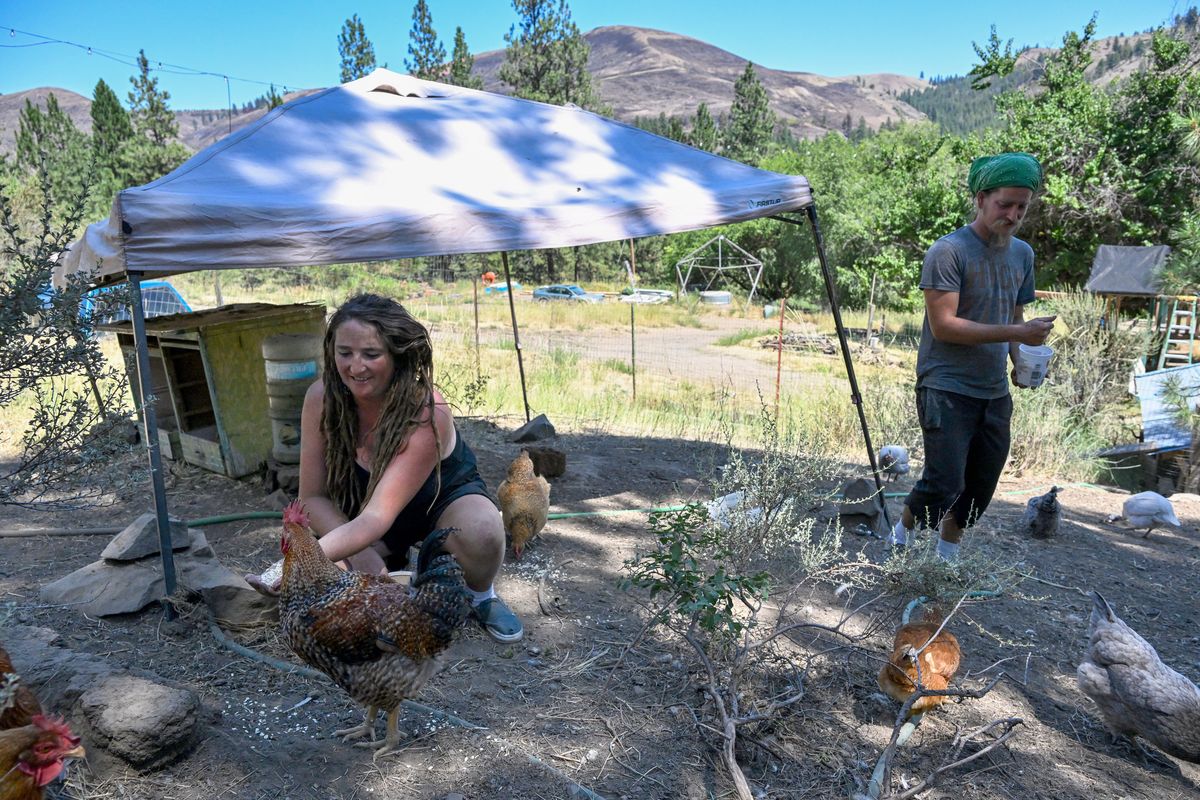
So Emma Stime and Adam Striker, who live off the beaten path from Mill Canyon Road, looked at their 31 chickens and decided to save as many as they could. Only five of the chickens allowed the two to put them in a dog crate to rescue them from the blaze. That was as much as they could do for them at the time.
“By the time we packed a few things up … We were just in this shadow, this big cloud of smoke,” Stime said. “And it was coming in fast.”
In a matter of hours, the fire 10 miles northeast of Davenport grew to more than 1,000 acres. It continued to grow as high winds spread the fire from hill to hill. As of Wednesday, the fire is sitting at more than 5,800 acres with 60% containment and has burned more than 51 structures, 21 of them being cabins, homes or RVs. About half of them are in the Moccasin Bay area near Lake Roosevelt.
“It’s an emotional time,” said Connor Nikkola, who works as the northeast region’s natural areas manager at the Washington Department of Natural Resources. Nikkola has been working on the incident management team assigned to the Western Pines fire.
“Some of these folks have had their cabin in their family for generations, and it’s tough to see the damage as they try to go through and salvage what family artifacts they can,” Nikkola said as he drove through the already burned areas above the canyon on Wednesday. “It’s hard, here in the canyon. There is only one way in. Basically one way out.”
Stime and Striker told firefighters nearby, who had come to tell them they should probably leave as soon as possible, that they wanted to try and spare their chickens. The two moved wood piles away from the coop and propane tanks far from the house. They labeled their drinking water in case the firefighters or neighbors needed extra, and took off with what they had in their truck.
“The sunset had made everything a bright orange. Everyone was glowing in the light,” Striker said outside his home Wednesday.
That night, the two stayed with a friend.
“You just stand back and hope for the best,” Striker said. “We know we are lucky here.”
Stime said their elderly neighbors, whose homes lie beyond the trees even further down the road, would have nowhere else to go if they lost their place. So they stayed.
It’s part of the reason Striker and Stime came back to the house in the middle of the fire and during evacuations – they knew if they could get to the backroads they came from, they’d be able to see if everyone was OK. When they came back the next day, nothing had burned – but the planes overhead were dropping retardant just beyond the trees. The two watched a DC-10 drop blood-red material directly into a hillside. The top of the mountain across the canyon from Stime and Striker’s property is still painted a light shade of pink, right where the plane had dropped the fire suppressant days before.
The topography of where the fire burned is no flat land. It began northeast of Davenport, but spread further up near the Spokane River. Parts of the land are flashy fuels and some brush, but intermixed within the steep cliffs and slopes are thick stands of trees. The fire had quickly moved from hill to hill, with some trees being partly spared, while others were blackened.
“The wind was a really big factor. Once it shot up those canyons and hit the wheat, it started spotting. It was so dry, it reignited,” Nikkola said. “We had a dozen air resources and just about under 450 people assigned to the fire … It was really hazardous because we couldn’t always get our dozers down the steep cliffs. A lot of that had to be hand lines.”
On top of wildfire season getting worse year after year, firefighters and their incident management teams also must plan what brush or trees are being “preheated” to become drier by the fire around them, making it easier for the fire to catch and spread. Even then, firefighters have to think even further ahead, like where the wind will shift or if it’s safe to send a crew into a canyon where the blaze around them is largely unpredictable.
“If the fire is moving fast, and there are houses there but there’s nothing we can do, we can’t send a crew to the bottom because they won’t be able to get out,” Nikkola said. “Our top priority is human life. That can never be replaced.”
Another challenge is the state being overwhelmed with other fires – there is a large amount of resources going to the Hope Fire, a wildfire north of Kettle Falls sitting at more than 7,000 acres. Incident management teams have to plan for teams on larger fires using the same air resources. If they can’t access a certain airplane or helicopter, the team has to switch gears, Nikkola said.
“The canyons were our biggest worry,” he said. “We really have to prioritize our resources.”
State firefighters have seen a similar fire before north of Davenport, however. In 2018, a 4,500 acre fire labeled the “Angel Springs Fire” burned close to the same area. Nikkola said one of the men who operate dozers to dig fire lines has dug the same line in the same spot nearly three times. And that fire raced through the same canyon where Striker and Stime currently reside.
Their house was just narrowly missed back then, but their neighbor’s wasn’t.
“It’s happened before, and our house made it. It happened again, and our house made it,” Stime said. “There’s just nothing you can do.”
Stime’s proximity to the fires has her brothers in Canada worried about her, she said. But she told them to only show up if her house burns to the ground.
“Not until I don’t have a house,” she said.
Most of the chickens have struggled behavior-wise since the fire, the two said. It stressed them out and they’re trying to get back to normal, Striker pointed out as the two fed the chickens. They’re just grateful every single one survived, Stime said.
The Western Pines fire is believed to be human-caused, according to a release from local and state fire agencies. State crews are expected to pull out of the operation soon and hand the fire back to local districts, Nikkola said.
“Every fire tells a story,” he added as he looked over the blackened canyon. “That’s what we’re here for.”