
The vague appearance of ICE agents could create problems for local police. Spokane’s police chief is trying to prevent that.
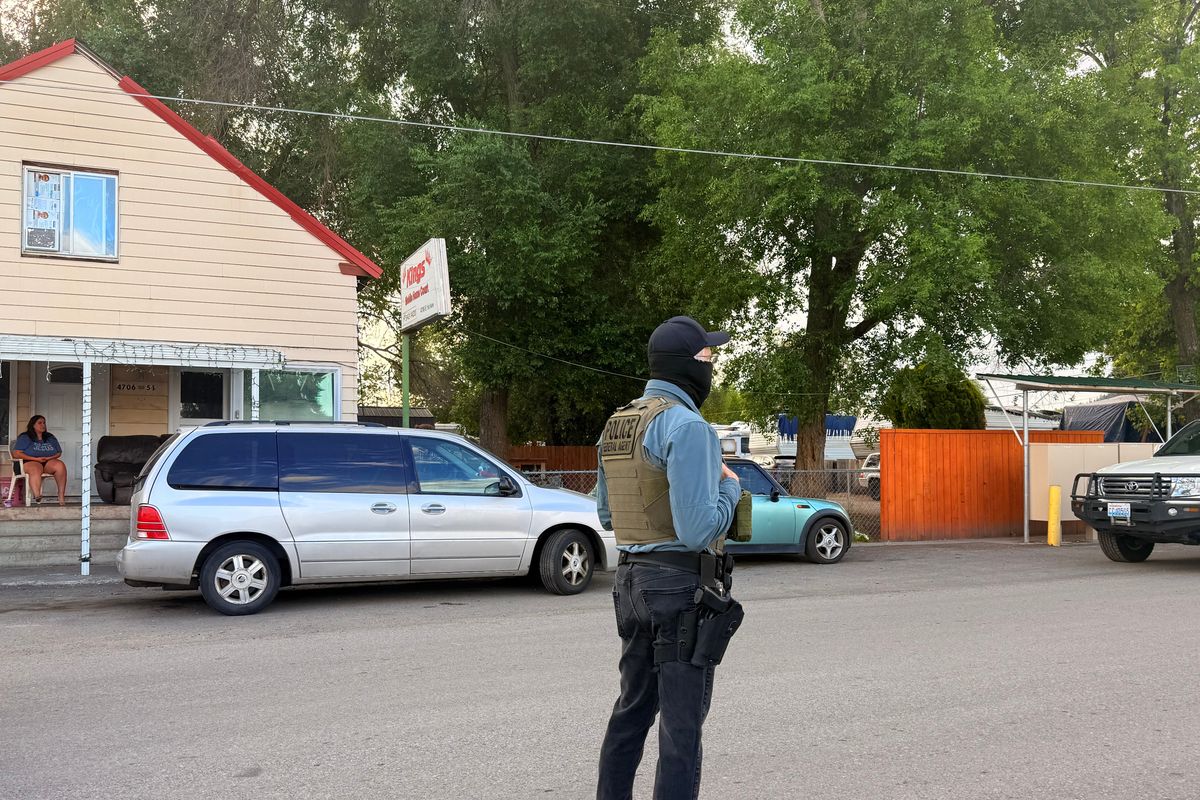
A woman sees a masked man with a gun on his hip dragging someone into a car. She panics, dials 911 and tells dispatch she just witnessed a kidnapping.
Spokane police officers arrive en masse, some SWAT, all with their guns drawn and pointed at the suspect. They discover the suspect is an Immigration and Customs Enforcement agent, conducting an arrest in plainclothes and a mask.
That hasn’t happened to that extent, said Spokane police Chief Kevin Hall – but with the growing number of ICE agents in plainclothes and masks all over the country arresting people, including in Spokane, it’s a scenario that could unfold.
The uncertainty around who is an agent and who isn’t is spreading waves of fear and confusion, NPR reported. Just two weeks ago, unidentified agents arrested a Venezuelan school teacher in San Antonio, Texas, as she left an immigration court hearing.
Agents also detained her 3-year-old son, a video from Newsweek shows, as her husband stood by and sobbed.
On June 4, federal police raided a home in Spokane Valley and arrested Luis David Ruiz-Rodriguez, a relative of another man who was arrested by ICE earlier in the year and sent to the detention center in Tacoma. Ruiz-Rodriguez’s arrest is believed to all be related to a family member’s harassment charge from December, although Spokane County court shows no record of criminal charges against Ruiz-Rodriguez.
In the raid, federal agents deployed a chemical agent and tore apart Ruiz-Rodriguez’s home. Couch cushions were strewn over the floor as agents sought a Nicaraguan birth certificate and other documents, according to an evidence inventory list obtained by The Spokesman-Review.
At the time, masked agents blocked streets and stood in front of the neighborhood with guns. None of them would identify themselves to the media or to others who had gathered and asked for an ID. The officers in the street were clad in vests that said “police, federal agent” on the back. When The Spokesman-Review asked why they were wearing masks, an unidentified agent replied, “Because we are getting threats.”
“This is an immigrant-heavy area,” Colton Langworthy, a neighbor, said at the time. “They all have jobs. This is the third time (agents) have been here and it goes on and on. There is no stop to it.”
The bulletin
According to a July 15 Spokane Police Department training bulletin obtained by The Spokesman-Review, Hall raised an urgent concern he wanted to address: that anyone could call local police to respond to a kidnapping, police would respond with guns drawn, the situation would escalate and an officer or bystander could get hurt.
He also noted that because ICE agents sometimes arrest in plainclothes, masks and unmarked cars, a citizen could replicate the behavior with little effort to hurt or harm someone.
“When responding to one of these incidents, there will be confusion, tension and fear,” the bulletin states. “… Uniformed SPD officers will create legitimacy and hopefully bring calmness and order to the incident.”
The bulletin states police are only to respond based on criminal activity, not perceived or reported immigration status. The policy is in direct accordance with the Keep Washington Working Act, a state law passed in 2019, which discourages local law enforcement and jails from assisting federal immigration authorities. The purpose of the law, according to the Attorney General’s office, is to ensure immigrants in Washington are still able to work and contribute to the economy without fear of being targeted by local police.
Hall also initiated something the police department hasn’t seen before: 911 dispatchers are set up to contact ICE to ask if they’re conducting an immigration operation nearby. If not, the dispatcher would send appropriate law enforcement. Hall did send the bulletin to ICE as a courtesy, but they didn’t respond, he said.
If police do respond to a call where the identity of a person is confusing or suspicious, they are required to request a supervisor, use de-escalation tactics and request the federal agent’s credentials. If it turns out that a federal agent was engaged in some sort of operation at the time, the role of SPD is to maintain public safety, provide clear communication to bystanders and refrain from interfering with any federal law enforcement actions, according to the bulletin.
Following the incident, police are to compile any necessary reports that allege criminal behavior.
“The purpose is for this to be resolved beforehand,” Hall said in an interview Thursday. “I look at everything through a lens of risk mitigation, and I started thinking, if my officer showed up to a kidnapping, they’re going to be amped up. They’re going to respond as a legitimate abduction. So if it’s ICE, how do they de-escalate that and make it safe for everyone there?”
Hall said the idea to reinforce and revamp police responsibilities in this way came from the community and other community leaders. Many people expressed deep concern and fear about what they should do during an ICE arrest or apparent abduction.
“I kept hearing it over and over, how do people know if they’re federal agents if they don’t identity themselves and look like militia members – and why wouldn’t someone take advantage of this and pretend they’re ICE to exploit people? I thought it was a good perspective,” Hall said. “I figured I needed to do something. I tried hard when we wrote this … This isn’t us against ICE or the (Trump) administration, this is us making people safe and to mitigate risk.”