
After more than four months in orbit, Spokane Astronaut Anne McClain will return to Earth soon with a reinvigorated ‘faith in humanity’
There’s nothing quite like the vantage point one’s afforded while hurtling through space at breakneck speeds hundreds of miles above the Earth’s surface.
“It kind of shifts in everybody over time up here for a variety of reasons: the physical location, the isolation, working together with the crew, the view, the perspective,” U.S. Army Col. Anne McClain said while gently bobbing around in microgravity Friday morning.
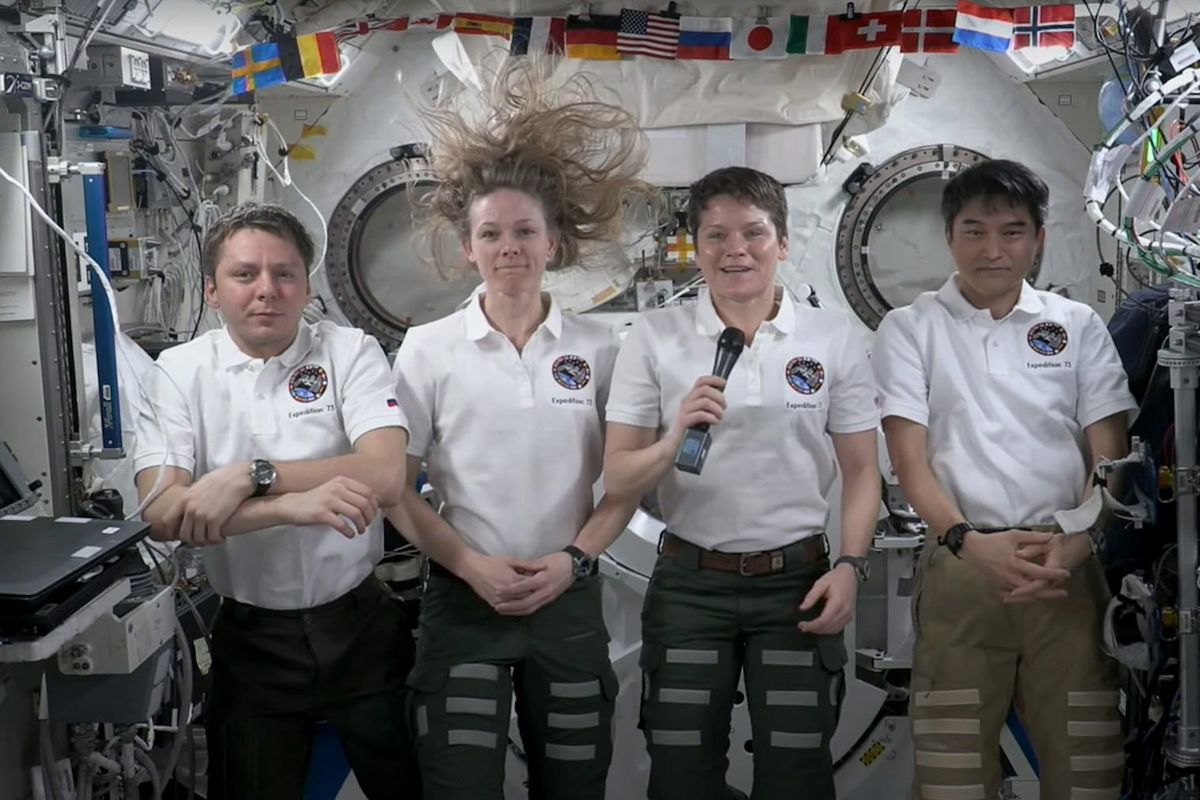
With their return imminent, Spokane’s own astronaut and the rest of NASA’s SpaceX Crew-10 mission took questions from terrestrial reporters Friday from aboard the International Space Station.
McClain, fellow NASA astronaut Nichole Ayers, Roscosmos cosmonaut Kirill Peskov and Japanese Aerospace Exploration Agency astronaut Takuya Onishi began their stay aboard the floating laboratory more than four months ago, and will splash down off the California coast in a few weeks after a handover with their replacements, Crew-11.
The staffing change is expected to happen within weeks, with Crew-11’s launch scheduled to occur no earlier than Thursday . A scrubbed launch like McClain and her group endured in March, a common occurrence due to weather or technical issues, could push their return date back.
McClain contributed to research, welcomed and wished farewell to multiple space travelers, and oversaw vital repair and maintenance tasks over these past few months. She also celebrated her birthday in space and spent six hours on her third spacewalk. She was accompanied by Ayers on the latter, allowing her to participate in an all-female spacewalk six years after missing out on the planned first due to a spacesuit sizing issue.
Now, with the end in sight, McClain said she’s looking forward to returning home and “doing nothing for a couple of days.”
“For me personally, what’s really humbling and perspective-changing about spaceflight is how many people it takes to make this possible, how challenging it is to have a normal day on the space station,” McClain said. “There’s really no normal day. There’s always something going on, there’s always a problem to be solved, and there’s always a massive team on the ground somewhere around the world that is having to work really hard to keep the train on the tracks.”
Weighing in at more than 450 tons and measuring larger than a football field in length, the International Space Station has been continually staffed with human crews since 2000. With the quarter-century anniversary for the marvel of modern engineering and international diplomacy on the horizon in November, it remains a vital platform for scientific research that not only advances human spaceflight, but improves the lives of those back on Earth.
McClain said it’s been miraculous to see the research advancements made since her last stint aboard in 2019, and the way in which her work back then helped build the foundation for the current research being conducted. She said the station will remain a vital asset for science and humanity for years to come.
Earlier this year, SpaceX CEO Elon Musk had called for the station’s retirement well before its scheduled deorbiting in 2030, citing its “very little incremental utility.”
“Let’s go to Mars,” Musk wrote in a February post on X.
“We still are conducting, simultaneously, hundreds of experiments inside and outside of the space station,” McClain said. “The space station is more than ready to do that for the next six, seven years, and we’re excited to see that. Because as we shift our priorities toward Artemis and deep space exploration, there’s a lot of questions that we have left to answer, and I think it’s absolutely critical that the space station is a platform here that we can continue using as a proving ground for those missions.”
The Artemis program seeks to return American astronauts to the moon for the first time since the Apollo missions of the 1960s and early ’70s, and McClain was among those in the running for one of the program’s missions prior to her naming to Crew-10. Now with two spaceflights under her belt totaling more than 330 days and counting, the 46-year-old could be tapped for a moon voyage in the years to come.
A few days before McClain was strapped into a SpaceX Dragon Endurance capsule atop a Falcon 9 rocket in March, she reflected on her last voyage, the relationships she managed to build with her crew mates, the real life impacts of their work and how the differences we tend to focus on back on Earth are nearly impossible to see while orbiting 250 miles above the Earth.
McClain said Friday she’s still humbled by the experience and astonished by the individuals, hard work and collaboration that make space flight possible. She’s returning with a renewed, fervent faith in humanity.
“We are literally, physically dependent on our lives to people that we haven’t met, but who we require to do their jobs right every single day, so that we can do ours, so that we can live up here,” McClain said.
“To me, that’s really humbling, because it gives me such faith in humanity and how people do the right thing, how people want the best, how people want to be inspired by space exploration. They want to be part of something good like this, and how all of our differences across the world really melt away when we just try to do something incredible together.”
As the video connection ended, McClain struck a Superman pose and gently soared upward out of view. Her crewmates flipped and soared around her as the team enjoyed their remaining hours in microgravity.
“We can’t wait to see you guys back home,” a NASA spokesperson said.