
Ammi Midstokke: Taming the Lion’s Head
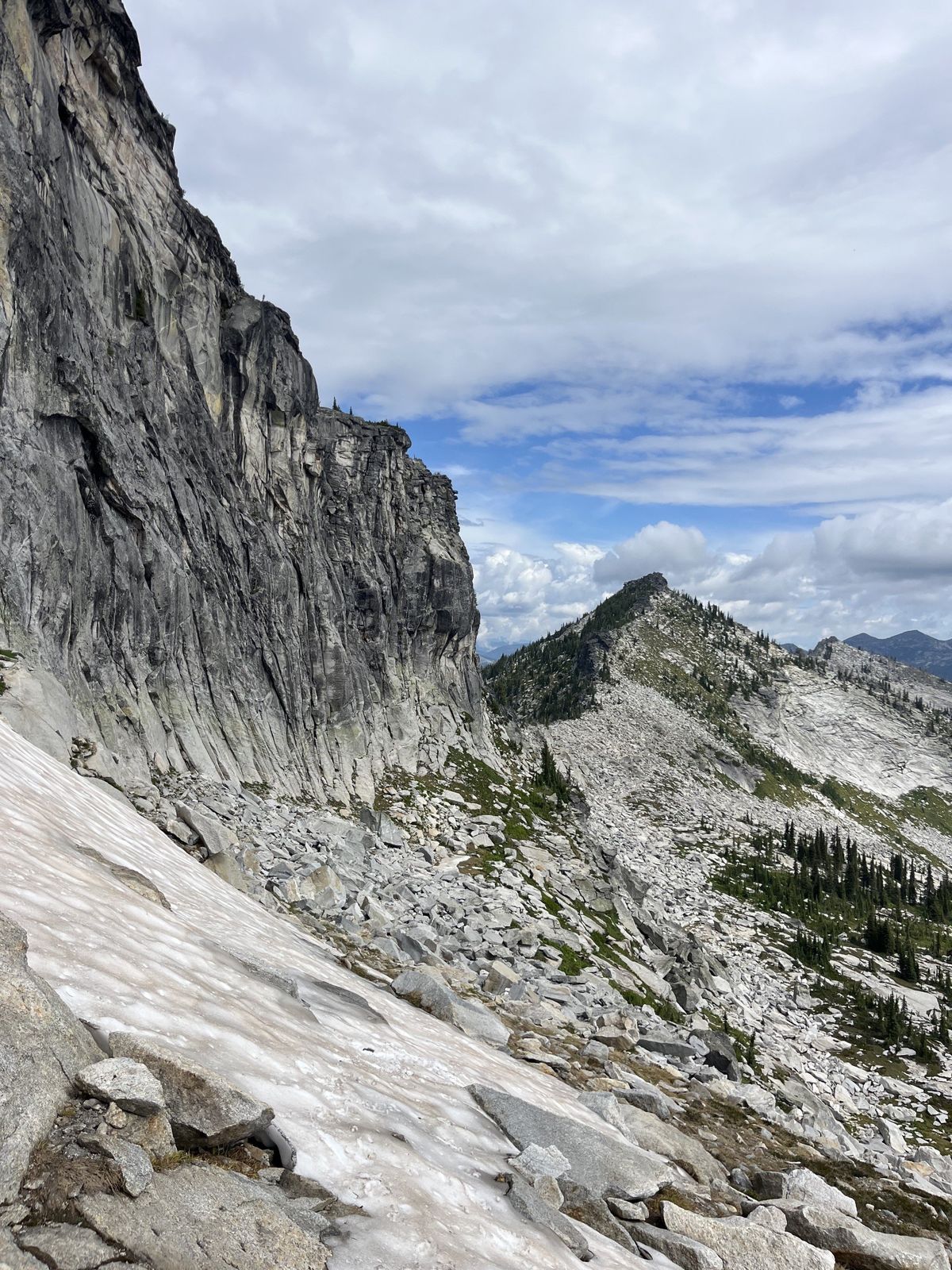
“Could you imagine how hard it was to be an explorer?” Lindsey asked. I did not share that one of the many reasons our current state of swallowed-by-nature was so hard was precisely because we were, in fact, exploring.
“Exploring” is the term I use to describe most kinds of travel in which I know where I left from and where I’d like to get to, but everything in between remains a gray area of unknowns yet to be discovered. Like how far it is between water holes, how many cliffs will need to be navigated around, how long it might take to reach one place, what is on the other side of that ridge, or if we’ll still be friends after this adventure. Less creative hikers call it “being lost.”
For some time now, I’ve wanted to attempt a traverse over the iconic Lion’s Head Ridge in the Selkirk Mountains. This incredible rock feature can be seen from miles around: Two enormous, blocky mountain tops defined by sheer charcoal cliffs and steep granite slabs. To the west lies Lookout Mountain and Priest Lake, and to the east lies the ridgeline of familiar peaks like Harrison, Beehive, and Pyramid. I’ve asked a few people familiar with the range to hike it, but surprisingly no one seemed to think the wild, trail-free traverse seemed fun.
I had to find someone unfamiliar with the terrain, tough enough to survive it, but reliant on me for navigation (so they know that murdering me is not an option, even if it’s an occasional consideration).
I have heard there are those who find friends by common interests. I find mine by schlepping them into the wilderness to see if they can survive. Which is why Lindsey later said, “We should totally do one of those survivor shows.” I did not tell her we were just doing the real thing, though she still had a sense of humor at this point.
On our first day, 17 miles into the Long Canyon trail, we dropped our packs to scramble to the top of Pyramid Peak, hand over foot. When Lindsey chuckled and asked if this was what the rest of the trip would be like, I told her the truth.
“Yes, but there’s more brush. And we’ll be wearing our packs.”
We camped at Pyramid Lake that first night, retreating to our tent to watch a carpet of mosquitoes await our exit. There, I pored over maps with contour lines in the hopes we’d have at least a vague idea of a reasonable route.
There are three parts to off-trail hiking in the Selkirks: brush battling, cliff peering, and boulder scrambling. If you’re lucky, you might get some ridge hiking. On this route, we left the trail south of Ball Lakes, then took the ridge for a mere few hundred yards before descending into the abyss of brush thrashing that would define the journey. The good part about the bad parts is that you’re so relieved when one ends, the other seems good again.
Tired of picking your way across steep angle boulder slides and risking life and limb? Perfect: There’s a section of suffocating brush and stabbing timber to bring all your best swear words to the surface. Have you lost all the skin on your shins and perforated your thighs? Great: There’s a surprise rock climb awaiting to exfoliate your hands and reinforce your sphincter muscles.
In 1985, geology professor and mountaineer Rainer Newberry created an outdoor fun scale. Type I: Fun. Type II: Not fun, but fun to remember. Type III: Not fun, not fun to remember. Respective examples of these might be: A barbecue, running a 5K, taking underfed toddlers on a long hike.
In the Selkirks, we discovered Type IV Fun: Exhausting, occasionally terrifying, potentially traumatizing enough to induce selective memory coping mechanisms, but totally worth the views.
After our 21-mile first day, we launched ourselves into the true wilderness of the Kaniksu National Forest. If you have never been to this rugged country of wonders, these magnificent public lands are for all of us to enjoy and I highly encourage you to visit them. There are accessible trails to breathtaking alpine lakes, granite slabs one can walk up, and horizons of ancient peaks stretching in all directions. And yes, mosquitoes and leeches and yellow jackets (Lindsey averaged one sting per day) and bears and goats and huckleberries and the most precious little mountain flowers of all colors and shapes.
It took us nine hours to get nearly 7 1/2 miles that second day. We dropped into saddles, skirted around peaks, and found ourselves at impassable chasms. It was the chasms that brought Lindsey to her figurative and literal edge. Maybe it was because she was out of water or we’d forgotten to eat our ration of candy that hour, but when I asked if she was willing to climb down the rocks to navigate around the cliff, she sat firmly on the ground and said, “No.” Plus some swear words.
This is a woman who runs 100 miles of trail for fun, so I was pretty sure she just needed a snack. That’s an essential bit of perception to have with your outdoor buddies: Are they setting a boundary or do you need to make a sandwich right now? Sour gummies saved us (Trader Joe’s: Feel free to sponsor us any time).
When we crested our last ridge that evening, not long before sunset, the purpose of all suffering was clear. Tucked beneath the towering walls of Lion’s Head and the bowl of pale granite talus is a magical alpine field of soft grass with a perfect mountain spring meandering through it. It is a reward that exists for the strong-willed and thick-skinned, for it can only be accessed via the treachery of Selkirk bushwhacking. And it is worth every drop of blood shed.
It was this paradise I reminded myself of the next day when we searched for a way over Lion’s Head, rerouted ourselves for two hours, were pummeled by rain storm after rain storm, abandoned Abandon Mountain and opted for the safer-but-exponentially-more-miserable side-hill route around it. It was morning coffee consumed in this fairyland of greenery and glass-smooth water that dropped off the edge of the world to gift us a wild vista as wide, wide, wide as our big hearts could see that made every slip and slide and pucker and clamber a small price to pay for the humbling glory of nature.
By the time we trekked down the West Forks Lake Trail, I was limping and in need of salt, while Lindsey was glowing and had stopped reminding me she didn’t come out here to die. But there was still a kind of giddiness to our gaits, some internal knowledge that we’d seen and felt rare things, singular things, once-in-a-lifetime things.
The reality is, we shouldn’t only do things for fun. Sometimes we should do them for perspective.