
Summer Stories 2025: ‘Tuesday, cursed’
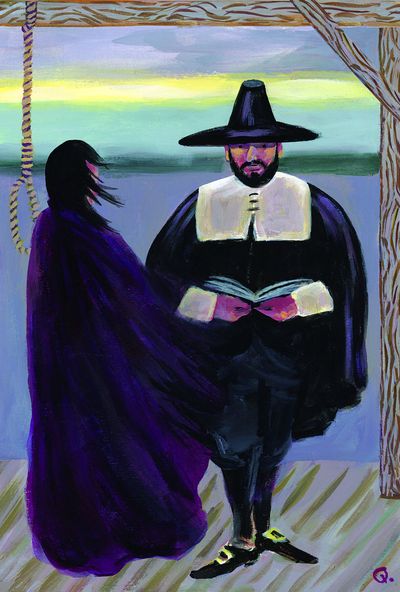
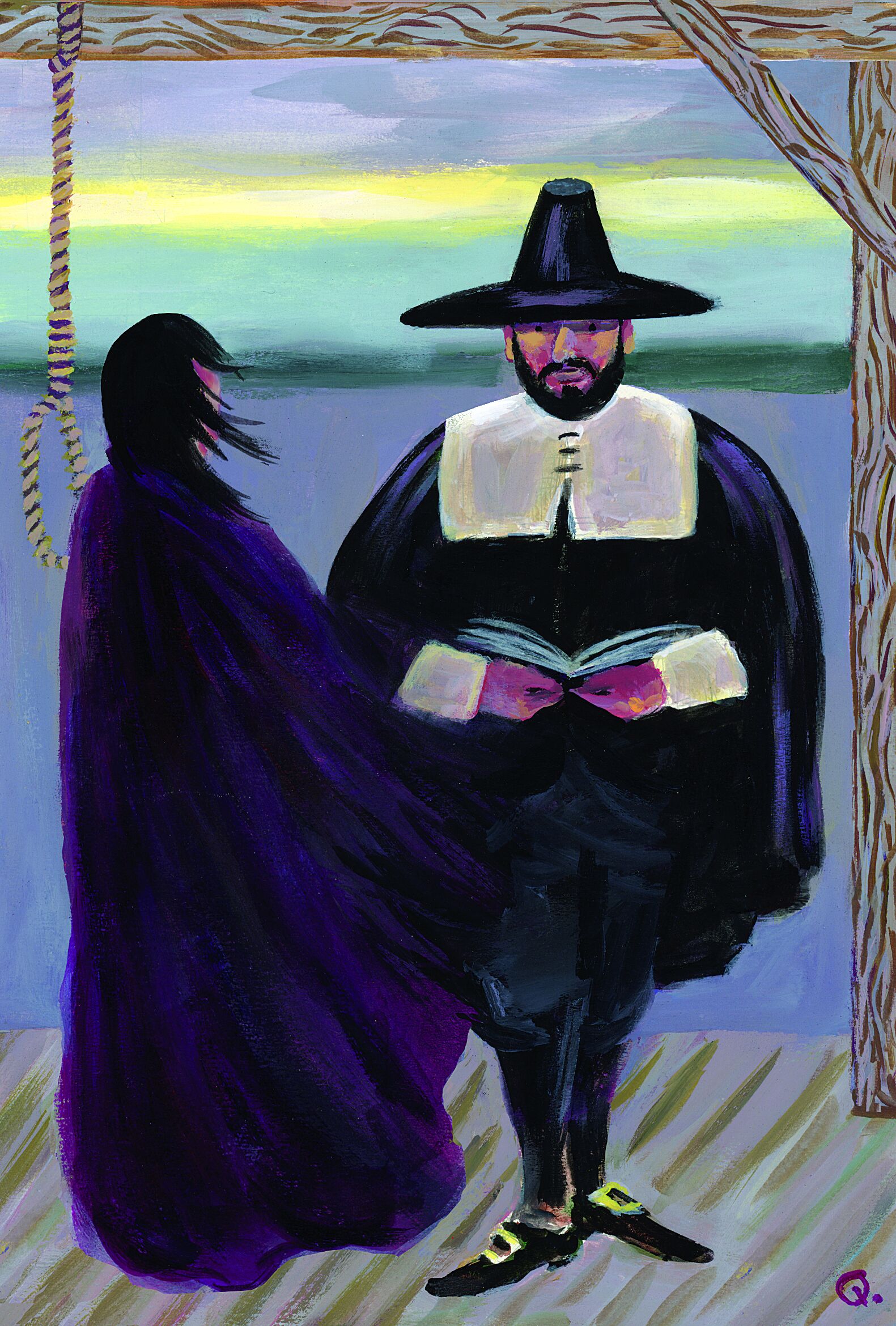
Tuesday, June 10, 1692, was a windy day. Cold salt air bent slender seagrass and flapped dark linen skirts and coats of a group of Salem Village Puritans gathered on a grassy knoll overlooking the sea. Sunshine sparkled on the dark Atlantic waters and the assembled crowd watched Bridget Bishop hang by her neck from a wooden gallows for the capital crime of practicing witchcraft. The ocean air did not rustle Bridget’s skirts, likely tied around her feet, which moved while she struggled. Until she was still. Silence then, but for the wind and waves of relief flooding the crowd’s racing hearts now warm as the summer sun, cooled by the wind that gently spun Bridget’s body in languid circles. The witch, and so the evil she invited into their village, was dead. This was the end.
Except it wasn’t.
Tuesday, Nov. 8, 2016, was a windy day. For eight months an American attorney, former senator and Secretary of State, who fought tirelessly for women’s human rights, proved an intelligent and over-qualified candidate for the presidency of the United States. But she was a woman and so, was branded a witch. They hated her laugh. The man who lost the nomination to her by 3 million votes (a self-proclaimed “champion of women”) called the woman “unqualified,” declared the free and fair election he’d lost to her was “rigged,” and featured on his official (failed) candidacy website was an invitation to a debate viewing party called Bern the Witch. It became a rallying cry among the man’s supporters. On that windy Tuesday in November 2016, (white) men of all ages overwhelmingly chose to hang America in a cyclone wind of incompetence and cruelty, rather than ever be led by a woman.
Tuesday, Nov. 5, 2024 was a windy day. For years, an American attorney, who was also a federal prosecutor and vice president of the United States, who fought tirelessly for women’s human rights, proved an intelligent and over-qualified candidate for the presidency of the United States. But she was a woman and so, was branded a witch. They hated her laugh. A beloved American Christian pastor who led the evangelical campaign support for the man running against the woman, accused her of practicing “witchcraft” when moderators employed fact-checking during a debate. On that windy Tuesday in November 2024, (white) men of all ages overwhelmingly chose to hang America in a cyclone wind of incompetence and cruelty rather than ever be led by a woman.
On that beautiful afternoon in June 333 years ago, Bridget Bishop turned her face to the sun, took her last breath of sea air, “I am no witch,” and then – in the instant of sudden bright blackness – she saw it all. It was coming, cursed forever by this Tuesday wind.
America.
The Salem villagers could not know what Bridget understood now; if she was not a witch, maybe the others weren’t either? In the blackness she watched these future-American Puritan men continue the age-olde tradition of convincing them all that women are Creation’s sub-par afterthoughts, feeble-minded, weak-willed and therefore more susceptible to Satan’s machinations, a liability that brought sickness and evil to Salem Village and to the world. The village girls writhed and howled, and Bridget watched the women of Salem believe the men’s lies and turn on one another. She saw the truth of the five men hung, one pressed, punished not for Witcraft, but their proximity to the women. Husbands, sons and fathers accused their wives, they accused their mothers and their daughters; only fathers and sons did not accuse one another. Just as in the centuries of Europe’s Witch Hunts, every judge, every magistrate, every sheriff, every jailer, every minister, every executioner: all men.
Straight-line winds from a thunderstorm move fast, cutting paths of destruction a person can see coming and so try to hide. But circular winds can roar suddenly from quiet stillness. Caught in a blizzard, we are blind and breathless, gasping and groping for air and shelter until we suffocate and freeze. Bridget watched herself and everyone she knew spin in a cyclone of lies made by these men who would rather hang a woman for a witch than untangle the simplest reality of their fear, of human existence.
In the blackness, Bridget watched her own death and the one quiet, careful month after, the village shell-shocked and still; then the roar of the Court of Oyer and Temor back to life. Accusations, hundreds imprisoned, 14 women hung on this very scaffold, prison deaths, the colonists’ entire baby version of the nearly 50,000 women burned for witches in Europe, and then suddenly … the wrong man’s wife gets accused, and four months in, it’s all over. Years of silence.
She watched America born of winds that filled the sails of ships of her brethren, European colonists who stole and destroyed Indigenous lives, then saw winds bring ships of enslaved people whose hands built the America we know, full sails bringing more immigrants to America who, with Indigenous and Black Americans, created true greatness in the nation that seemed, for the longest time, to be propelled by a slow but relatively straight, true wind; a wind that emanated from the Left and appeared to urge America forward in the direction of freedom and humanity for them all.
But the straight, true wind bent to a horseshoe. Bridget watched the trials twisted by an American man hailed as a champion of freedom so frustrated by his desire to cheat on his wife with Marylin Monroe that he wrote a play about Salem, recasting the murderous men as thoughtful heroes, and an 11-year-old orphaned girl as an evil seductresses, a homewrecker horny for a historically 60-year-old man; the predictable, grimy lens of the male gaze. Bridget watched generations of American students made to read and perform this play, evermore fed the lie of Salem Village gone wild, wicked teenage girls, witches, preying on slightly flawed but ultimately valorous and moral men.
Bridget saw the horseshoe become a blizzard of misogyny and incompetence, men’s white and blinding voices from both the Left and the Right forever screaming “Well, actually …” and “I’d vote for a woman, just not that woman … or that one …not that one either …” She beheld a dizzying blur of white men in red hats door-dashing potato salad with raisins holding hands with white men soaked in patchouli door-dashing compostable bottles of celery juice, young and old, angry and hell-bent on uniting to make sure a woman never leads this nation. And she watched the white, wind-blind women believe the lie just as she had, watched them betray every other woman and fight one another for survival, convinced the men who are the danger would protect them from it, and she saw the blizzard feed and thrive and grow and turn around and hang the women anyway. All of them.
On July 23, 1692, Sarah Good was hung on the same scaffold beside the sea. Sarah had given birth in prison to a daughter, Mercy, who died there days later in the cold, dank cell. Sarah’s 4-year-old daughter Dorothy, also imprisoned for a witch, nearly died there as well. As she climbed the steps to her death, the Rev. Nicholas Noyes urged Sarah one last time, to admit she was a witch. And according to those present, passed from generations since, Sarah turned to that man and said, “I am no more a witch than you are a wizard, and if you take away my life, God will give you blood to drink.” Years later white male author, Salem native, and trial judge ancestor Nathaniel Hawthorne would take Sarah Good’s remarkable words, put them in a novel and give them to … a man.
Bridgette Bishop swung in the summer wind that sunny day in June, all of America lay bare to her in the dark, out of order but in perfect elegance. Because last of all, she watched the Rev. Noyes sit up in bed, choke on his own blood, and die. And even as the sky went black, Bridget was lit from within by the truth: Men invented the devil, then accused women of dancing with him; men invented witches, then accused us of being them. She could see at last, there is only one survival in the hurricane force of the lie of patriarchy, born of fear and deadly to all humans. Bridget could see now, as if in brightest sunlight and ocean air – we are more. In number and force. If only the women of her ancestry and progeny would wake up from the blinding white cyclone of lies, admit the humanity of and hold tight to all our sisters and to one another, we would stand strong in that cruel wind. We are our only hope, our own and only shelter in the storm.
Because forever and always, there were never witches. Only women.