
U.S. tribes bolster caribou recovery and restoration in British Columbia
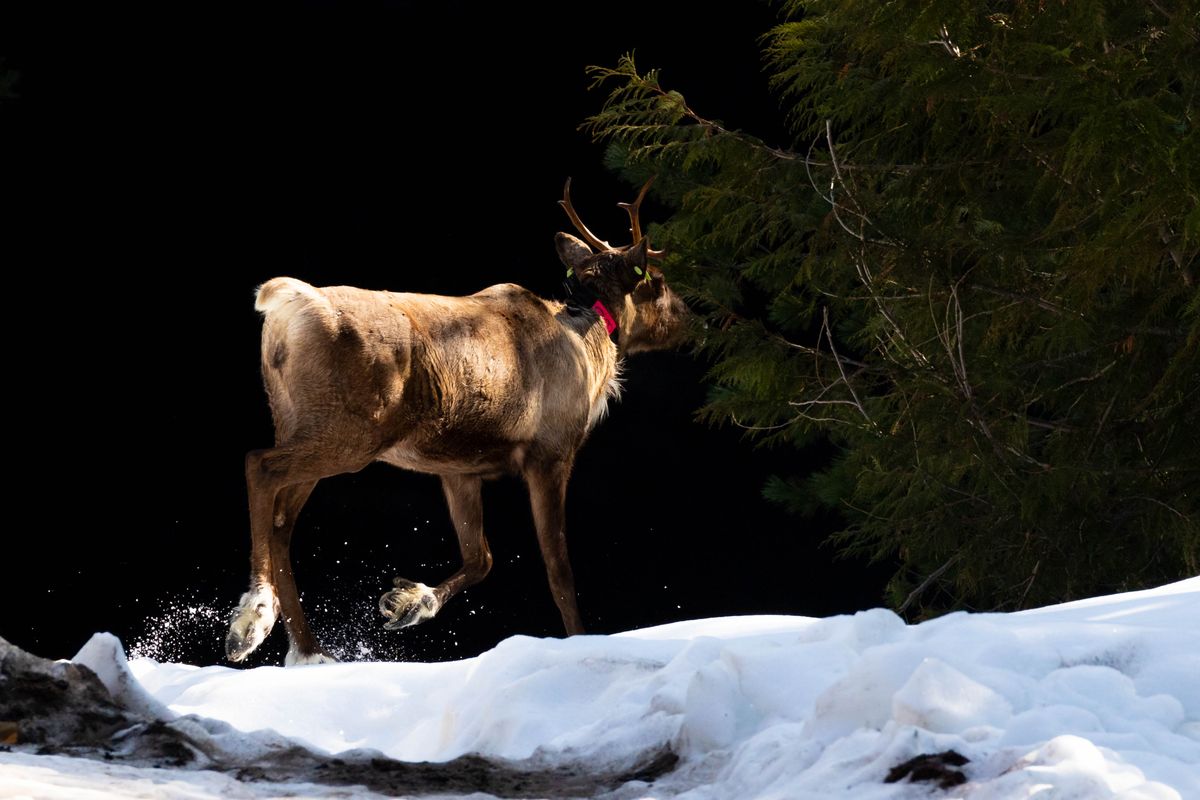
NAKUSP, British Columbia – Six years after the last wild caribou in the Lower 48 was relocated to Canada, conservationists and Inland Northwest tribes see a glimmer of hope less than 100 miles north of the border.
Nestled by a hot springs resort near Goat Range Provincial Park, some woodland caribou cows of the southern mountain population are about to give birth in the safety of 6-hectare enclosure guarded from predators by a high-voltage electric fence.
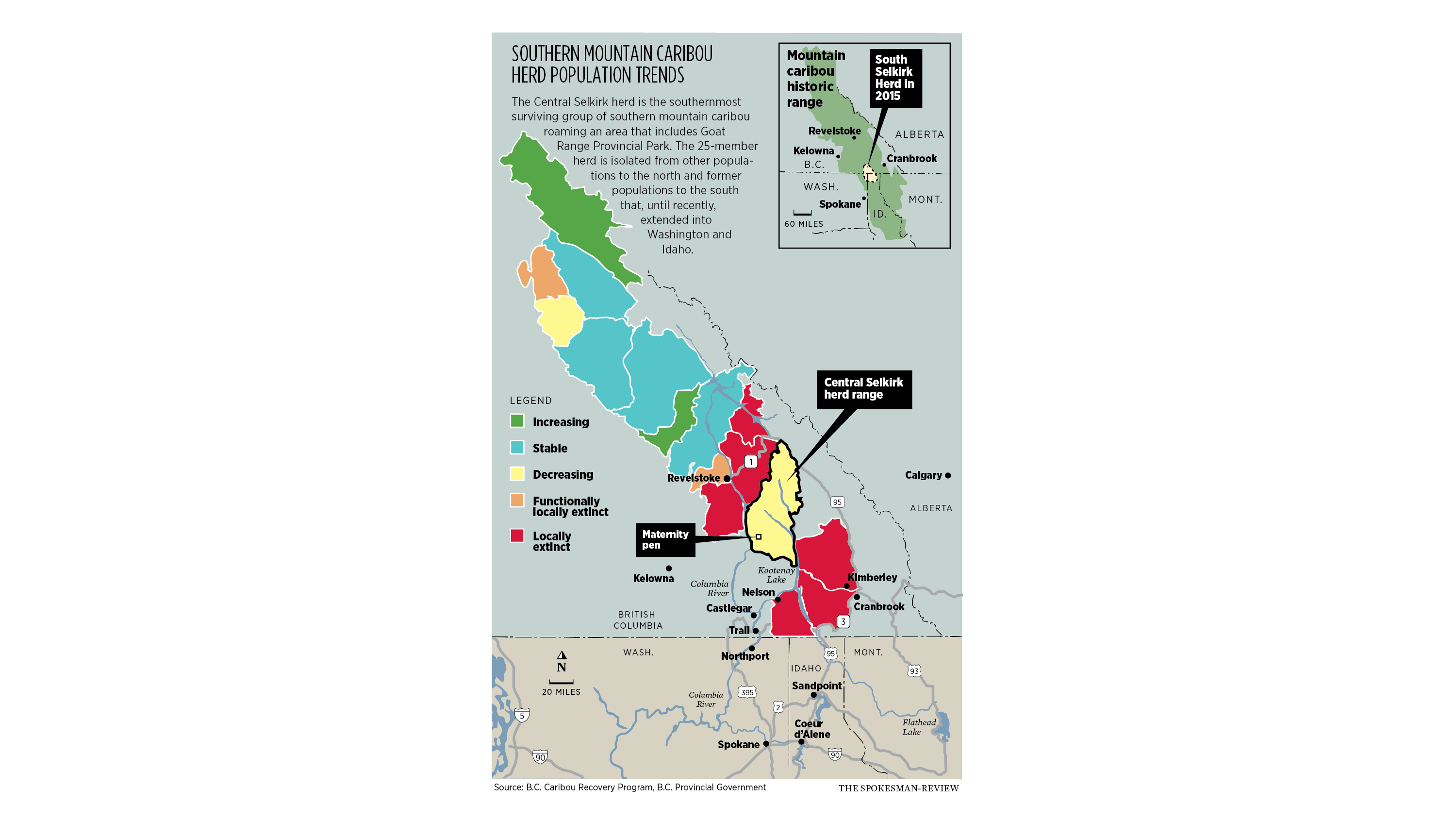
The 10 adults and one yearling make up the female portion of the Central Selkirk herd, estimated at 25 animals two years ago and now the southernmost surviving group of the endangered species. A herd size of 200 is considered healthy and self-sustaining.
Wildlife biologists and volunteers for the Arrow Lakes Caribou Society located and captured the caribou in the mountains near Nakusp by helicopter in late March. Some of the caribou are expected to give birth by early June and will be released in late July.
Now in the fourth year of the maternity pen project, organizers see signs of modest success where other attempts have failed. The population has held steady and improved slightly since 2022, when seven females and one yearling were captured. Five calves were born in the pen last year.
The Arrow Lakes Caribou Society, a Canadian nonprofit based in the village of Nakusp, aims to rehabilitate the herd by working with local stakeholders to protect their habitat.
“The immediate concern is to just arrest the extirpation of these animals,” said Hugh Watt, president of the society.
Extirpation, or local extinction, continues to creep north from the U.S. border. Conservation efforts are a long way from restoring herds that have already been lost, Watt cautioned.
“The idea is to take strong action to stop the decline and hopefully reverse that and start growing the population again,” Watt said. “You have to start somewhere, and that’s where we’re starting.”
Bringing woodland caribou back to the United States, whether through reintroduction or natural migration south, has generated international support for the Arrow Lakes project from the U.S. Fish and Wildlife Service, Native American tribes and private organizations.
“It really resonates because it’s within many people’s recent memory that those animals were there,” Watt said. “It’s not like something that happened 100 years ago.”
The Confederated Tribes of the Colville Reservation became a partner of the Arrow Lakes Caribou Society last year. Along with the Kalispel Tribe of Indians, the Colville Tribes support the project financially and with staff from their natural resources department.
Nakusp, which sits on the east bank of Upper Arrow Lake on the Columbia River, is within the traditional homelands of the Sinixt Band, one of the 12 Colville tribes. Chairman Jarred-Michael Erickson, who worked as a biologist for the tribes’ fish and wildlife department before he became chairman, said the caribou were a traditional source of subsistence, and the tribes see it as their duty to care for the land.
But beyond that, Erickson said, they have an affinity with the endangered species.
“A lot of our native species are kind of like us as Natives,” Erickson said. “You know, we were also hunted, unfortunately.”
Disappearance of the gray ghost
Reindeer Express, a farm in Reardan, Washington, raises reindeer to join Santa at holiday events across the Inland Northwest. Although reindeer and caribou are technically the same species, they’re not directly related to the endangered woodland caribou.
Reindeer have been domesticated by the native Sámi of Scandanavia for hundreds of years, which has led to slight genetic differences. The “rein” in reindeer implies their domestication, Reindeer Express owner Ed Bernhardt said.
Bernhardt’s animals were sourced from a farm in Oregon, and from Alaska, where reindeer were introduced from Russia in the 1800s as native caribou dwindled.
Woodland caribou are a subspecies, distinct from their tundra counterparts by larger hooves that allow them to snowshoe over deep snowpack. They live in smaller herds and migrate vertically through steep terrain rather than long distances, and feed on tree lichen.
The British Columbia Caribou Recovery Program estimates there are about 4,000 southern mountain caribou remaining.
Caribou once lived not only in the Inland Northwest, but were also found in the Great Lakes region and New England when Europeans arrived. In Idaho, their range extended as far south as the South Fork of the Clearwater River – about the latitude of the Washington-Oregon state line, according to their endangered listing in the Federal Register.
Caribou were believed to be extinct in the southern Selkirk Mountains by the 1930s, but tracks discovered in the ’50s led an Idaho Fish and Game biologist to trace and eventually photograph them, The Spokesman-Review reported at the time. The herd was estimated to have 75 to 100 in 1959.
The creatures remained elusive as their numbers ebbed again, earning them the nickname “the gray ghosts.” Complicating matters, the herd tended to migrate north and south of the border throughout the year.
By the time they were added to the endangered species list in 1983, the herd was down to about 25 members.
Attempts to supplement the herd with “transplants” from herds in British Columbia introduced about 100 caribou to North Idaho in the late ’80s and ’90s.
But pressures from the caribou struggling to adapt to their new environment and the systemic pressures against their habitat persisted. Their population dropped from 46 in 2009 to 27 in 2012. Wildlife biologists believed they were hunted by wolves.
The Selkirk Caribou International Technical Working Group, a multiagency coalition including federal and local governments, tribes and first nations, made a last-ditch effort in 2018 to build a maternity pen in the Darkwoods Conservation Area near Ymir, B.C. The attempt was thwarted by unseasonably deep snowfall that overtopped the fence.
“We were getting frustrated with the lack of effort and care,” said Ray Entz, wildlife director of the Kalispel Tribe’s Natural Resources Department, which spearheaded the project. “But by then it was just too late.”
The following year, Canadian officials captured the last surviving member of the South Selkirk herd near Creston, B.C., and moved her farther north to another maternity pen by Revelstoke. The adult female integrated into the Revelstoke herd at least until her radio collar stopped working, Entz said.
It’s possible, though unlikely, that individual animals may have wandered into the United States since then.
“They don’t call them the gray ghost for nothing,” Entz said.
But at a population level, they are certainly gone.
Calving season in the maternity penAmong several options considered, experts concluded that a spot just meters away from Nakusp Hot Springs was the overall best location for a new maternity pen. Thick woods and a nearby stream deaden the sound, and it hasn’t been an issue over the years, said Frances Swan, director of the Arrow Lakes Caribou Society.
The bigger challenge is keeping an eye out for predators: bears, cougars, wolves and wolverines. Security cameras and traps, including a booby trap with bear spray, are set up nearby. A grizzly has been lurking lately.
Within the electric fence, the pen is surrounded by a tall black tarp. Only staff shepherds are allowed inside to replenish feed in a manger.
The shepherds oversee the day-to-day operation of the pen, working in shifts. Most of the work involves keeping track of each caribou from a lookout tower and documenting their health and habits. One of them, Sam Legebokow, said she enjoys the quiet solitude.
“It feels magical to hear them,” she said. “As they walk, you can hear their tendons snap.”
When the calves are a few weeks old, the herd will be released directly from the pen into the woods. Swan hopes to double the pen size later this summer.
Indigenous stewardship
In 1956, the Canadian government declared the Sinixt Indigenous people extinct. Their descendants survived, however, in Washington state, where many of them were forced south onto the Colville Reservation in the late 1800s.
The territory of the Sinixt, also known as the Lakes Band, ranged from Kettle Falls in Washington to the “Big Bend” of the Columbia River north of Revelstoke, B.C. The area overlaps neatly with much of the southern mountain caribou range.
The Supreme Court of Canada ruled in 2021 that the Sinixt have constitutionally protected hunting rights on their ancestral land after Rick Desautel, a member of the Sinixt Band, killed an elk in a ceremonial hunt near Vallican, B.C., in 2010. The Sinixt Confederacy has since opened an office in Nelson, B.C., focused on natural resource conservation.
“The stewardship of all natural and living things within our territory is our responsibility as a Native people – to take care of the animals because they take care of us,” said Richard Whitney, director of the Colville Tribes’ Fish and Wildlife Department.
Whitney, who is named after his uncle Desautel, said it is better to address the underlying threats to endangered species by improving habitat rather than intervening.
“It’s unfortunate it is to the stage where maternity pens are needed,” he said. “Interactions with humans is not the goal, but it is kind of a last effort to save them before they are lost even farther north.”
Both Whitney and Jarred-Michael Erickson, the chairman of the Colville Tribes, said they hope one day the population can return to a level where the caribou can be sustainably hunted again.
“The tribes see first foods as medicine,” Whitney said. “That is a medicine that our people haven’t had for decades.”
Restoration outlook
The caribou recovery faces many obstacles that led to their decline in the first place: habitat destruction from overdevelopment, roads and logging, climate change, encroaching predator populations that are out of balance, high-impact recreation and poaching.
It’s an uphill battle as caribou reproduce slowly, one calf at a time.
The Arrow Lakes Caribou Society plans to shift more effort to habitat protection and recovery.
Swan said the grassroots organization is unique because it has local buy-in from stakeholders with an interest in the land, including loggers and recreationists.
The mountains near Nakusp are a popular destination for snowmobiling and heli-skiing. Throughout the year, an app tracks the herd’s radio collar data and notifies recreationists what areas are off limits.
“It’s a flexible system where you can still have openings when caribou aren’t in the area,” said Swan, whose background is in forestry and land management. “I think it’s a good modern way of dealing with things rather than just saying this entire huge area is closed.”
One other maternity pen still operating in British Columbia, north of Prince George, is a source of encouragement.
“They started at the same population numbers that we have basically and now their population has grown significantly,” Swan said.
The Linfitt Pen released 21 female adults and 18 calves last summer.
“So it does work,” Swan said.