
Moderate voters in this Washington district could help decide control of Congress in 2026

VANCOUVER, Wash. – On a Sunday two weeks before Halloween, people flocked from across southwestern Washington to the pumpkin patch and harvest festival at Bi-Zi Farms, on the outskirts of the biggest city in this largely rural corner of the state.
Bill Zimmerman, the farm’s namesake, considers himself a conservative Democrat. His son Joe Zimmerman, who now runs the operation, said he has always identified as a Republican but has seen the party change dramatically over the past decade or so.
“I feel like my feet are firmly planted on the ground and the ruler is sliding underneath my feet,” said Joe Zimmerman, describing a political shift that has left him feeling “not Republican enough” to fit into today’s GOP.
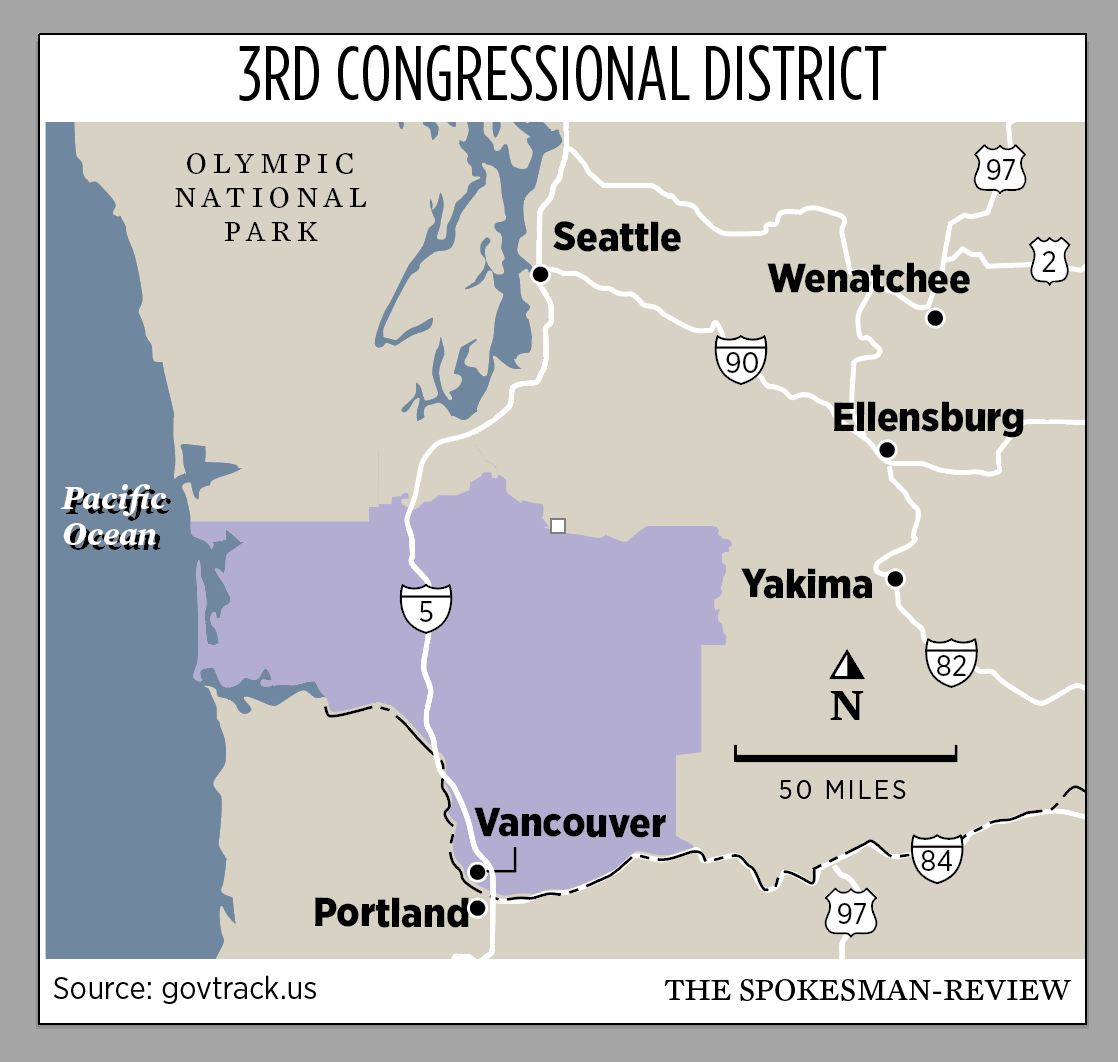
The Zimmermans are the type of voters who have helped Rep. Marie Gluesenkamp Perez, a Democrat from Skamania County, get elected twice in a district that favored President Donald Trump in 2016, 2020 and 2024. Washington’s 3rd Congressional District is about as far from the nation’s capital as any in the continental United States, but it’s a focal point of the high-stakes battle for control of the House of Representatives in next year’s midterm elections.
“There’s a whole bunch of us that are the traditional vote-for-the-right-person moderates,” Joe Zimmerman said, but he added that he isn’t sure they’re numerous enough to re-elect the incumbent in an era when politics is increasingly nationalized. “My fear is that southwest Washington is going to go, shall we say, it’s going to go political.”
Bill Zimmerman said he likes that Gluesenkamp Perez is more focused on local issues than national ones, pointing out that she’s the district’s only representative in his 72-year lifetime to serve on the House subcommittee in charge of agriculture funding. His 50-year-old son, who served six years in the Marine Corps Reserves before returning home to run the farm the family has operated since 1872, said he appreciates that she’s accessible and easy to talk to.
“It’s irrelevant that she’s a Democrat or a Republican,” Joe Zimmerman said. “To be honest, when I see her and when I talk with her, I don’t see her as either.”
But in one of the nation’s increasingly rare “swing” districts, both parties are gearing up to pour resources into the race headlined by Gluesenkamp Perez and Republican John Braun, the state Senate minority leader. The outcome could help decide whether Republicans maintain total control of the levers of federal power or Democrats seize the House for the second half of Trump’s term, letting them block partisan bills and conduct oversight of the administration’s actions.
The race will test both sides of the coalition that helped Gluesenkamp Perez twice defeat GOP firebrand Joe Kent, who now leads the National Counterterrorism Center in the Trump administration.
Braun, a seasoned politician with less political baggage than Kent, hopes to draw support from the moderate Republicans who crossed the aisle to back the Democratic congresswoman. Meanwhile, Gluesenkamp Perez has angered some progressives by breaking with her party and voting with Republicans more often than virtually any other Democrat.
“I’m afraid it could be a much tougher race,” Bill Zimmerman said, adding that Braun has earned legitimacy from his years in the state Senate. “With her record of not voting 100% Democrat, she loses a certain percentage of Democrat votes.”
The “Trump Score,” a rating published in October by the Institute for Legislative Analysis, a conservative nonprofit, found that Gluesenkamp Perez has aligned with Trump’s position on nearly 50% of votes since December 2024. That’s nearly the same as Rep. Brian Fitzpatrick, a moderate Republican from Pennsylvania who scored just over 51% on the group’s index, which rates each vote as either with or against the GOP platform.
“I have a great deal of respect for that, that she’s willing to take a look at what actually is being proposed, and not just what the Democrat Party is saying we should do,” said Bill Zimmerman. “The Democrats set up Trump to win. If they would have worked harder on the border, if they would have stopped all their crazy tax-and-spend deals, they probably would have done better.”
Gluesenkamp Perez’s voting record also largely aligns with her predecessor, former Rep. Jaime Herrera Beutler, a moderate who lost re-election after she was one of just 10 Republicans who voted to impeach Trump for his role in the Capitol riot in January 2021.
Fred McGrath, president of the Institute for Legislative Analysis, said that while his group didn’t produce a “Trump Score” when Herrera Beutler was in Congress, she scored exactly 50% in its “limited government rating,” which used a similar methodology, in her last year in office. Two years later, in 2024, Gluesenkamp Perez scored just over 46% by that same metric.
Gluesenkamp Perez has broken with her party in voting in April for a bill to require proof of U.S. citizenship to vote, voting to avert a government shutdown last December and opposing the Biden administration’s approach to student debt forgiveness, among other votes. With Republicans in the House majority, her votes have never been decisive, but they have drawn the ire of some on the left.
Sitting at the farm near booths selling donuts and hot cider, Brittany Licini said she was upset by a recent vote Gluesenkamp Perez took with Republicans, though she couldn’t remember what it was about. The 32-year-old Vancouver resident said she’s “not anti-Republican 24/7,” but she doesn’t like what the Trump administration is doing and doesn’t see much of a middle ground.
“I like the idea of someone voting based on their ideas and not necessarily just voting along party lines,” Licini said. “It’s just that right now it’s so extreme.”
In addition to Trump’s singular ability to command the nation’s attention, Gluesenkamp Perez faces another challenge in today’s fragmented media environment, where the decline of local news outlets and the rise of algorithm-driven platforms like TikTok and Facebook combine to give the highest-profile politicians more attention than rank-and-file members of Congress.
“When I’m paying attention to politics, I’m paying attention to the bigger, macro lens,” said Xander Torres of Vancouver, 32. He said he prefers Democrats like New York City mayoral candidate Zohran Mamdani, but Trump “has moved the Overton window to the point where I would take John McCain.”
Republicans have taken advantage of the spotlight on big cities run by Democrats, casting them as crime-ridden and proof of progressive policies gone too far.
Jayden Fox, a 20-year-old resident of Yacolt, about 30 miles north of Vancouver, said his experience living in Portland and Tacoma have made him worry about the world in which his 1-year-old daughter will grow up. He said he considers himself conservative, an independent who leans Republican and called Trump his “preferred president,” although he doesn’t agree with everything the administration does.
“Over the last few years, anybody who lives here would tell you it’s been going downhill,” Fox said, as a band played classic rock tunes near the pumpkin patch.
Nearby, 67-year-old Mike Stratton of Lake Shore said he wishes Gluesenkamp Perez were more like former Presidents Barack Obama and John F. Kennedy, describing them as good at communicating what they stood for.
“This is what drives me nuts about her: She wishes and washes,” he said. “I’m independent, but it would be nice to know where my politicians stand.”
In an interview, Gluesenkamp Perez said she tries to balance the different perspectives she hears from her constituents and votes based on what she sees as best for her district and the country in the long term.
“I don’t fault anyone for not spending a lot of time reading through what I’ve said about my votes, but if you’re able to lift up the hood, you can see that there is a lot of consistency in how I’m thinking through these things,” she said, using one of the frequent automotive expressions that nod to her pre-Congress days running an auto repair shop across the river in Portland, which her husband Dean still owns.
In a phone call between stops in her district – the House has been out of session since mid-September – the congresswoman said she believes “most Americans don’t primarily identify themselves through a political lens,” but rather through relationships with family, friends and neighbors.
“Yeah, things are messed up,” she said, “but one of the cool things about being home is there are a lot of really patriotic, community-minded, diligent people in this country, and it is depressing to see that not reflected in the culture in D.C. But I also feel like we have such a gift here in southwest Washington. Like, we still have a very strong local identity.”
Braun, the most prominent Republican to enter the open primary, sees the seat as key to his party defending their slim majority in the House. In an interview, he gave a matter-of-fact response when asked why he chose to challenge Gluesenkamp Perez.
“This has historically been a Republican district,” he said. “It’s a district that all the Republican candidates won in the last cycle except for in the House, and it’s a district that is going to be critical for the Republicans to maintain control of the U.S. House of Representatives in 2026.”
A retired Navy captain who runs a company near Chehalis that builds specialty emergency vehicles, outside of his part-time role as GOP leader in the state Senate, Braun described the 3rd as a “very independent” district whose residents are focused on issues that affect them locally.
“Their ability to survive and thrive in southwest Washington is what they’re most interested in, and what I think that anyone who represents the district ought to be focused on,” he said. “I also feel like our current incumbent, while I think she seems genuine, is not getting a lot done for the district or the state or the country, and we can do better.”
Braun distanced himself from the rhetoric of the National Republican Campaign Committee, the House GOP campaign arm, which has accused Gluesenkamp Perez and other swing-district Democrats in a flurry of statements – as many as seven per day – of “rooting for Americans to suffer,” hating police and somehow being culpable in a brutal murder allegedly committed by an unauthorized immigrant in Texas, despite her frequently voting with Republicans on border-security measures.
“I think we’ve got to get back to an election that is based on who has the better ideas,” Braun said. “I’m focused on my race, and I’ve been very clear in public that I view Marie Gluesenkamp Perez as my opponent and not my enemy.”
Braun said he likes what Trump has done on many issues, including immigration enforcement, but as a business owner in a highly trade-dependent state, he disagrees with the president’s tariff policy.
The House Democrats’ campaign arm, in a statement when Braun entered the race, called him a “swamp creature” and “nothing more than a suit in Olympia who works for special interests like Big Pharma, not for working people.” He dismissed that attack as a “canned response.”
Travis Ridout, a political science professor at Washington State University, said it’s “a pretty solid law of American political history” that a president’s party loses seats in midterm elections. As of Monday, an average of surveys compiled by analyst Nate Silver showed just over 42% of Americans approve of the job Trump is doing, a new low in his second term.
But Ridout said the extraordinary middecade redistricting Republicans are doing in Texas and other states – and which Democrats in California are trying to counter in their own effort to redraw the congressional map for partisan gain – will make it harder for Democrats to retake the House majority. He also emphasized that unforeseen events in the next year make it hard to predict which party will have the upper hand.
“Don’t be surprised if there’s a surprise,” Ridout said.
Erin Covey, the House analyst at the Cook Political Report, a nonpartisan publication that analyzes elections, said she estimates that Republicans will gain a total of between six and nine new seats through gerrymandering. So while the current GOP majority in the House is a mere three seats, Democrats may need to “flip” as many as 12 seats to take control of the lower chamber.
While the party out of power has “flipped” an average of about 12 seats in recent midterm elections, that number has declined as both parties have redrawn congressional maps to make more seats easier for incumbents to win, she said. Washington’s 3rd is one of just 16 of the House’s 435 seats that Cook Political Report considers a “toss-up,” with eight held by each party.
“This is one of the most competitive districts in the country,” Covey said. “And it’s one of the 13 seats that is held by a Democrat that Trump carried last year, so that puts it in its own unique category.”
While Democrats have an outside chance of gaining the four seats they need to take control of the Senate, most analysts consider that less likely than the party winning a House majority.
Covey said the stakes of the race may be high enough that the most politically engaged Democratic voters – the same people who are likely to be frustrated by Gluesenkamp Perez breaking with her party – will vote for her to help their party take control of the House.
“There may be some folks who are so frustrated by her moderation that they abstain entirely,” Covey said, but voters typically “come home” to their preferred party in the general election because they understand the stakes of a House majority.
Joe Zimmerman said he thinks a victory for Gluesenkamp Perez next November would also require strong support among the district’s independent voters.
“She’s one of the few people I see that is true to herself, and yet she can’t win,” he said. “She’s definitely not going to appease the Republicans, and now she’s not appeasing her own party. I can see her getting re-elected, but she’s going to do it from the middle.”